




The amplitude of SHM $y= 2(\sin{5 \pi t}+ \sqrt{2} \cos{\pi t})$ is
Answer
 Verified
595.5k+ views
Hint: Simple Harmonic Motion is the motion of an object which is moving back and forth along a straight line. The amplitude of a SHM can be defined as the maximum displacement of a particle from its mean position. To solve this problem, use the standard equation of SHM. Compare this standard equation with the equation given in the question. After comparing the equations, take the magnitude of obtained amplitudes. This obtained value will be the amplitude of SHM.
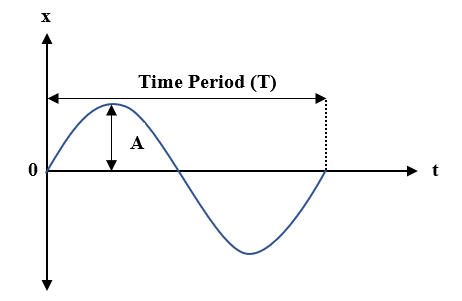
Complete step by step answer:
Given: $y= 2(\sin{5 \pi t}+ \sqrt{2} \cos{\pi t})$
$\Rightarrow y= 2\sin{5 \pi t}+ 2\sqrt{2} \cos{\pi t}$ …(1)
The standard equation of SHM i.e. Simple Harmonic Motion is given by,
$y ={A}_{1}\sin {\omega t} + {A}_{2} \cos {\omega t}$ …(2)
Comparing equation. (1) and equation. (2) we get,
${A}_{1}=2$ and ${A}_{2}= 2\sqrt {2}$
Now, amplitude is given by,
$A= \sqrt{{A}_{1}^{2} +{A}_{2}^{2}}$
Substituting values in above equation we get,
$A= \sqrt {{2}^{2} +{(2\sqrt {2})}^{2}}$
$\Rightarrow A= \sqrt {4+8}$
$\Rightarrow A= \sqrt {12}$
$\Rightarrow A= 2\sqrt {3}$
$\therefore A= 3.46cm$
Hence, the amplitude of SHM $y= 2(\sin{5 \pi t}+ \sqrt{2} \cos{\pi t})$ is 3.46cm.
Note:
Students should remember that the wave equation of Simple Harmonic Motion (SHM) contains all the information regarding the state of the wave. Using the equation, we can find wavelength, frequency, amplitude and phase. We can also find the position and momentum of the particle performing SHM. At all positions of oscillation, the particle has the same energy i.e. the energy of the particle remains constant throughout the oscillation. It is given by,
$E= \dfrac {1}{2} mA {\omega}^{2}$
Where A is the amplitude
$\omega$ is the angular frequency
Complete step by step answer:
Given: $y= 2(\sin{5 \pi t}+ \sqrt{2} \cos{\pi t})$
$\Rightarrow y= 2\sin{5 \pi t}+ 2\sqrt{2} \cos{\pi t}$ …(1)
The standard equation of SHM i.e. Simple Harmonic Motion is given by,
$y ={A}_{1}\sin {\omega t} + {A}_{2} \cos {\omega t}$ …(2)
Comparing equation. (1) and equation. (2) we get,
${A}_{1}=2$ and ${A}_{2}= 2\sqrt {2}$
Now, amplitude is given by,
$A= \sqrt{{A}_{1}^{2} +{A}_{2}^{2}}$
Substituting values in above equation we get,
$A= \sqrt {{2}^{2} +{(2\sqrt {2})}^{2}}$
$\Rightarrow A= \sqrt {4+8}$
$\Rightarrow A= \sqrt {12}$
$\Rightarrow A= 2\sqrt {3}$
$\therefore A= 3.46cm$
Hence, the amplitude of SHM $y= 2(\sin{5 \pi t}+ \sqrt{2} \cos{\pi t})$ is 3.46cm.
Note:
Students should remember that the wave equation of Simple Harmonic Motion (SHM) contains all the information regarding the state of the wave. Using the equation, we can find wavelength, frequency, amplitude and phase. We can also find the position and momentum of the particle performing SHM. At all positions of oscillation, the particle has the same energy i.e. the energy of the particle remains constant throughout the oscillation. It is given by,
$E= \dfrac {1}{2} mA {\omega}^{2}$
Where A is the amplitude
$\omega$ is the angular frequency
Recently Updated Pages
Master Class 11 Social Science: Engaging Questions & Answers for Success

Master Class 11 Physics: Engaging Questions & Answers for Success
Master Class 11 Maths: Engaging Questions & Answers for Success
Master Class 11 Economics: Engaging Questions & Answers for Success
Master Class 11 Computer Science: Engaging Questions & Answers for Success
Master Class 11 Chemistry: Engaging Questions & Answers for Success
Trending doubts
One Metric ton is equal to kg A 10000 B 1000 C 100 class 11 physics CBSE
There are 720 permutations of the digits 1 2 3 4 5 class 11 maths CBSE
1 Quintal is equal to a 110 kg b 10 kg c 100kg d 1000 class 11 physics CBSE
State and prove Bernoullis theorem class 11 physics CBSE
Difference Between Prokaryotic Cells and Eukaryotic Cells
Discuss the various forms of bacteria class 11 biology CBSE