




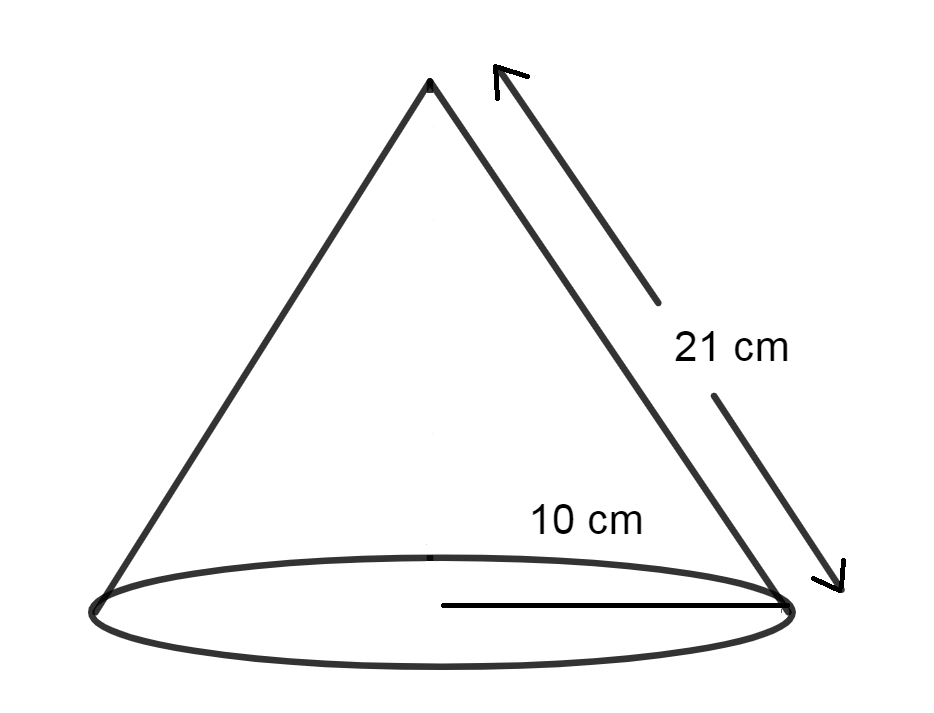
The adjoining figure shows the measure of a Joker’s cap. How much cloth is needed to make such a cap?
Answer
 Verified
637.8k+ views
Hint: To find the amount of the cloth we will find the curved surface area of the cone using formula \[\pi rl\] where \[\pi {\text{ is }}\dfrac{{22}}{7}\], r is radius and l is slant height.
Complete step by step solution:
In the question we are given the shape and dimension of a Joker's cap and we have to find the amount of cloth required to make a cap.
As the figure is given in the question,
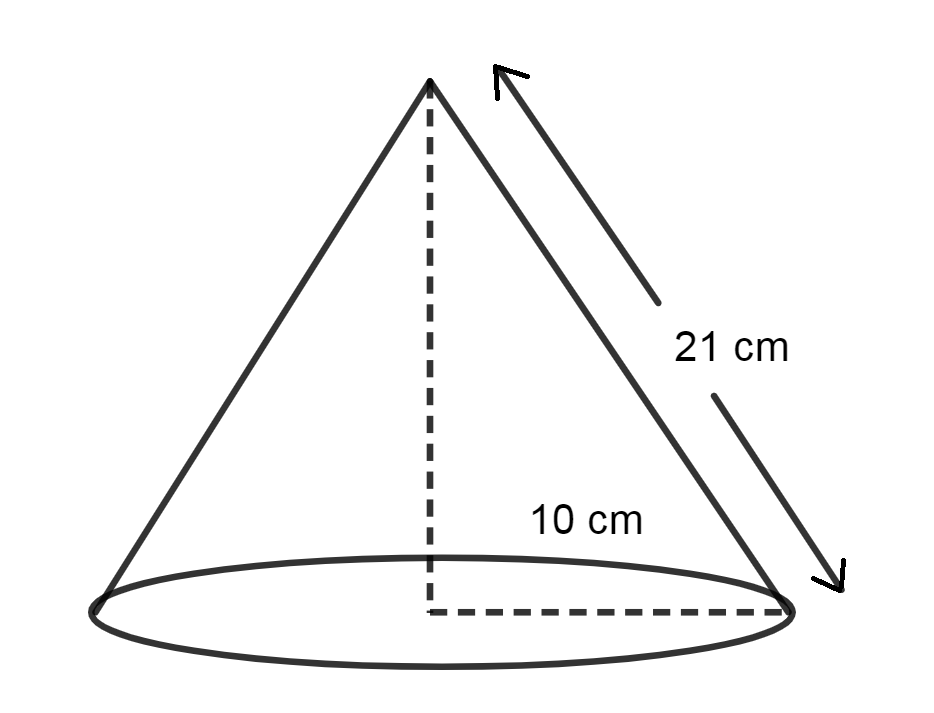
Now here we are given the length of radius which is 10cm and slant height which is 21cm. This means that r is equal to 10cm and l is 21cm as radius is represented by r and slant height as l.
Now to find the amount of cloth we have to find the curved surface area from the given dimensions.
For the cone, the formula of curved surface is \[\pi rl\] here r is radius, l is slant height and \[\pi \] is taken as value \[\dfrac{{22}}{7}.\]
Now substituting the value of radius and slant height as 10cm and 21cm respectively, so we get, curved surface area as,
\[\dfrac{{22}}{7}rl{\text{ or }}\dfrac{{22}}{7} \times 10cm \times 21cm\]
So the curved surface area is\[22 \times 10 \times 3{\text{ or 660c}}{{\rm{m}}^{\rm{2}}}\].
Hence, the amount of cloth required to make a cap is \[660c{m^2}\].
Note: Students while solving generally find total surface area instead of curved surface area as they miss out the fact that for measurement of cloth base area shall be exchanged.
Complete step by step solution:
In the question we are given the shape and dimension of a Joker's cap and we have to find the amount of cloth required to make a cap.
As the figure is given in the question,
Now here we are given the length of radius which is 10cm and slant height which is 21cm. This means that r is equal to 10cm and l is 21cm as radius is represented by r and slant height as l.
Now to find the amount of cloth we have to find the curved surface area from the given dimensions.
For the cone, the formula of curved surface is \[\pi rl\] here r is radius, l is slant height and \[\pi \] is taken as value \[\dfrac{{22}}{7}.\]
Now substituting the value of radius and slant height as 10cm and 21cm respectively, so we get, curved surface area as,
\[\dfrac{{22}}{7}rl{\text{ or }}\dfrac{{22}}{7} \times 10cm \times 21cm\]
So the curved surface area is\[22 \times 10 \times 3{\text{ or 660c}}{{\rm{m}}^{\rm{2}}}\].
Hence, the amount of cloth required to make a cap is \[660c{m^2}\].
Note: Students while solving generally find total surface area instead of curved surface area as they miss out the fact that for measurement of cloth base area shall be exchanged.
Recently Updated Pages
Master Class 11 English: Engaging Questions & Answers for Success

Master Class 11 Social Science: Engaging Questions & Answers for Success
Master Class 11 Maths: Engaging Questions & Answers for Success
Master Class 11 Biology: Engaging Questions & Answers for Success
Master Class 11 Physics: Engaging Questions & Answers for Success
Master Class 11 Chemistry: Engaging Questions & Answers for Success
Trending doubts
Explain the Treaty of Vienna of 1815 class 10 social science CBSE
What is the full form of POSCO class 10 social science CBSE
Define Potential, Developed, Stock and Reserved resources
The diagonals of a rhombus are 10cm and 24cm Find the class 10 maths CBSE
Fill the blanks with proper collective nouns 1 A of class 10 english CBSE
One number is chosen from numbers 1 to 200 Find the class 10 maths CBSE