




The adjacent sides of a rectangle are \[\left( 4{{x}^{2}}-3y \right)\] and 5xy. Find its area.
Answer
 Verified
640.5k+ views
Hint: If we have the length and breadth of a rectangle, then its area is equal to the product of its length and breadth. Mathematically, it can be written as follows:
Area of rectangle = length (l) \[\times \] breadth (b)
Complete step-by-step answer:
In the question, we have been given that the adjacent sides of a rectangle are \[\left( 4{{x}^{2}}-3y \right)\] and 5xy. Let us first draw the figure of the rectangle. Then, we can mark its adjacent sides which are given to us.
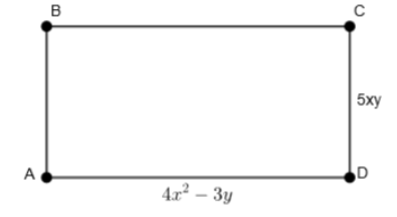
The longest side in the figure represents the length of the rectangle and it is taken in the horizontal direction. So, we get the length of the rectangle as \[\left( 4{{x}^{2}}-3y \right)\]. The other adjacent side in the figure represents the breadth of the rectangle and it is taken in the vertical direction. So, we get the breadth of the rectangle as 5xy. The length and breadth can be taken in any direction – horizontal or vertical depending on the conditions.
So, let us represent the dimensions as length, \[l=4{{x}^{2}}-3y\] and breadth, \[b=5xy\]
Now, we know that area \[=l\times b\]
So we can substitute the values of l and b in it and we get,
\[\text{Area}=\left( 4{{x}^{2}}-3y \right)\left( 5xy \right)\text{sq}\text{.units}\]
On further multiplying the terms, we get,
\[Area=4\times 5{{x}^{3}}y-3\times 5x{{y}^{2}}\]
\[=20{{x}^{3}}y-15x{{y}^{2}}\text{ sq}\text{.units}\]
Therefore, the area of the rectangle is equal to \[20{{x}^{3}}y-15x{{y}^{2}}\text{ sq}\text{.units}\]
Note: Students have to be careful while calculating the area of the rectangle. Also, students need to remember that the adjacent sides of a rectangle are length and breadth. Also, don’t forget to mention the unit of the area in the answer. Since the area is in the space occupied by a flat surface or the surface of an object, it is measured in the number of unit squares that cover the surface.
Area of rectangle = length (l) \[\times \] breadth (b)
Complete step-by-step answer:
In the question, we have been given that the adjacent sides of a rectangle are \[\left( 4{{x}^{2}}-3y \right)\] and 5xy. Let us first draw the figure of the rectangle. Then, we can mark its adjacent sides which are given to us.
The longest side in the figure represents the length of the rectangle and it is taken in the horizontal direction. So, we get the length of the rectangle as \[\left( 4{{x}^{2}}-3y \right)\]. The other adjacent side in the figure represents the breadth of the rectangle and it is taken in the vertical direction. So, we get the breadth of the rectangle as 5xy. The length and breadth can be taken in any direction – horizontal or vertical depending on the conditions.
So, let us represent the dimensions as length, \[l=4{{x}^{2}}-3y\] and breadth, \[b=5xy\]
Now, we know that area \[=l\times b\]
So we can substitute the values of l and b in it and we get,
\[\text{Area}=\left( 4{{x}^{2}}-3y \right)\left( 5xy \right)\text{sq}\text{.units}\]
On further multiplying the terms, we get,
\[Area=4\times 5{{x}^{3}}y-3\times 5x{{y}^{2}}\]
\[=20{{x}^{3}}y-15x{{y}^{2}}\text{ sq}\text{.units}\]
Therefore, the area of the rectangle is equal to \[20{{x}^{3}}y-15x{{y}^{2}}\text{ sq}\text{.units}\]
Note: Students have to be careful while calculating the area of the rectangle. Also, students need to remember that the adjacent sides of a rectangle are length and breadth. Also, don’t forget to mention the unit of the area in the answer. Since the area is in the space occupied by a flat surface or the surface of an object, it is measured in the number of unit squares that cover the surface.
Recently Updated Pages
Master Class 11 Social Science: Engaging Questions & Answers for Success

Master Class 11 Chemistry: Engaging Questions & Answers for Success
Master Class 12 Business Studies: Engaging Questions & Answers for Success
Master Class 12 Chemistry: Engaging Questions & Answers for Success
Master Class 12 Biology: Engaging Questions & Answers for Success
Class 12 Question and Answer - Your Ultimate Solutions Guide
Trending doubts
One Metric ton is equal to kg A 10000 B 1000 C 100 class 11 physics CBSE
Difference Between Prokaryotic Cells and Eukaryotic Cells
How many of the following diseases can be studied with class 11 biology CBSE
Two of the body parts which do not appear in MRI are class 11 biology CBSE
Which of the following enzymes is used for carboxylation class 11 biology CBSE
Explain zero factorial class 11 maths CBSE