




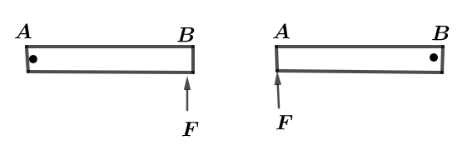
The adjacent figure shows a non-uniform metre stick $AB$ having the linear mass density variation $\lambda = {\lambda _0}x$ , where ${\lambda _0}$ is a constant and $x$ is the distance from end $A$, placed on a smooth horizontal surface. In the first experiment, the rod is pivoted at end $A$ and force $F$ is applied perpendicular to the rod at the other end $B$ and in the Second experiment, the rod is pivoted at B and the force is applied perpendicular to the rod at point $A$. If in the first case the angular acceleration is ${\alpha _A}$ and in the second case its ${\alpha _B}$ then,
A. ${\alpha _A} = {\alpha _B}$
B. ${\alpha _A} > {\alpha _B}$
C. ${\alpha _A} < {\alpha _B}$
D. Data is insufficient to determine
Answer
 Verified
516k+ views
Hint: In mechanics, when a perpendicular force is applied to the length of a given rod, it produced a rotational torque hence produce angular acceleration which depends upon the moment of inertia of the rod as, $\tau = I\alpha $ . where, $\tau $ is the torque acting on the rod due to force acting on it, $\alpha $ is the angular acceleration and $I$ is the moment of inertia about the rotational axis. Here, we will compare the torque acting on both cases and then find the relation between angular accelerations produced in both cases.
Formula used:
The torque acting on a rod of length say $L$ and perpendicular force $F$ to the length is given by,
$\tau = FL$
Moment of inertia of a rod of mass $m$ at a perpendicular distance from axes of rotation $r$ is given by,
$I = m{r^2}$
Complete step by step answer:
Since, the length of rod and the applied perpendicular force $F$ is same in both cases, so the torque acting in both cases will be,
${\tau _A} = {\tau _B} = FL$
$\Rightarrow {\tau _A} = {\tau _B}$
Now, in the first case when force is applied at end B, let’s assume the moment of inertia will be ${I_A}$ and the angular acceleration ${\alpha _A}$ . It’s given to us that linear mass density varies as $\lambda = {\lambda _0}x$ which means, as we will move from one end to another end of the rod the mass of the rod will increase such that, mass distribution is far for rotation about point A and mass distribution is less for rotation about point B, which means distance from ends point to axes of rotation will be ${r_A} > {r_B}$.
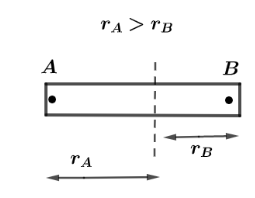
Let us assume that when force is applied at end $B$, the mass of the rod is ${m_A}$ such that the moment of inertia in the first case will be, ${I_A} = m{r_A}^2$. Now, in the second case, the moment of inertia about point $B$ can be written as ${I_B} = m{r_B}^2$ .
Since, ${r_A} > {r_B}$
${I_A} > {I_B}$
$\Rightarrow \dfrac{{{I_A}}}{{{I_B}}} > 1$
Now, as we have ${\tau _A} = {\tau _B}$
${I_A}{\alpha _A} = {I_B}{\alpha _B}$
$\Rightarrow \dfrac{{{I_A}}}{{{I_B}}} = \dfrac{{{\alpha _A}}}{{{\alpha _B}}}$
From relation, $\dfrac{{{I_A}}}{{{I_B}}} > 1$ we have,
$\dfrac{{{\alpha _A}}}{{{\alpha _B}}} > 1$
Which shows that,
$\therefore {\alpha _A} > {\alpha _B}$
Hence, the correct option is B.
Note: It should be remembered that, it’s just the mass distribution which is increasing as one moves from one end to another but total mass remains constant and due to varying mass distribution the distance from action point to the axes of rotation is different in both cases which produce different angular acceleration in both cases even when total mass and length of the rod is same in both cases.
Formula used:
The torque acting on a rod of length say $L$ and perpendicular force $F$ to the length is given by,
$\tau = FL$
Moment of inertia of a rod of mass $m$ at a perpendicular distance from axes of rotation $r$ is given by,
$I = m{r^2}$
Complete step by step answer:
Since, the length of rod and the applied perpendicular force $F$ is same in both cases, so the torque acting in both cases will be,
${\tau _A} = {\tau _B} = FL$
$\Rightarrow {\tau _A} = {\tau _B}$
Now, in the first case when force is applied at end B, let’s assume the moment of inertia will be ${I_A}$ and the angular acceleration ${\alpha _A}$ . It’s given to us that linear mass density varies as $\lambda = {\lambda _0}x$ which means, as we will move from one end to another end of the rod the mass of the rod will increase such that, mass distribution is far for rotation about point A and mass distribution is less for rotation about point B, which means distance from ends point to axes of rotation will be ${r_A} > {r_B}$.
Let us assume that when force is applied at end $B$, the mass of the rod is ${m_A}$ such that the moment of inertia in the first case will be, ${I_A} = m{r_A}^2$. Now, in the second case, the moment of inertia about point $B$ can be written as ${I_B} = m{r_B}^2$ .
Since, ${r_A} > {r_B}$
${I_A} > {I_B}$
$\Rightarrow \dfrac{{{I_A}}}{{{I_B}}} > 1$
Now, as we have ${\tau _A} = {\tau _B}$
${I_A}{\alpha _A} = {I_B}{\alpha _B}$
$\Rightarrow \dfrac{{{I_A}}}{{{I_B}}} = \dfrac{{{\alpha _A}}}{{{\alpha _B}}}$
From relation, $\dfrac{{{I_A}}}{{{I_B}}} > 1$ we have,
$\dfrac{{{\alpha _A}}}{{{\alpha _B}}} > 1$
Which shows that,
$\therefore {\alpha _A} > {\alpha _B}$
Hence, the correct option is B.
Note: It should be remembered that, it’s just the mass distribution which is increasing as one moves from one end to another but total mass remains constant and due to varying mass distribution the distance from action point to the axes of rotation is different in both cases which produce different angular acceleration in both cases even when total mass and length of the rod is same in both cases.
Recently Updated Pages
Master Class 11 Computer Science: Engaging Questions & Answers for Success

Master Class 11 Business Studies: Engaging Questions & Answers for Success
Master Class 11 Economics: Engaging Questions & Answers for Success
Master Class 11 English: Engaging Questions & Answers for Success
Master Class 11 Maths: Engaging Questions & Answers for Success
Master Class 11 Biology: Engaging Questions & Answers for Success
Trending doubts
One Metric ton is equal to kg A 10000 B 1000 C 100 class 11 physics CBSE
There are 720 permutations of the digits 1 2 3 4 5 class 11 maths CBSE
Discuss the various forms of bacteria class 11 biology CBSE
Draw a diagram of a plant cell and label at least eight class 11 biology CBSE
State the laws of reflection of light
Explain zero factorial class 11 maths CBSE