




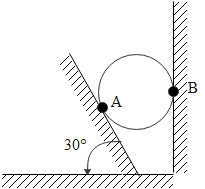
The 50 kg homogeneous smooth sphere rests on the ${30^ \circ }$ incline A and bears against the smooth vertical wall B. The contact force at B is ($g = 10\dfrac{m}{{{s^2}}}$)
\[\begin{array}{l}
A.\;\;\;\;\;\;\;\;250N\\
B.\;\;\;\;\;\;\;\;0N\\
C.\;\;\;\;\;\;\;\dfrac{{\;500}}{{\sqrt 3 }}N\\
D.\;\;\;\;\;\;\;\;250N
\end{array}\]
Answer
 Verified
612.9k+ views
Hint: In order to solve this problem, first we need to draw a free body diagram which will show us the various forces acting on the system. Then comparing the directions of various forces, we can obtain the equations of motion for the system. By solving these equations, we may obtain the contact force.
Complete step by step solution:
Let us first draw a free body diagram of the ball which involves two normal forces at A & B. These forces are perpendicular to walls from which they are applied and also to the gravitational force. Their magnitude is given to be equal to $50 \times 10 = 500N$ (where the gravitational force is equal to the product of the mass of the ball and the acceleration due to gravity.)
Let us call the normal from wall A to be ${N_A}$ and the normal from wall B to be ${N_B}$. Now by doing some simple calculations, we can find out the angle between the vertical and ${N_A}$ which is equal to the angle made by incline & floor which is equal to ${30^ \circ }$
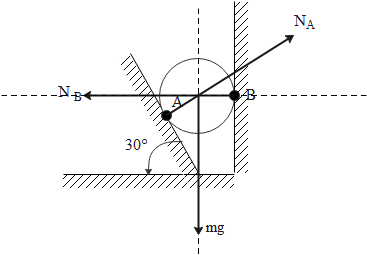
Now, we can resolve ${N_A}$ into its horizontal & vertical components which are given to be ${N_A}\cos {30^ \circ }$ & ${N_A}\sin {30^ \circ }$ which is equal to $\dfrac{{\sqrt 3 {N_A}}}{2}$ & $\dfrac{{{N_A}}}{2}$ respectively.
Since the sphere is in equilibrium forces along vertical & horizontal should be balanced. On equating them we get
$mg = {N_A}\cos {30^ \circ }$
$\dfrac{{\sqrt 3 {N_A}}}{2} = 500$ … (1)
${N_B} = {N_A}\sin {30^ \circ }$
${N_B} = \dfrac{{{N_A}}}{2}$ … (2)
Putting value of ${N_A}$ from equation 1
${N_B} = \dfrac{{2 \times 500}}{{\sqrt 3 \times 2}} = \dfrac{{500}}{{\sqrt 3 }}$ N
Hence the correct option is C.
Note: Students often make mistakes while taking angle between components of force. The angle should be calculated carefully. Also, it must be remembered that normal always acts perpendicular to surface and point of contact. Hence in the case of a sphere it always passes from the center.
Complete step by step solution:
Let us first draw a free body diagram of the ball which involves two normal forces at A & B. These forces are perpendicular to walls from which they are applied and also to the gravitational force. Their magnitude is given to be equal to $50 \times 10 = 500N$ (where the gravitational force is equal to the product of the mass of the ball and the acceleration due to gravity.)
Let us call the normal from wall A to be ${N_A}$ and the normal from wall B to be ${N_B}$. Now by doing some simple calculations, we can find out the angle between the vertical and ${N_A}$ which is equal to the angle made by incline & floor which is equal to ${30^ \circ }$
Now, we can resolve ${N_A}$ into its horizontal & vertical components which are given to be ${N_A}\cos {30^ \circ }$ & ${N_A}\sin {30^ \circ }$ which is equal to $\dfrac{{\sqrt 3 {N_A}}}{2}$ & $\dfrac{{{N_A}}}{2}$ respectively.
Since the sphere is in equilibrium forces along vertical & horizontal should be balanced. On equating them we get
$mg = {N_A}\cos {30^ \circ }$
$\dfrac{{\sqrt 3 {N_A}}}{2} = 500$ … (1)
${N_B} = {N_A}\sin {30^ \circ }$
${N_B} = \dfrac{{{N_A}}}{2}$ … (2)
Putting value of ${N_A}$ from equation 1
${N_B} = \dfrac{{2 \times 500}}{{\sqrt 3 \times 2}} = \dfrac{{500}}{{\sqrt 3 }}$ N
Hence the correct option is C.
Note: Students often make mistakes while taking angle between components of force. The angle should be calculated carefully. Also, it must be remembered that normal always acts perpendicular to surface and point of contact. Hence in the case of a sphere it always passes from the center.
Recently Updated Pages
Master Class 11 Social Science: Engaging Questions & Answers for Success

Master Class 11 Physics: Engaging Questions & Answers for Success
Master Class 11 Maths: Engaging Questions & Answers for Success
Master Class 11 Economics: Engaging Questions & Answers for Success
Master Class 11 Computer Science: Engaging Questions & Answers for Success
Master Class 11 Chemistry: Engaging Questions & Answers for Success
Trending doubts
One Metric ton is equal to kg A 10000 B 1000 C 100 class 11 physics CBSE
There are 720 permutations of the digits 1 2 3 4 5 class 11 maths CBSE
1 Quintal is equal to a 110 kg b 10 kg c 100kg d 1000 class 11 physics CBSE
State and prove Bernoullis theorem class 11 physics CBSE
Difference Between Prokaryotic Cells and Eukaryotic Cells
Discuss the various forms of bacteria class 11 biology CBSE