




How do you test for symmetry for $r=1-2\sin \left( \theta \right)$ ?
Answer
 Verified
542.1k+ views
Hint: In this question we have been asked to test the given expression $r=1-2\sin \theta $ for symmetry. We know that $\sin \theta $ is symmetric about the y-axis. That is $\sin \left( \pi -\theta \right)=\sin \theta $ . The definition of symmetry says that “if $\left( x,y \right)$ is a point on the curve then $\left( p,q \right)$ another point that is equidistant (mirror image) with respect to y-axis (or x-axis) should also lie on the curve.
Complete step by step solution:
Now considering the question we have been asked to test the given expression $r=1-2\sin \theta $ for symmetry.
From the basic concepts of trigonometry we know that $\sin \theta $ is symmetric about the y-axis. That is $\sin \left( \pi -\theta \right)=\sin \theta $ .
From the basic concepts we know that the definition of symmetry says that “if $\left( x,y \right)$ is a point on the curve then $\left( p,q \right)$ another point that is equidistant (mirror image) with respect to y-axis (or x-axis) should also lie on the curve.
Now we can say that for a point $\left( r,\theta \right)$ the equidistant point will be $\left( r,\pi -\theta \right)$ with respect to y-axis. If we verify this point by substituting it in the given expression we will have $\begin{align}
& \Rightarrow r=1-2\sin \left( \pi -\theta \right) \\
& \Rightarrow r=1-2\sin \theta \\
\end{align}$ .
Hence we can conclude that the given expression $r=1-2\sin \theta $ is symmetric about the y-axis.
The graph of this curve is shown below:
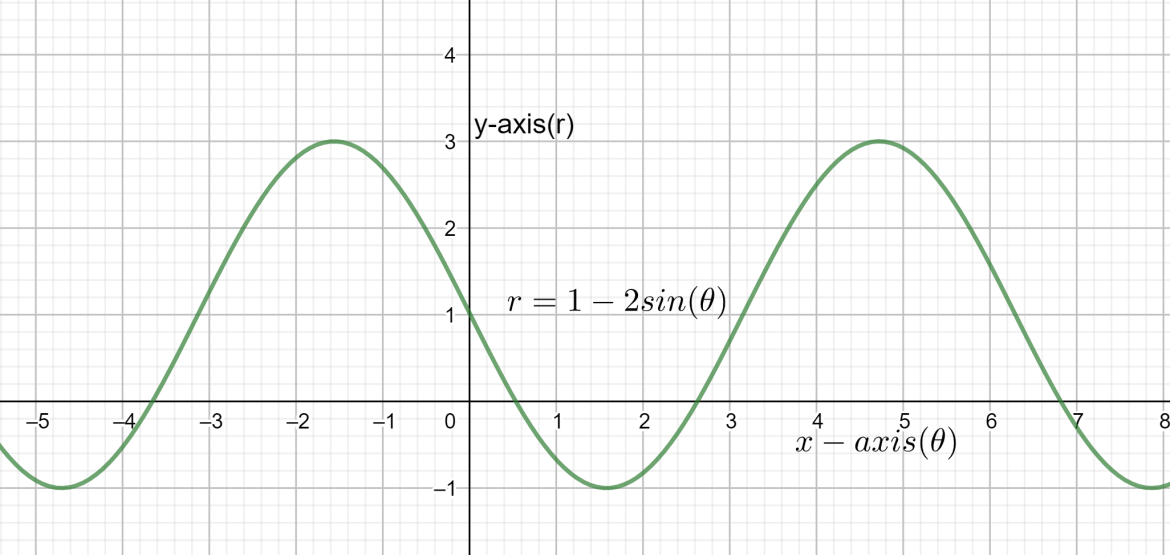
Note: While answering questions of this type we should be sure with our concepts that we are going to apply. Similarly we also know that $\cos \theta $ is symmetric about the x-axis that is $\cos \left( -\theta \right)=\cos \theta $. Someone can confuse between these two and consider that the sine function is symmetric about the x-axis and end up having a wrong conclusion so we should be careful.
Complete step by step solution:
Now considering the question we have been asked to test the given expression $r=1-2\sin \theta $ for symmetry.
From the basic concepts of trigonometry we know that $\sin \theta $ is symmetric about the y-axis. That is $\sin \left( \pi -\theta \right)=\sin \theta $ .
From the basic concepts we know that the definition of symmetry says that “if $\left( x,y \right)$ is a point on the curve then $\left( p,q \right)$ another point that is equidistant (mirror image) with respect to y-axis (or x-axis) should also lie on the curve.
Now we can say that for a point $\left( r,\theta \right)$ the equidistant point will be $\left( r,\pi -\theta \right)$ with respect to y-axis. If we verify this point by substituting it in the given expression we will have $\begin{align}
& \Rightarrow r=1-2\sin \left( \pi -\theta \right) \\
& \Rightarrow r=1-2\sin \theta \\
\end{align}$ .
Hence we can conclude that the given expression $r=1-2\sin \theta $ is symmetric about the y-axis.
The graph of this curve is shown below:
Note: While answering questions of this type we should be sure with our concepts that we are going to apply. Similarly we also know that $\cos \theta $ is symmetric about the x-axis that is $\cos \left( -\theta \right)=\cos \theta $. Someone can confuse between these two and consider that the sine function is symmetric about the x-axis and end up having a wrong conclusion so we should be careful.
Recently Updated Pages
Master Class 11 English: Engaging Questions & Answers for Success

Master Class 11 Maths: Engaging Questions & Answers for Success
Master Class 11 Biology: Engaging Questions & Answers for Success
Master Class 11 Physics: Engaging Questions & Answers for Success
Master Class 11 Accountancy: Engaging Questions & Answers for Success
Class 11 Question and Answer - Your Ultimate Solutions Guide
Trending doubts
One Metric ton is equal to kg A 10000 B 1000 C 100 class 11 physics CBSE
Discuss the various forms of bacteria class 11 biology CBSE
Draw a diagram of a plant cell and label at least eight class 11 biology CBSE
State the laws of reflection of light
Explain zero factorial class 11 maths CBSE
10 examples of friction in our daily life