




Why is tertiary carbocation more stable than secondary?
Answer
 Verified
576k+ views
Hint: Carbocations are the species in which the carbon atom attains a positive charge. It is an electron deficient species and its structure is planar. Carbocations are generally of three types which are: Primary carbocation $({1^o})$ , secondary carbocation $({2^o})$ and the tertiary carbocation $({3^o})$ . We will now discuss their stability.
Complete answer:
Carbocation is a species which has a positive charge on the carbon atom and is electron-deficient in nature. So, if we compare the tertiary carbocation and secondary carbocation.
So, there are two criteria for the stability of carbocations, one is the inductive effect and the second one is the hyperconjugation effect.
Inductive effect $( + I)$ : The tendency of some compounds to donate their electron tendency is known as inductive effect. For example: Alkyl groups have positive inductive effects $( + I)$ .
So, in tertiary carbocations, three alkyl groups are present which applies the $ + I$effect while in secondary carbocation there are only two alkyl groups.
Thus, according to the inductive effect, tertiary carbocation is more stable than secondary carbocation.
Hyperconjugation effect: Hyperconjugation refers to the delocalization of electrons with the by participation of sigma bonds. It is also known as sigma bond resonance.
More the hyperconjugation, more will be the stability of carbocation.
Now, let us see hyperconjugation in tertiary carbocation:
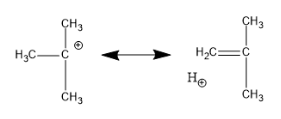
Following this type of sigma bond resonance, there can be a total of nine structures.
Now, hyperconjugation for secondary carbocation:
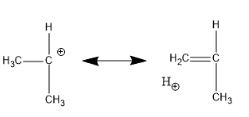
Hence, in secondary carbocation, there are only six hyperconjugation structures.
So, we can say that tertiary carbocation is more stable than secondary carbocation.
Note:
We should remember that the tertiary carbocations are those in which three alkyl groups are present on carbocation and in secondary, two alkyl groups are present on carbocation. And primary carbocation is in which only one alkyl group is attached to the carbocation. There is one more type of carbocation which is methyl carbocation in which there is no alkyl group attached to carbocation.
Complete answer:
Carbocation is a species which has a positive charge on the carbon atom and is electron-deficient in nature. So, if we compare the tertiary carbocation and secondary carbocation.
So, there are two criteria for the stability of carbocations, one is the inductive effect and the second one is the hyperconjugation effect.
Inductive effect $( + I)$ : The tendency of some compounds to donate their electron tendency is known as inductive effect. For example: Alkyl groups have positive inductive effects $( + I)$ .
So, in tertiary carbocations, three alkyl groups are present which applies the $ + I$effect while in secondary carbocation there are only two alkyl groups.
Thus, according to the inductive effect, tertiary carbocation is more stable than secondary carbocation.
Hyperconjugation effect: Hyperconjugation refers to the delocalization of electrons with the by participation of sigma bonds. It is also known as sigma bond resonance.
More the hyperconjugation, more will be the stability of carbocation.
Now, let us see hyperconjugation in tertiary carbocation:
Following this type of sigma bond resonance, there can be a total of nine structures.
Now, hyperconjugation for secondary carbocation:
Hence, in secondary carbocation, there are only six hyperconjugation structures.
So, we can say that tertiary carbocation is more stable than secondary carbocation.
Note:
We should remember that the tertiary carbocations are those in which three alkyl groups are present on carbocation and in secondary, two alkyl groups are present on carbocation. And primary carbocation is in which only one alkyl group is attached to the carbocation. There is one more type of carbocation which is methyl carbocation in which there is no alkyl group attached to carbocation.
Recently Updated Pages
Which of the following graphs shows the variation of class 12 physics CBSE

Draw a labelled diagram of the human male reproductive class 12 biology CBSE
Describe the experiment to compare the emf of two cells class 12 physics CBSE
What is standard hydrogen electrode
What is conventional current and electric current class 12 physics CBSE
2Bromopentane is treated with an alcoholic KOH solution class 12 chemistry CBSE
Trending doubts
Draw a labelled sketch of the human eye class 12 physics CBSE
Which are the Top 10 Largest Countries of the World?
Differentiate between homogeneous and heterogeneous class 12 chemistry CBSE
Draw ray diagrams each showing i myopic eye and ii class 12 physics CBSE
Which is the correct genotypic ratio of mendel dihybrid class 12 biology CBSE
What is the Full Form of PVC, PET, HDPE, LDPE, PP and PS ?