




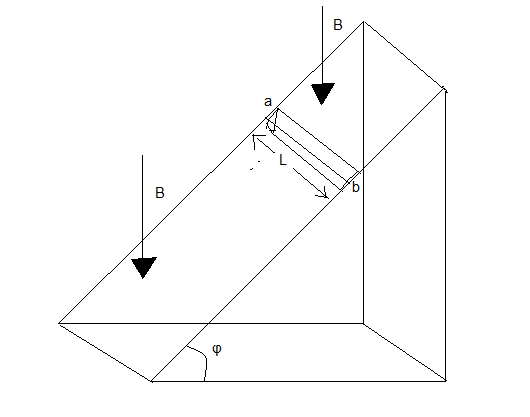
What is the terminal speed of the bar?
$ \left( A \right)\dfrac{{mgR}}{{{B^2}{l^2}\sin \phi }} \\
\left( B \right)\dfrac{{mgR\cos \phi }}{{{B^2}{l^2}{{\sin }^2}\phi }} \\
\left( C \right)\dfrac{{mgR\sin \phi }}{{{B^2}{l^2}{{\cos }^2}\phi }} \\
\left( D \right)\dfrac{{mgR\sin \phi }}{{{B^2}{l^2}\cos \phi }} \\ $
Answer
 Verified
541.5k+ views
Hint :In order to solve the question, we are going to equate the magnetic field with the gravitational force, as in this condition only the bar will attain a terminal velocity. The terminal velocity is then derived from the equation by simplifying it and further solving the equation.
The formula used here is
Gravitational force is given by $ mg\sin \phi $
And magnetic force is given by $ Ilb\cos \phi $
Here, $ mg\sin \phi = Ilb\cos \phi $
Here $ m $ is the mass of the bar, $ g $ is the acceleration of gravity, $ B $ is the magnetic force, $ l $ is the length of the rod, $ b $ is the breadth, $ \phi $ is the angle.
The current in the bar $ I $ is given as
$ I = \dfrac{{Blv\cos \phi }}{R} $
Complete Step By Step Answer:
The bar attains the terminal velocity when the magnetic field is balanced by the gravitational force, so if we equate the two forces then, the equation becomes
$ mg\sin \phi = Ilb\cos \phi $
Here $ m $ is the mass of the bar, $ g $ is the acceleration of gravity, $ B $ is the magnetic force, $ l $ is the length of the rod, $ b $ is the breadth, $ \phi $ is the angle.
Where on left hand side, we have the gravitational force and on the right hand side, we have the magnetic field
The current in the bar $ I $ is given as
$ I = \dfrac{{Blv\cos \phi }}{R} $
Using this relation in the above equation
$ mg\sin \phi = \dfrac{{{B^2}{l^2}v{{\cos }^2}\phi }}{R} $
Rearranging the terms we get, the relation for velocity
$ v = \dfrac{{mgR\sin \phi }}{{{B^2}{l^2}{{\cos }^2}\phi }} $
Hence, the terminal speed of the bar $ v = \dfrac{{mgR\sin \phi }}{{{B^2}{l^2}{{\cos }^2}\phi }} $
Hence, option $ \left( C \right)\dfrac{{mg\sin \phi R}}{{{B^2}{l^2}{{\cos }^2}\phi }} $ is correct.
Note :
Terminal velocity is the steady speed that is achieved by the freely falling objects under gravity in air or in some medium. In this question, it is a very important step to see what all forces are acting on the bar and then checking the condition of equilibrium where the terminal velocity can be attained.
The formula used here is
Gravitational force is given by $ mg\sin \phi $
And magnetic force is given by $ Ilb\cos \phi $
Here, $ mg\sin \phi = Ilb\cos \phi $
Here $ m $ is the mass of the bar, $ g $ is the acceleration of gravity, $ B $ is the magnetic force, $ l $ is the length of the rod, $ b $ is the breadth, $ \phi $ is the angle.
The current in the bar $ I $ is given as
$ I = \dfrac{{Blv\cos \phi }}{R} $
Complete Step By Step Answer:
The bar attains the terminal velocity when the magnetic field is balanced by the gravitational force, so if we equate the two forces then, the equation becomes
$ mg\sin \phi = Ilb\cos \phi $
Here $ m $ is the mass of the bar, $ g $ is the acceleration of gravity, $ B $ is the magnetic force, $ l $ is the length of the rod, $ b $ is the breadth, $ \phi $ is the angle.
Where on left hand side, we have the gravitational force and on the right hand side, we have the magnetic field
The current in the bar $ I $ is given as
$ I = \dfrac{{Blv\cos \phi }}{R} $
Using this relation in the above equation
$ mg\sin \phi = \dfrac{{{B^2}{l^2}v{{\cos }^2}\phi }}{R} $
Rearranging the terms we get, the relation for velocity
$ v = \dfrac{{mgR\sin \phi }}{{{B^2}{l^2}{{\cos }^2}\phi }} $
Hence, the terminal speed of the bar $ v = \dfrac{{mgR\sin \phi }}{{{B^2}{l^2}{{\cos }^2}\phi }} $
Hence, option $ \left( C \right)\dfrac{{mg\sin \phi R}}{{{B^2}{l^2}{{\cos }^2}\phi }} $ is correct.
Note :
Terminal velocity is the steady speed that is achieved by the freely falling objects under gravity in air or in some medium. In this question, it is a very important step to see what all forces are acting on the bar and then checking the condition of equilibrium where the terminal velocity can be attained.
Recently Updated Pages
Master Class 12 Economics: Engaging Questions & Answers for Success

Master Class 12 Physics: Engaging Questions & Answers for Success
Master Class 12 English: Engaging Questions & Answers for Success
Master Class 12 Social Science: Engaging Questions & Answers for Success
Master Class 12 Maths: Engaging Questions & Answers for Success
Master Class 12 Business Studies: Engaging Questions & Answers for Success
Trending doubts
Which are the Top 10 Largest Countries of the World?
What are the major means of transport Explain each class 12 social science CBSE
Draw a labelled sketch of the human eye class 12 physics CBSE
Differentiate between insitu conservation and exsitu class 12 biology CBSE
Draw a neat and well labeled diagram of TS of ovary class 12 biology CBSE
Differentiate between homogeneous and heterogeneous class 12 chemistry CBSE