




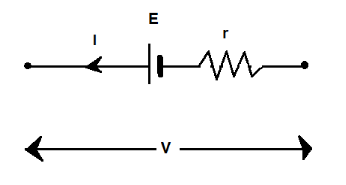
Terminal potential difference of the cell shown in the diagram is given by V= __________
A. $E - Ir$
B. $E$
C. $E + Ir$
D. $\left( {E - r} \right)I$
Answer
 Verified
596.7k+ views
Hint: The potential difference across a cell in a circuit is called a terminal potential difference. According to Ohm’s law, the current passing through a conductor is directly proportional to voltage applied across it. Using Ohm’s law appropriately, we can easily choose the correct option.
Complete step by step answer:
We are given to find the terminal potential difference of the cell shown in the above diagram.
Here, the cell is in an open circuit.
We are given that E is present in the cell. E is the electromotive force (emf) of the cell. Electromotive force is the energy provided by the cell into the circuit.‘r’ is the internal resistance. E is the energy of the cell but due to the presence of an internal resistor some of this energy is taken by the internal resistor out of the circuit.Therefore the voltage reduces slightly. Reduction in the voltage is equal to the product of current in the circuit and the internal resistance of the cell. This reduction is subtracted from the Energy of the cell to give the potential difference.
$V = E - Ir$
Thus the right answer is Option A, $E - Ir$.
Note:: The terminal voltage of a cell is equal to the emf of the cell given only if the value of internal resistance is zero and the circuit is open. Closed circuit is a circuit which is activated by a switch and needs the switch to close the circuit loop making the current flow whereas open circuit is a circuit where the switch is open and current will not flow as the continuity is broken. Do not confuse open circuit with a closed circuit.
Complete step by step answer:
We are given to find the terminal potential difference of the cell shown in the above diagram.
Here, the cell is in an open circuit.
We are given that E is present in the cell. E is the electromotive force (emf) of the cell. Electromotive force is the energy provided by the cell into the circuit.‘r’ is the internal resistance. E is the energy of the cell but due to the presence of an internal resistor some of this energy is taken by the internal resistor out of the circuit.Therefore the voltage reduces slightly. Reduction in the voltage is equal to the product of current in the circuit and the internal resistance of the cell. This reduction is subtracted from the Energy of the cell to give the potential difference.
$V = E - Ir$
Thus the right answer is Option A, $E - Ir$.
Note:: The terminal voltage of a cell is equal to the emf of the cell given only if the value of internal resistance is zero and the circuit is open. Closed circuit is a circuit which is activated by a switch and needs the switch to close the circuit loop making the current flow whereas open circuit is a circuit where the switch is open and current will not flow as the continuity is broken. Do not confuse open circuit with a closed circuit.
Recently Updated Pages
Master Class 12 Social Science: Engaging Questions & Answers for Success

Master Class 12 Physics: Engaging Questions & Answers for Success
Master Class 12 Maths: Engaging Questions & Answers for Success
Master Class 12 Economics: Engaging Questions & Answers for Success
Master Class 12 Chemistry: Engaging Questions & Answers for Success
Master Class 12 Business Studies: Engaging Questions & Answers for Success
Trending doubts
Which are the Top 10 Largest Countries of the World?
Draw a labelled sketch of the human eye class 12 physics CBSE
Explain the structure of megasporangium class 12 biology CBSE
What are the major means of transport Explain each class 12 social science CBSE
How many chromosomes are found in human ovum a 46 b class 12 biology CBSE
The diagram of the section of a maize grain is given class 12 biology CBSE