




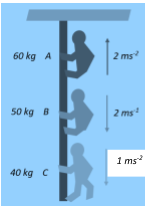
Tension in the rope at the rigid support is: (Take $g = 10\;ms^{-2}$)
A). 760 N
B). 41360 N
C). 1580 N
D). 1620 N
Answer
 Verified
542.4k+ views
Hint: Use free-body diagrams on each climber to determine the tension that is imparted by each climber to the rope due to their weight as well as their acceleration, if any. In the case of climber B, recall that constant velocity of descent implies no acceleration. To this end, determine the net tension acting on the rope at the rigid support by taking the sum of tensions imparted by each climber.
Formula Used:
$F_{gravity} = mg$
$F_{acceleration} = ma$
Complete step-by-step solution:
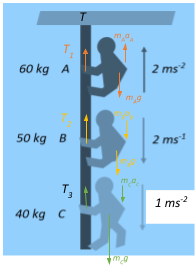
The tension in the rope at the rigid support will be the additive sum of tension imparted to the rope by each climber. The forces acting on the climber and the tension imparted to the rope is as shown in the figure. Let us look at each climber individually.
For climber A ascending upwards:
$m_A = 60\;kg$ and $a_A = 2\;ms^{-2}$
From the figure, we see that,
$T_1 – m_Ag = m_Aa_A \Rightarrow T_1 = m_Ag + m_Aa_A$
$\Rightarrow T = (60 \times 10) + (60 \times 2) = 600 + 120 = 720\;N$
For climber B descending downwards:
$m_B =50\;kg$ and constant velocity $v = 2\;ms^{-1}$ which means that acceleration $a_B = 0$
From the figure, we see that,
$T_2-m_Bg = 0 \Rightarrow T_2 = m_B g = 50 \times 10 = 500\;N$
For climber C descending downwards:
$m_C = 40\;kg$ and $a_C = 1\;ms^{-2}$
From the figure we see that,
$T_3 = m_Cg-m_Ca_C = (40 \times 10)-(40 \times 1) = 400-40 = 360\;N $
Therefore, the net tension at the rigid support would be:
$T = T_1 +T_2 +T_3 = 720 + 500 + 360 = 1580\;N$
Therefore, the correct option would be C. 1580 N
Note: Always use free body diagrams to summarize the list of all influencing forces in a system as this ensures that all forces are accounted for. This also guarantees that we are directionally-conscious while deducing the forces and their contribution, since the net force will always depend on the direction in which individual forces act.
Also, do not mistake downward acceleration for deceleration since this implies that there is an acceleration but in the downward direction, whereas deceleration implies a diminishing rate of velocity. The effect of downward acceleration is accounted for by the force that defines it, so there is no need to use a negative sign to signify acceleration in the downward direction. Negative sign for acceleration is thus always reserved to indicate deceleration.
Formula Used:
$F_{gravity} = mg$
$F_{acceleration} = ma$
Complete step-by-step solution:
The tension in the rope at the rigid support will be the additive sum of tension imparted to the rope by each climber. The forces acting on the climber and the tension imparted to the rope is as shown in the figure. Let us look at each climber individually.
For climber A ascending upwards:
$m_A = 60\;kg$ and $a_A = 2\;ms^{-2}$
From the figure, we see that,
$T_1 – m_Ag = m_Aa_A \Rightarrow T_1 = m_Ag + m_Aa_A$
$\Rightarrow T = (60 \times 10) + (60 \times 2) = 600 + 120 = 720\;N$
For climber B descending downwards:
$m_B =50\;kg$ and constant velocity $v = 2\;ms^{-1}$ which means that acceleration $a_B = 0$
From the figure, we see that,
$T_2-m_Bg = 0 \Rightarrow T_2 = m_B g = 50 \times 10 = 500\;N$
For climber C descending downwards:
$m_C = 40\;kg$ and $a_C = 1\;ms^{-2}$
From the figure we see that,
$T_3 = m_Cg-m_Ca_C = (40 \times 10)-(40 \times 1) = 400-40 = 360\;N $
Therefore, the net tension at the rigid support would be:
$T = T_1 +T_2 +T_3 = 720 + 500 + 360 = 1580\;N$
Therefore, the correct option would be C. 1580 N
Note: Always use free body diagrams to summarize the list of all influencing forces in a system as this ensures that all forces are accounted for. This also guarantees that we are directionally-conscious while deducing the forces and their contribution, since the net force will always depend on the direction in which individual forces act.
Also, do not mistake downward acceleration for deceleration since this implies that there is an acceleration but in the downward direction, whereas deceleration implies a diminishing rate of velocity. The effect of downward acceleration is accounted for by the force that defines it, so there is no need to use a negative sign to signify acceleration in the downward direction. Negative sign for acceleration is thus always reserved to indicate deceleration.
Recently Updated Pages
Master Class 11 Computer Science: Engaging Questions & Answers for Success

Master Class 11 Business Studies: Engaging Questions & Answers for Success
Master Class 11 Economics: Engaging Questions & Answers for Success
Master Class 11 English: Engaging Questions & Answers for Success
Master Class 11 Maths: Engaging Questions & Answers for Success
Master Class 11 Biology: Engaging Questions & Answers for Success
Trending doubts
One Metric ton is equal to kg A 10000 B 1000 C 100 class 11 physics CBSE
There are 720 permutations of the digits 1 2 3 4 5 class 11 maths CBSE
Discuss the various forms of bacteria class 11 biology CBSE
Draw a diagram of a plant cell and label at least eight class 11 biology CBSE
State the laws of reflection of light
10 examples of friction in our daily life