




Temperature gradient in a rod of $0.5\ m$ long is $80{}^\circ C/m$. If the temperature of hotter end of the rod is $30{}^\circ C$, then the temperature of the cooler end is
(a) $0{}^\circ C$
(b) $-10{}^\circ C$
(c) $10{}^\circ C$
(d) $40{}^\circ C$
Answer
 Verified
601.2k+ views
Hint: We know that temperature gradient is given by $k=\dfrac{\Delta T}{x}$, which means the difference of temperatures at two ends divided by the length or distance x. Using this formula, we will find the value of temperature of the cooler ends.
Formula used: $k=\dfrac{\Delta T}{x}$
Complete step-by-step answer:
In the question it is given that the temperature gradient in a rod of $0.5\ m$ long is $80{}^\circ C/m$. If the temperature of the hotter end of the rod is $30{}^\circ C$ and we are asked to find the temperature at the hotter end. So, based on this we will draw a figure for our simplicity.
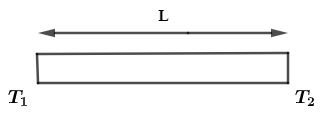
Now, as shown in the figure, let us assume that ${{T}_{1}}$ is the temperature of rod at hotter end and ${{T}_{2}}$ is the temperature of rod at colder end. Now, the length of rod is 0.5 m as given in the question, so this values can be given mathematically as, ${{T}_{1}}=30{}^\circ C$, $L=0.5\ m$ value of temperature gradient is $k=80{}^\circ C/m$.
Now, we know that temperature gradient can be given by the formula,
$k=\dfrac{\Delta T}{x}$
So, on substituting the values we will get,
$k=\dfrac{{{T}_{1}}-{{T}_{2}}}{x}\Rightarrow 80=\dfrac{30-{{T}_{2}}}{0.5}$
$\Rightarrow 80\times 0.5=30-{{T}_{2}}$
$\Rightarrow {{T}_{2}}=-10{}^\circ C$
Thus, we can say that the temperature at the cooler end of the rod is $-10{}^\circ C$.
Hence, option (b) is correct.
Note: Student should not get confuse between Heat rate Q and Temperature gradient k as the formula of Q is $\dfrac{dQ}{dt}=\dfrac{bA}{x}\left( {{T}_{1}}-{{T}_{2}} \right)$ and formula of k is $k=\dfrac{\Delta T}{x}$, both are different terms though temperature gradient is a part of heat rate Q. So, student must take care and read the question properly and work accordingly.
Formula used: $k=\dfrac{\Delta T}{x}$
Complete step-by-step answer:
In the question it is given that the temperature gradient in a rod of $0.5\ m$ long is $80{}^\circ C/m$. If the temperature of the hotter end of the rod is $30{}^\circ C$ and we are asked to find the temperature at the hotter end. So, based on this we will draw a figure for our simplicity.
Now, as shown in the figure, let us assume that ${{T}_{1}}$ is the temperature of rod at hotter end and ${{T}_{2}}$ is the temperature of rod at colder end. Now, the length of rod is 0.5 m as given in the question, so this values can be given mathematically as, ${{T}_{1}}=30{}^\circ C$, $L=0.5\ m$ value of temperature gradient is $k=80{}^\circ C/m$.
Now, we know that temperature gradient can be given by the formula,
$k=\dfrac{\Delta T}{x}$
So, on substituting the values we will get,
$k=\dfrac{{{T}_{1}}-{{T}_{2}}}{x}\Rightarrow 80=\dfrac{30-{{T}_{2}}}{0.5}$
$\Rightarrow 80\times 0.5=30-{{T}_{2}}$
$\Rightarrow {{T}_{2}}=-10{}^\circ C$
Thus, we can say that the temperature at the cooler end of the rod is $-10{}^\circ C$.
Hence, option (b) is correct.
Note: Student should not get confuse between Heat rate Q and Temperature gradient k as the formula of Q is $\dfrac{dQ}{dt}=\dfrac{bA}{x}\left( {{T}_{1}}-{{T}_{2}} \right)$ and formula of k is $k=\dfrac{\Delta T}{x}$, both are different terms though temperature gradient is a part of heat rate Q. So, student must take care and read the question properly and work accordingly.
Recently Updated Pages
Master Class 11 Computer Science: Engaging Questions & Answers for Success

Master Class 11 Business Studies: Engaging Questions & Answers for Success
Master Class 11 Economics: Engaging Questions & Answers for Success
Master Class 11 English: Engaging Questions & Answers for Success
Master Class 11 Maths: Engaging Questions & Answers for Success
Master Class 11 Biology: Engaging Questions & Answers for Success
Trending doubts
One Metric ton is equal to kg A 10000 B 1000 C 100 class 11 physics CBSE
There are 720 permutations of the digits 1 2 3 4 5 class 11 maths CBSE
Discuss the various forms of bacteria class 11 biology CBSE
Draw a diagram of a plant cell and label at least eight class 11 biology CBSE
State the laws of reflection of light
Explain zero factorial class 11 maths CBSE