




Teja and Murali on either side of a temple of 30 meters height, observe its top at the angles of elevation ${{30}^{\circ }}$ and ${{60}^{\circ }}$ respectively. Find the distance between the two boys.
Answer
 Verified
631.2k+ views
Hint: We will apply the formula of trigonometric ratios. We consider one angle which is less than 90 degrees and take that angle as a guide. Then we will apply trigonometric ratios like $\sin \left( \theta \right)=\dfrac{\text{perpendicular}}{\text{Hypotenuse}}\,\,,\,\,\cos \left( \theta \right)=\dfrac{\text{Base}}{\text{Hypotenuse}}$ and $\tan \left( \theta \right)=\dfrac{\text{perpendicular}}{\text{Base}}$.
Complete step-by-step solution -
The diagram for the question is given below.
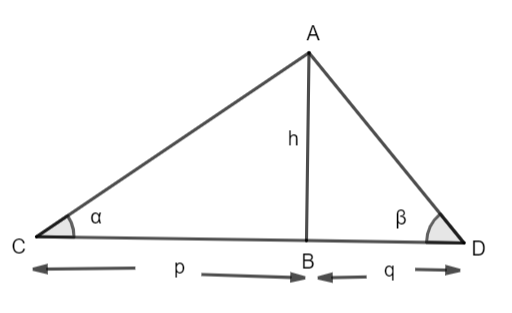
We are clearly given the height of the temple which is 30 metres. We need to find the base which is actually the distance between C and D. The distance is shown in the diagram as CD. Let us suppose here that Murali is standing on point D. This is because the point D represents angle $\beta $ which is ${{60}^{\circ }}$ and Teja is standing on the point C. This point C represents the angle ${{30}^{\circ }}$. We will suppose that the AB is the height of the temple which is 30 meters. And we are measuring the distance of Teja standing at point C from point B. Also we will measure the distance of Murali from point B to D where he is standing. For that we consider CB as p meters and BD as q meters.
The diagram is now illustrated as shown below.
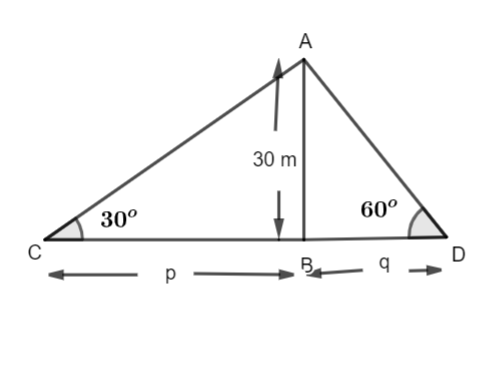
We will solve this question with the help of trigonometric ratios. But here we need to select as to which trigonometric operation will solve this question. For that we will watch the figure again. In the diagram we are given just the height and the base is considered by us. Therefore we will select that trigonometric operation which includes height and the base. So clearly we need tan operator here. Now, for measuring distance CB we have
$\begin{align}
& \tan \left( \alpha \right)=\dfrac{\text{perpendicular}}{\text{base}} \\
& \Rightarrow \tan \left( \alpha \right)=\dfrac{h}{p} \\
& \Rightarrow \tan \left( \alpha \right)=\dfrac{h}{p} \\
& \Rightarrow \tan \left( \alpha \right)=\dfrac{30}{p} \\
\end{align}$
We have the angle $\alpha ={{30}^{\circ }}$.
$\begin{align}
& \Rightarrow \tan \left( {{30}^{\circ }} \right)=\dfrac{30}{p} \\
& \Rightarrow p=\dfrac{30}{\tan \left( {{30}^{\circ }} \right)} \\
\end{align}$
As the value of $\tan \left( {{30}^{\circ }} \right)$ is $\dfrac{1}{\sqrt{3}}$.
$\begin{align}
& \Rightarrow p=\dfrac{30}{\tan \left( {{30}^{\circ }} \right)} \\
& \Rightarrow p=\dfrac{30}{\dfrac{1}{\sqrt{3}}} \\
& \Rightarrow p=\dfrac{30}{1}\times \dfrac{\sqrt{3}}{1} \\
& \Rightarrow p=30\sqrt{3} \\
\end{align}$
Now, we will for measuring distance BD we have
$\begin{align}
& \tan \left( \beta \right)=\dfrac{\text{perpendicular}}{\text{base}} \\
& \Rightarrow \tan \left( \beta \right)=\dfrac{h}{q} \\
& \Rightarrow \tan \left( \beta \right)=\dfrac{h}{q} \\
& \Rightarrow \tan \left( \beta \right)=\dfrac{30}{q} \\
\end{align}$
We have the angle $\beta ={{60}^{\circ }}$. Therefore, we have
$\begin{align}
& \Rightarrow \tan \left( {{60}^{\circ }} \right)=\dfrac{30}{q} \\
& \Rightarrow q=\dfrac{30}{\tan \left( {{60}^{\circ }} \right)} \\
\end{align}$
As the value of $\tan \left( {{60}^{\circ }} \right)$ is $\sqrt{3}$.
$\begin{align}
& \Rightarrow q=\dfrac{30}{\tan \left( {{60}^{\circ }} \right)} \\
& \Rightarrow q=\dfrac{30}{\sqrt{3}} \\
& \Rightarrow q=\dfrac{30}{1}\times \dfrac{1}{\sqrt{3}} \\
& \Rightarrow q=\dfrac{30}{\sqrt{3}} \\
\end{align}$
After rationalizing we have,
$\begin{align}
& \Rightarrow q=\dfrac{30\sqrt{3}}{3} \\
& \Rightarrow q=10\sqrt{3} \\
\end{align}$
Therefore, the distance between C and D is given by the sum of p + q. That is $10\sqrt{3}+30\sqrt{3}$ which is $40\sqrt{3}$.
Note: We could also have selected sine or cosine operations but only if we had given the values of the two hypotenuses given in the figure. The distance can never be negative. If by chance the distance is coming as a negative value then one needs to check the mistake.
Complete step-by-step solution -
The diagram for the question is given below.
We are clearly given the height of the temple which is 30 metres. We need to find the base which is actually the distance between C and D. The distance is shown in the diagram as CD. Let us suppose here that Murali is standing on point D. This is because the point D represents angle $\beta $ which is ${{60}^{\circ }}$ and Teja is standing on the point C. This point C represents the angle ${{30}^{\circ }}$. We will suppose that the AB is the height of the temple which is 30 meters. And we are measuring the distance of Teja standing at point C from point B. Also we will measure the distance of Murali from point B to D where he is standing. For that we consider CB as p meters and BD as q meters.
The diagram is now illustrated as shown below.
We will solve this question with the help of trigonometric ratios. But here we need to select as to which trigonometric operation will solve this question. For that we will watch the figure again. In the diagram we are given just the height and the base is considered by us. Therefore we will select that trigonometric operation which includes height and the base. So clearly we need tan operator here. Now, for measuring distance CB we have
$\begin{align}
& \tan \left( \alpha \right)=\dfrac{\text{perpendicular}}{\text{base}} \\
& \Rightarrow \tan \left( \alpha \right)=\dfrac{h}{p} \\
& \Rightarrow \tan \left( \alpha \right)=\dfrac{h}{p} \\
& \Rightarrow \tan \left( \alpha \right)=\dfrac{30}{p} \\
\end{align}$
We have the angle $\alpha ={{30}^{\circ }}$.
$\begin{align}
& \Rightarrow \tan \left( {{30}^{\circ }} \right)=\dfrac{30}{p} \\
& \Rightarrow p=\dfrac{30}{\tan \left( {{30}^{\circ }} \right)} \\
\end{align}$
As the value of $\tan \left( {{30}^{\circ }} \right)$ is $\dfrac{1}{\sqrt{3}}$.
$\begin{align}
& \Rightarrow p=\dfrac{30}{\tan \left( {{30}^{\circ }} \right)} \\
& \Rightarrow p=\dfrac{30}{\dfrac{1}{\sqrt{3}}} \\
& \Rightarrow p=\dfrac{30}{1}\times \dfrac{\sqrt{3}}{1} \\
& \Rightarrow p=30\sqrt{3} \\
\end{align}$
Now, we will for measuring distance BD we have
$\begin{align}
& \tan \left( \beta \right)=\dfrac{\text{perpendicular}}{\text{base}} \\
& \Rightarrow \tan \left( \beta \right)=\dfrac{h}{q} \\
& \Rightarrow \tan \left( \beta \right)=\dfrac{h}{q} \\
& \Rightarrow \tan \left( \beta \right)=\dfrac{30}{q} \\
\end{align}$
We have the angle $\beta ={{60}^{\circ }}$. Therefore, we have
$\begin{align}
& \Rightarrow \tan \left( {{60}^{\circ }} \right)=\dfrac{30}{q} \\
& \Rightarrow q=\dfrac{30}{\tan \left( {{60}^{\circ }} \right)} \\
\end{align}$
As the value of $\tan \left( {{60}^{\circ }} \right)$ is $\sqrt{3}$.
$\begin{align}
& \Rightarrow q=\dfrac{30}{\tan \left( {{60}^{\circ }} \right)} \\
& \Rightarrow q=\dfrac{30}{\sqrt{3}} \\
& \Rightarrow q=\dfrac{30}{1}\times \dfrac{1}{\sqrt{3}} \\
& \Rightarrow q=\dfrac{30}{\sqrt{3}} \\
\end{align}$
After rationalizing we have,
$\begin{align}
& \Rightarrow q=\dfrac{30\sqrt{3}}{3} \\
& \Rightarrow q=10\sqrt{3} \\
\end{align}$
Therefore, the distance between C and D is given by the sum of p + q. That is $10\sqrt{3}+30\sqrt{3}$ which is $40\sqrt{3}$.
Note: We could also have selected sine or cosine operations but only if we had given the values of the two hypotenuses given in the figure. The distance can never be negative. If by chance the distance is coming as a negative value then one needs to check the mistake.
Recently Updated Pages
Three beakers labelled as A B and C each containing 25 mL of water were taken A small amount of NaOH anhydrous CuSO4 and NaCl were added to the beakers A B and C respectively It was observed that there was an increase in the temperature of the solutions contained in beakers A and B whereas in case of beaker C the temperature of the solution falls Which one of the following statements isarecorrect i In beakers A and B exothermic process has occurred ii In beakers A and B endothermic process has occurred iii In beaker C exothermic process has occurred iv In beaker C endothermic process has occurred

Master Class 10 Social Science: Engaging Questions & Answers for Success
Master Class 10 Science: Engaging Questions & Answers for Success
Master Class 10 Maths: Engaging Questions & Answers for Success
Master Class 10 General Knowledge: Engaging Questions & Answers for Success
Master Class 10 Computer Science: Engaging Questions & Answers for Success
Three beakers labelled as A B and C each containing 25 mL of water were taken A small amount of NaOH anhydrous CuSO4 and NaCl were added to the beakers A B and C respectively It was observed that there was an increase in the temperature of the solutions contained in beakers A and B whereas in case of beaker C the temperature of the solution falls Which one of the following statements isarecorrect i In beakers A and B exothermic process has occurred ii In beakers A and B endothermic process has occurred iii In beaker C exothermic process has occurred iv In beaker C endothermic process has occurred
Master Class 10 Social Science: Engaging Questions & Answers for Success
Master Class 10 Science: Engaging Questions & Answers for Success
Trending doubts
Explain the Treaty of Vienna of 1815 class 10 social science CBSE
In cricket, what is the term for a bowler taking five wickets in an innings?
Who Won 36 Oscar Awards? Record Holder Revealed
What is the name of Japan Parliament?
What is the median of the first 10 natural numbers class 10 maths CBSE
Why is it 530 pm in india when it is 1200 afternoon class 10 social science CBSE