




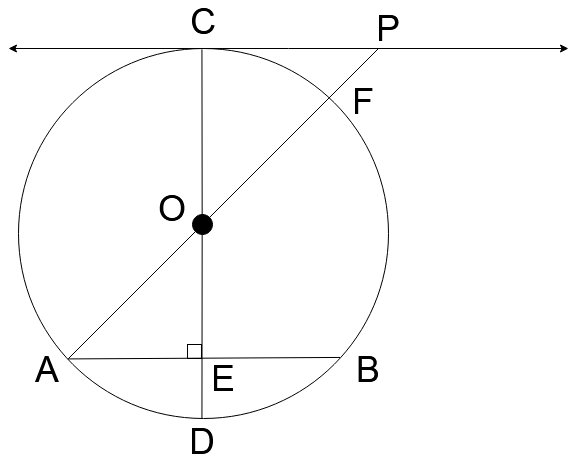
Tangent $\overleftrightarrow {PC}$ intersects the circle $O$ at $C$ , chord $\overline {AB} ||\overleftrightarrow {CP}$ , diameter $\overline {COD} $ intersects $\overline {AB} $ at $E$ , and diameter $\overline {AOF} $ is extended to $P$ . If $\angle OAE = 30^\circ $ , find $mF\overset{\lower0.5em\hbox{$\smash{\scriptscriptstyle\frown}$}}{B} $ and $mB\overset{\lower0.5em\hbox{$\smash{\scriptscriptstyle\frown}$}}{D} $ .
Answer
 Verified
644.7k+ views
Hint: You can start by explaining why we need to calculate the angles corresponding to the given arcs and write the equation for finding the length of the arc, i.e. Length of an arc \[ = 2\pi r\dfrac{n}{{360}}\] . Then calculate the angle \[\angle AOE\] by using the property of the triangle that states that the sum of all the angles in a triangle is \[180^\circ \] . Then use the concept of vertically opposite angles to find \[\angle COF\] . Then calculate the values of \[\angle FOB\] and \[\angle BOD\] . Then put these values in the equation Length of an arc \[ = 2\pi r\dfrac{n}{{360}}\] to reach the solution.
Complete step by step answer:
Let’s start the solution by redrawing the above diagram in the following manner -
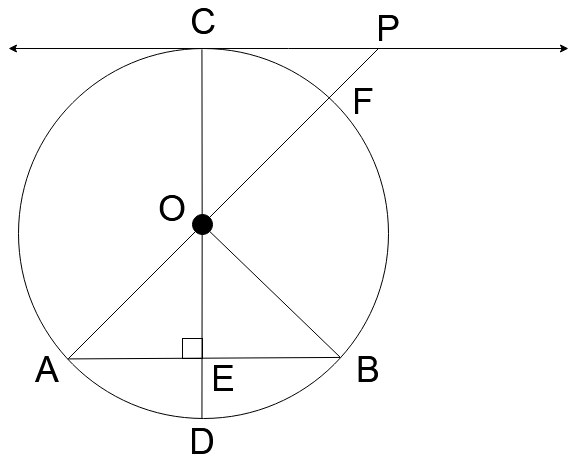
Now, in this problem, we have to find $mF\overset{\lower0.5em\hbox{$\smash{\scriptscriptstyle\frown}$}}{B} $ and $mB\overset{\lower0.5em\hbox{$\smash{\scriptscriptstyle\frown}$}}{D} $ . Both of these are arcs and we know for a fact that the length of an arc can be calculated by using the angle which the two ends points of the arc make at the center. For this, we use the following equation
Length of an arc \[ = 2\pi r\dfrac{n}{{360}}\] (Equation 1)
Here, \[n = \] the angle that the two endpoints of the arc make at the center
So in this case to calculate $mF\overset{\lower0.5em\hbox{$\smash{\scriptscriptstyle\frown}$}}{B} $ we have to calculate \[\angle FOB\] and to find out $mB\overset{\lower0.5em\hbox{$\smash{\scriptscriptstyle\frown}$}}{D} $ , we have to calculate the value of \[\angle BOD\] .
To solve this question we will first use a very interesting property of triangles. A triangle has 3 angles and the sum of all the three angles is always equal to \[180^\circ \] .
So, we now know that in $\Delta AOE$
$\angle AOE + \angle OEA + \angle OAE = 180^\circ $
Given in the problem,
\[\angle OAE = 30^\circ \]
\[\angle OEA = 90^\circ \] (Chords are always perpendicular to the radius)
So, \[\angle AOE + 90^\circ + 30^\circ = 180^\circ \]
\[\angle AOE = 60^\circ \]
We can also say that
\[\angle AOE = \angle COF = 60^\circ \] (Vertically opposite angles)
Now,
$\because \angle AEO = \angle OEB = 90^\circ $
$\because OE = OE$ (Common)
$\because OA = OB = $ Radius
$\therefore \Delta AOE \cong \Delta OBE$
$\therefore \angle AOE = \angle EOB = 60^\circ $
We, also know
$\angle AOE + \angle FOB + \angle EOB = 180^\circ $ (They all lie on a straight line)
$\therefore \angle FOB = 60^\circ $
So using equation 1 to calculate the value of $mF\overset{\lower0.5em\hbox{$\smash{\scriptscriptstyle\frown}$}}{B} $ , we get
\[mF\overset{\lower0.5em\hbox{$\smash{\scriptscriptstyle\frown}$}}{B} = 2\pi r\dfrac{{60}}{{360}}\]
\[mF\overset{\lower0.5em\hbox{$\smash{\scriptscriptstyle\frown}$}}{B} = \dfrac{1}{3}\pi r\]
Also, \[\angle EOB = \angle BOD = 60^\circ \]
So using equation 1 to calculate the value of $mB\overset{\lower0.5em\hbox{$\smash{\scriptscriptstyle\frown}$}}{D} $ , we get
\[mB\overset{\lower0.5em\hbox{$\smash{\scriptscriptstyle\frown}$}}{D} = 2\pi r\dfrac{{60}}{{360}}\]
\[mB\overset{\lower0.5em\hbox{$\smash{\scriptscriptstyle\frown}$}}{D} = \dfrac{1}{3}\pi r\]
Hence, $mF\overset{\lower0.5em\hbox{$\smash{\scriptscriptstyle\frown}$}}{B} $ and $mB\overset{\lower0.5em\hbox{$\smash{\scriptscriptstyle\frown}$}}{D} $ are both equal to \[\dfrac{1}{3}\pi r\] .
Note: In such a type of problem we can easily solve by using the basic properties of arcs in a circle. But, it is especially very important to remember what symbols represent what part. For example, we are given \[\overleftrightarrow {PC}\] that represents a tangent, \[\overline {COD} \] that represents a diameter, \[\overline {AB} \] represents a chord, and $mF\overset{\lower0.5em\hbox{$\smash{\scriptscriptstyle\frown}$}}{B} $ represents an arc.
Complete step by step answer:
Let’s start the solution by redrawing the above diagram in the following manner -
Now, in this problem, we have to find $mF\overset{\lower0.5em\hbox{$\smash{\scriptscriptstyle\frown}$}}{B} $ and $mB\overset{\lower0.5em\hbox{$\smash{\scriptscriptstyle\frown}$}}{D} $ . Both of these are arcs and we know for a fact that the length of an arc can be calculated by using the angle which the two ends points of the arc make at the center. For this, we use the following equation
Length of an arc \[ = 2\pi r\dfrac{n}{{360}}\] (Equation 1)
Here, \[n = \] the angle that the two endpoints of the arc make at the center
So in this case to calculate $mF\overset{\lower0.5em\hbox{$\smash{\scriptscriptstyle\frown}$}}{B} $ we have to calculate \[\angle FOB\] and to find out $mB\overset{\lower0.5em\hbox{$\smash{\scriptscriptstyle\frown}$}}{D} $ , we have to calculate the value of \[\angle BOD\] .
To solve this question we will first use a very interesting property of triangles. A triangle has 3 angles and the sum of all the three angles is always equal to \[180^\circ \] .
So, we now know that in $\Delta AOE$
$\angle AOE + \angle OEA + \angle OAE = 180^\circ $
Given in the problem,
\[\angle OAE = 30^\circ \]
\[\angle OEA = 90^\circ \] (Chords are always perpendicular to the radius)
So, \[\angle AOE + 90^\circ + 30^\circ = 180^\circ \]
\[\angle AOE = 60^\circ \]
We can also say that
\[\angle AOE = \angle COF = 60^\circ \] (Vertically opposite angles)
Now,
$\because \angle AEO = \angle OEB = 90^\circ $
$\because OE = OE$ (Common)
$\because OA = OB = $ Radius
$\therefore \Delta AOE \cong \Delta OBE$
$\therefore \angle AOE = \angle EOB = 60^\circ $
We, also know
$\angle AOE + \angle FOB + \angle EOB = 180^\circ $ (They all lie on a straight line)
$\therefore \angle FOB = 60^\circ $
So using equation 1 to calculate the value of $mF\overset{\lower0.5em\hbox{$\smash{\scriptscriptstyle\frown}$}}{B} $ , we get
\[mF\overset{\lower0.5em\hbox{$\smash{\scriptscriptstyle\frown}$}}{B} = 2\pi r\dfrac{{60}}{{360}}\]
\[mF\overset{\lower0.5em\hbox{$\smash{\scriptscriptstyle\frown}$}}{B} = \dfrac{1}{3}\pi r\]
Also, \[\angle EOB = \angle BOD = 60^\circ \]
So using equation 1 to calculate the value of $mB\overset{\lower0.5em\hbox{$\smash{\scriptscriptstyle\frown}$}}{D} $ , we get
\[mB\overset{\lower0.5em\hbox{$\smash{\scriptscriptstyle\frown}$}}{D} = 2\pi r\dfrac{{60}}{{360}}\]
\[mB\overset{\lower0.5em\hbox{$\smash{\scriptscriptstyle\frown}$}}{D} = \dfrac{1}{3}\pi r\]
Hence, $mF\overset{\lower0.5em\hbox{$\smash{\scriptscriptstyle\frown}$}}{B} $ and $mB\overset{\lower0.5em\hbox{$\smash{\scriptscriptstyle\frown}$}}{D} $ are both equal to \[\dfrac{1}{3}\pi r\] .
Note: In such a type of problem we can easily solve by using the basic properties of arcs in a circle. But, it is especially very important to remember what symbols represent what part. For example, we are given \[\overleftrightarrow {PC}\] that represents a tangent, \[\overline {COD} \] that represents a diameter, \[\overline {AB} \] represents a chord, and $mF\overset{\lower0.5em\hbox{$\smash{\scriptscriptstyle\frown}$}}{B} $ represents an arc.
Recently Updated Pages
Basicity of sulphurous acid and sulphuric acid are

Master Class 11 English: Engaging Questions & Answers for Success
Master Class 11 Physics: Engaging Questions & Answers for Success
Master Class 11 Computer Science: Engaging Questions & Answers for Success
Master Class 11 Chemistry: Engaging Questions & Answers for Success
Master Class 11 Social Science: Engaging Questions & Answers for Success
Trending doubts
Difference Between Prokaryotic Cells and Eukaryotic Cells
Two of the body parts which do not appear in MRI are class 11 biology CBSE
One Metric ton is equal to kg A 10000 B 1000 C 100 class 11 physics CBSE
10 examples of friction in our daily life
Draw a diagram of nephron and explain its structur class 11 biology CBSE
What will happen if the mucus is not secreted by the class 11 biology CBSE