




How will you synthesize benzoic acid from bromobenzene.
Answer
 Verified
599.1k+ views
Hint: Before answering this question, one should know about benzoic acid and bromobenzene. Benzoic acid is an aromatic carboxylic acid. It is found naturally in many plants Bromobenzene is an unsaturated compound that can readily undergo an addition reaction.
Complete answer:
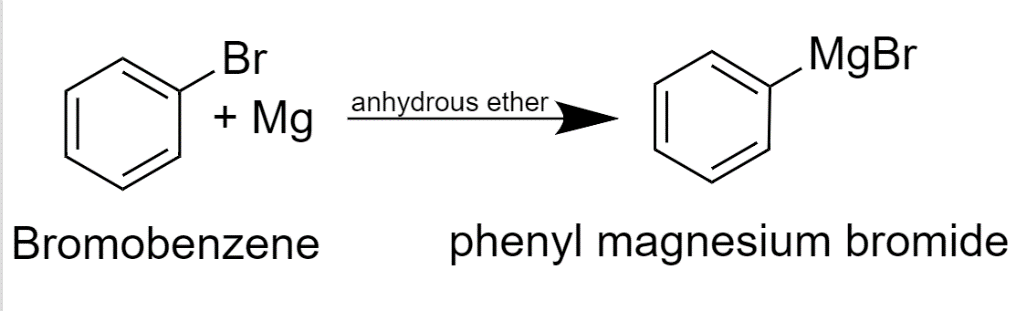
In this Grignard reagent, phenylmagnesium bromide is prepared with the help of bromobenzene and Mg metal in which diethyl ether is used as a solvent and there are some anhydrous conditions. The diethyl ether is used as a solvent to make Grignard reagents is important as the Partial positive charge on Mg in the Grignard reagent is stabilized by lone pairs of electrons on the oxygen to make sure it formed. In inert solvents, Grignard reagents are not formed. In nucleophilic addition reactions, diethyl ether or tetrahydrofuran functions well as a solvent because ether is not reactive with other reactants.
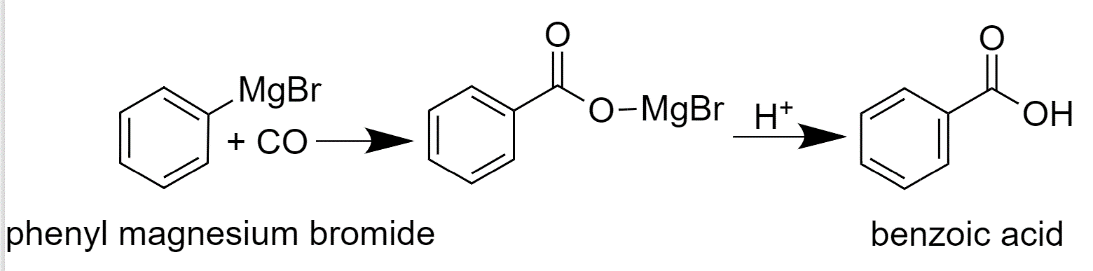
Phenyl magnesium bromide is then reacted with $C{{O}_{2}}$. After this, it will undergo hydrolysis and will give Benzoic acid.
Note:
The Carbon of the Grignard reagent shows two characteristics :
It acts as a nucleophile for the reaction with Carbon dioxide as a carbanion.
It acts as a strong base too as it reacts with acidic hydrogen atoms to give an alkane.
RMgX + HA = RH + MgAX
The structure of the Grignard reagent is represented as a partly ionic compound $\delta R...MgX\delta -+$Water, alcohols, terminal acetylenes, phenols, and carboxylic acids are some compounds that have acidic hydrogen and they will be readily donating a proton to destroy the reagent.
Complete answer:
In this Grignard reagent, phenylmagnesium bromide is prepared with the help of bromobenzene and Mg metal in which diethyl ether is used as a solvent and there are some anhydrous conditions. The diethyl ether is used as a solvent to make Grignard reagents is important as the Partial positive charge on Mg in the Grignard reagent is stabilized by lone pairs of electrons on the oxygen to make sure it formed. In inert solvents, Grignard reagents are not formed. In nucleophilic addition reactions, diethyl ether or tetrahydrofuran functions well as a solvent because ether is not reactive with other reactants.
Phenyl magnesium bromide is then reacted with $C{{O}_{2}}$. After this, it will undergo hydrolysis and will give Benzoic acid.
Note:
The Carbon of the Grignard reagent shows two characteristics :
It acts as a nucleophile for the reaction with Carbon dioxide as a carbanion.
It acts as a strong base too as it reacts with acidic hydrogen atoms to give an alkane.
RMgX + HA = RH + MgAX
The structure of the Grignard reagent is represented as a partly ionic compound $\delta R...MgX\delta -+$Water, alcohols, terminal acetylenes, phenols, and carboxylic acids are some compounds that have acidic hydrogen and they will be readily donating a proton to destroy the reagent.
Recently Updated Pages
Write structures of the following compounds i 2 Chloro3methylpentane class 11 chemistry CBSE

What is BLO What is the full form of BLO class 8 social science CBSE
Explain the Treaty of Vienna of 1815 class 10 social science CBSE
A Paragraph on Pollution in about 100-150 Words
XIX+XXX A 49 B 51 C 55 D 44 class 5 maths CBSE
If x a + bt + ct2 where x is in meters and t is in class 11 physics CBSE
Trending doubts
One Metric ton is equal to kg A 10000 B 1000 C 100 class 11 physics CBSE
Find the value of the expression given below sin 30circ class 11 maths CBSE
What do you mean by retardation What is its SI uni class 11 physics CBSE
Draw a diagram of nephron and explain its structur class 11 biology CBSE
10 examples of friction in our daily life
Difference between physical and chemical change class 11 chemistry CBSE