




Syngenesious condition is found in the family
(a) Liliaceae
(b) Malvaceae
(c) Compositae
(d) Cruciferae
Answer
 Verified
627.3k+ views
Hint: The condition is found in the plants belonging to one of the largest plant families and the plants of this family are primarily famous as garden ornamentals.
Complete Answer:
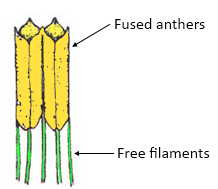
Syngenesious types of stamens are found in the plant family Compositae or Asteraceae in which the anthers are united but their stalks are free. The united anthers form a tube-like
structure.
Compositae is considered as one of the largest plant families to which many ornamental plants belong. In the flowers of the plants belonging to this family, there are five stamens that remain fused to corolla while the anthers are found in connate or syngenesious condition. In this way, a short tube is formed around the style. The pollens are released inside this tube and get collected around the growing style. When the style grows and elongates, it is pushed out of this tube.
The image representing syngenesious condition has been given below -
Additional information:
Features of Compositae: -Compositae is a large group of flowering plants.
-They are hydrophytes, xerophytes, and semi-aquatic.
-The stem can be erect, woody, hairy, and may sometimes have latex.
-The leaf is exstipulate, petiolate, radical.
-Androecium will be absent and gynaeceum may be present or absent.
-It produces endospermic seeds
So, the correct answer is ‘Compositae’.
Note: The angiosperms are of different types such as Asteraceae, Brassicaceae, and Poaceae. Compositae/ Asteraceae is predominantly an ornamental plant like Dahlias, Cosmos, Dandelion and many of them also have medicinal values.
Complete Answer:
Syngenesious types of stamens are found in the plant family Compositae or Asteraceae in which the anthers are united but their stalks are free. The united anthers form a tube-like
structure.
Compositae is considered as one of the largest plant families to which many ornamental plants belong. In the flowers of the plants belonging to this family, there are five stamens that remain fused to corolla while the anthers are found in connate or syngenesious condition. In this way, a short tube is formed around the style. The pollens are released inside this tube and get collected around the growing style. When the style grows and elongates, it is pushed out of this tube.
The image representing syngenesious condition has been given below -
Additional information:
Features of Compositae: -Compositae is a large group of flowering plants.
-They are hydrophytes, xerophytes, and semi-aquatic.
-The stem can be erect, woody, hairy, and may sometimes have latex.
-The leaf is exstipulate, petiolate, radical.
-Androecium will be absent and gynaeceum may be present or absent.
-It produces endospermic seeds
So, the correct answer is ‘Compositae’.
Note: The angiosperms are of different types such as Asteraceae, Brassicaceae, and Poaceae. Compositae/ Asteraceae is predominantly an ornamental plant like Dahlias, Cosmos, Dandelion and many of them also have medicinal values.
Recently Updated Pages
Master Class 12 Economics: Engaging Questions & Answers for Success

Master Class 12 English: Engaging Questions & Answers for Success
Master Class 12 Social Science: Engaging Questions & Answers for Success
Master Class 12 Maths: Engaging Questions & Answers for Success
Master Class 12 Physics: Engaging Questions & Answers for Success
Master Class 12 Business Studies: Engaging Questions & Answers for Success
Trending doubts
Which are the Top 10 Largest Countries of the World?
Draw a labelled sketch of the human eye class 12 physics CBSE
Differentiate between homogeneous and heterogeneous class 12 chemistry CBSE
Why is the cell called the structural and functional class 12 biology CBSE
Draw ray diagrams each showing i myopic eye and ii class 12 physics CBSE
Which is the correct genotypic ratio of mendel dihybrid class 12 biology CBSE