




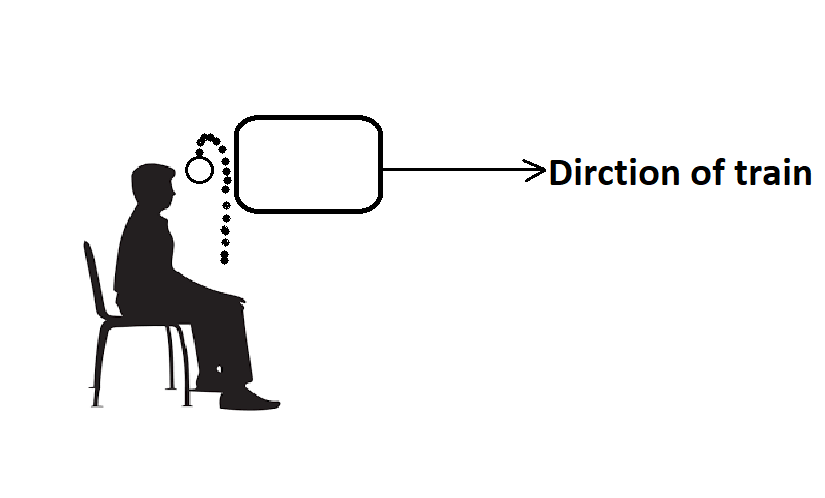
Suppose you are sitting in a high speed train like Jan Shatabdi express which is travelling with a uniform velocity. If you flip a coin as shown in the fig. you will observe that
A. The coin does not reach again in your hand
B. The coin reaches again in your hand
C. The coin falls behind you
D. The coin fall in front of you
Answer
 Verified
575.4k+ views
Hint: This question is an easy application of the concept of the relative motion. The coin will be having the horizontal velocity of the train due to the virtue of the relative motion. Relative velocity is the velocity of an object or observer B in another object or observer A's remaining frame.
Complete step by step answer:
So, if the coin is placed in the arm, zero is the relative shift between the train and the coin.
The force acting on the coin by frictional force as the coin flips, ceases operating on the palm and hand and starts to travel at the uniform speed at which it travelled horizontally at the time of flip.
As the train was running at a uniform pace, the distance travelled by the coin will be the same as yours and the train.
Or,
When the coin was kept at Palm, there was zero relative motion between the train and the coin.The force acting on the coin by frictional force, at the palm of the hand, started operating after the coin was flipped, and it begins to travel at the uniform speed at which it travelled horizontally at the time of flip. As the train was running at a uniform speed, the distance travelled by the coin would be the same as that of the rider and the train.
So, the correct answer is “Option B”.
Note: In daily life, the reference point is taken to be the ground or the earth when we calculate an object 's velocity. For instance, if you are riding on a train and the train is riding at a speed of 100 km / hr, your speed is zero according to another passenger sitting on that train.
Complete step by step answer:
So, if the coin is placed in the arm, zero is the relative shift between the train and the coin.
The force acting on the coin by frictional force as the coin flips, ceases operating on the palm and hand and starts to travel at the uniform speed at which it travelled horizontally at the time of flip.
As the train was running at a uniform pace, the distance travelled by the coin will be the same as yours and the train.
Or,
When the coin was kept at Palm, there was zero relative motion between the train and the coin.The force acting on the coin by frictional force, at the palm of the hand, started operating after the coin was flipped, and it begins to travel at the uniform speed at which it travelled horizontally at the time of flip. As the train was running at a uniform speed, the distance travelled by the coin would be the same as that of the rider and the train.
So, the correct answer is “Option B”.
Note: In daily life, the reference point is taken to be the ground or the earth when we calculate an object 's velocity. For instance, if you are riding on a train and the train is riding at a speed of 100 km / hr, your speed is zero according to another passenger sitting on that train.
Recently Updated Pages
Master Class 11 Computer Science: Engaging Questions & Answers for Success

Master Class 11 Business Studies: Engaging Questions & Answers for Success
Master Class 11 Economics: Engaging Questions & Answers for Success
Master Class 11 English: Engaging Questions & Answers for Success
Master Class 11 Maths: Engaging Questions & Answers for Success
Master Class 11 Biology: Engaging Questions & Answers for Success
Trending doubts
One Metric ton is equal to kg A 10000 B 1000 C 100 class 11 physics CBSE
There are 720 permutations of the digits 1 2 3 4 5 class 11 maths CBSE
Discuss the various forms of bacteria class 11 biology CBSE
Draw a diagram of a plant cell and label at least eight class 11 biology CBSE
State the laws of reflection of light
10 examples of friction in our daily life