




Suppose U = { 3, 4, 5, 6, 7, 8, 9, 10, 11, 12, 13 } , A = { 3, 4, 5, 6, 9 } , B = { 3, 7, 9, 5 } and C =
{ 6, 8, 10, 12, 7 }. Write down the following set and draw Venn diagram for : A’
Answer
 Verified
623.4k+ views
Hint:- In this question first of all we have to assume that set U is a universal set in which both set A and set B are inscribed. And as we all know that if P is a universal set and set X is inscribed in P then X’ must be set P – set X.
Complete step-by-step answer:
Now let us assume U as a universal set.
So, U = { 3, 4, 5, 6, 7, 8, 9, 10, 11, 12, 13 }
And A = { 3, 4, 5, 6, 9 } , B = { 3, 7, 9, 5 } and C = { 6, 8, 10, 12, 7 }
Now as we all know that
A’ must be equal to the universal set – set A.
So, A’ = U – A or we can say that A’ must have all the other values of other sets that are inscribed in universal set U apart from set A.
Now the diagram given below will describe the set U, set A , set B and set C.
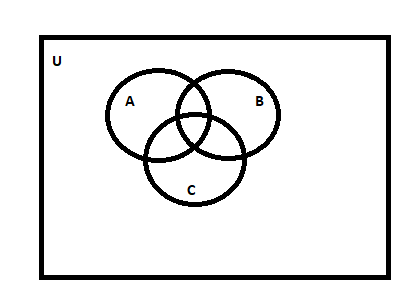
This diagram represents that sets A , B, C all are in the universal set U.
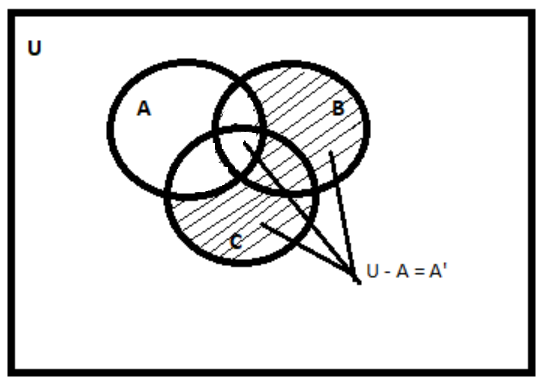
Now set A = { 3, 4, 5, 6, 9 } so set A’ = { 7, 8, 10, 11, 12 , 13 } which must be equal to all the values apart from set A.
Now let us highlight the A’ region in the Venn diagram by shading .
So, the diagram given below shows us the value or we can say the region of A’ .
Note:- Whenever we come up with this type of problem then always we have to keep in mind that the complement of any set here ( A’ ) is counted as a subtraction of the universal set and the set whose complement is asked in the question. The complement can also have the values such as \[A \cap B\], \[B \cap C\],\[C \cap A\] and \[A \cap B \cap C\] from the set but the only set A portion must not be included.
Complete step-by-step answer:
Now let us assume U as a universal set.
So, U = { 3, 4, 5, 6, 7, 8, 9, 10, 11, 12, 13 }
And A = { 3, 4, 5, 6, 9 } , B = { 3, 7, 9, 5 } and C = { 6, 8, 10, 12, 7 }
Now as we all know that
A’ must be equal to the universal set – set A.
So, A’ = U – A or we can say that A’ must have all the other values of other sets that are inscribed in universal set U apart from set A.
Now the diagram given below will describe the set U, set A , set B and set C.
This diagram represents that sets A , B, C all are in the universal set U.
Now set A = { 3, 4, 5, 6, 9 } so set A’ = { 7, 8, 10, 11, 12 , 13 } which must be equal to all the values apart from set A.
Now let us highlight the A’ region in the Venn diagram by shading .
So, the diagram given below shows us the value or we can say the region of A’ .
Note:- Whenever we come up with this type of problem then always we have to keep in mind that the complement of any set here ( A’ ) is counted as a subtraction of the universal set and the set whose complement is asked in the question. The complement can also have the values such as \[A \cap B\], \[B \cap C\],\[C \cap A\] and \[A \cap B \cap C\] from the set but the only set A portion must not be included.
Recently Updated Pages
Master Class 11 Social Science: Engaging Questions & Answers for Success

Master Class 11 English: Engaging Questions & Answers for Success
Master Class 11 Maths: Engaging Questions & Answers for Success
Master Class 11 Chemistry: Engaging Questions & Answers for Success
Master Class 11 Biology: Engaging Questions & Answers for Success
Master Class 11 Physics: Engaging Questions & Answers for Success
Trending doubts
Differentiate between an exothermic and an endothermic class 11 chemistry CBSE
One Metric ton is equal to kg A 10000 B 1000 C 100 class 11 physics CBSE
Difference Between Prokaryotic Cells and Eukaryotic Cells
There are 720 permutations of the digits 1 2 3 4 5 class 11 maths CBSE
Two of the body parts which do not appear in MRI are class 11 biology CBSE
Which gas is abundant in air class 11 chemistry CBSE