




Suppose the charge of a proton and an electron differ slightly. One of them is $ -e $ , the other is (e+ $ \Delta $ e). If the net of electrostatic force and gravitational force between two hydrogen atoms placed at a distance d (much greater than atomic size) apart is zero, then $ \Delta $ e is of the order of [Given mass of hydrogen $ {{m}_{h}}=1.67\times {{10}^{-27}}Kg $ ].
$ \left( A \right) $ $ {{10}^{-47}}C $
$ \left( B \right) $ $ {{10}^{-20}}C $
$ \left( C \right) $ $ {{10}^{-23}}C $
$ \left( D \right) $ $ {{10}^{-37}}C $
Answer
 Verified
549.9k+ views
Hint :We will be solving this question by comparing gravitational and electrostatic force. But before that we will brush up our concept regarding electrostatic force.The electrostatic force is one of the four fundamental forces of nature. Electrostatic force is an attractive and repulsive force between particles which are caused due to their electric charges. The electric force between a stationary charged body is conventionally known as the electrostatic force. It is also referred to as Coulomb’s force. This Coulomb interaction is named after the French physicist Charles-Augustin de Coulomb. Unit of Coulomb's force is Coulomb $ \left( C \right) $ .
Complete Step By Step Answer:
Here it is given that $ {{m}_{H}}=1.67\times {{10}^{-27}}kg $
Hydrogen atoms consist of one electron and one proton.
Net charge on hydrogen atom will be acting between two hydrogen atoms as
$ q=\left( e+\Delta e \right)-e=\Delta e $
Let the distance between them be $ d $ . as shown below.
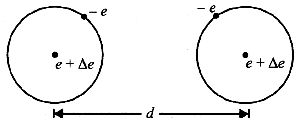
The gravitational force between two hydrogen atoms is given as below
$ {{F}_{g}}=\dfrac{G{{m}_{H}}^{2}}{{{r}^{2}}}...\left( 1 \right) $
The net electrostatic force between two H-atoms is given as
$ {{F}_{e}}=\dfrac{k{{\left( \Delta e \right)}^{2}}}{{{r}^{2}}}...\left( 2 \right) $
Where $ k $ is $ \dfrac{1}{4\pi {{\varepsilon }_{0}}}=9\times {{10}^{9}}N{{m}^{2}}{{C}^{-2}} $
As, the net force on the system is zero, Fe = Fg. Using eqns. (1) and (2), we will get
$ \dfrac{k{{\left( \Delta e \right)}^{2}}}{{{r}^{2}}}=\dfrac{G{{m}_{H}}^{2}}{{{r}^{2}}} $
$ \Delta e={{m}_{H}}\sqrt{\dfrac{G}{k}}=1.67\times {{10}^{-27}}\sqrt{\dfrac{6.67\times {{10}^{-11}}}{9\times {{10}^{9}}}}C $
$ \Delta e=1.436\times {{10}^{-37}}C $
Hence option $ \left( D \right) $ is the correct answer.
Note :
We use Coulomb's Law to solve the forces created by configurations of charge. There are many examples of electrostatic force. Few of them are listed below
The force of attraction of the plastic wrap to anyone’s hand and later when the hand is removed from the wrap, the attraction of paper to a charged scale or comb by rubbing to hair, the apparently spontaneous explosion of grain silos, photocopier & laser printer operation, etc.
Complete Step By Step Answer:
Here it is given that $ {{m}_{H}}=1.67\times {{10}^{-27}}kg $
Hydrogen atoms consist of one electron and one proton.
Net charge on hydrogen atom will be acting between two hydrogen atoms as
$ q=\left( e+\Delta e \right)-e=\Delta e $
Let the distance between them be $ d $ . as shown below.
The gravitational force between two hydrogen atoms is given as below
$ {{F}_{g}}=\dfrac{G{{m}_{H}}^{2}}{{{r}^{2}}}...\left( 1 \right) $
The net electrostatic force between two H-atoms is given as
$ {{F}_{e}}=\dfrac{k{{\left( \Delta e \right)}^{2}}}{{{r}^{2}}}...\left( 2 \right) $
Where $ k $ is $ \dfrac{1}{4\pi {{\varepsilon }_{0}}}=9\times {{10}^{9}}N{{m}^{2}}{{C}^{-2}} $
As, the net force on the system is zero, Fe = Fg. Using eqns. (1) and (2), we will get
$ \dfrac{k{{\left( \Delta e \right)}^{2}}}{{{r}^{2}}}=\dfrac{G{{m}_{H}}^{2}}{{{r}^{2}}} $
$ \Delta e={{m}_{H}}\sqrt{\dfrac{G}{k}}=1.67\times {{10}^{-27}}\sqrt{\dfrac{6.67\times {{10}^{-11}}}{9\times {{10}^{9}}}}C $
$ \Delta e=1.436\times {{10}^{-37}}C $
Hence option $ \left( D \right) $ is the correct answer.
Note :
We use Coulomb's Law to solve the forces created by configurations of charge. There are many examples of electrostatic force. Few of them are listed below
The force of attraction of the plastic wrap to anyone’s hand and later when the hand is removed from the wrap, the attraction of paper to a charged scale or comb by rubbing to hair, the apparently spontaneous explosion of grain silos, photocopier & laser printer operation, etc.
Recently Updated Pages
Master Class 12 Economics: Engaging Questions & Answers for Success

Master Class 12 English: Engaging Questions & Answers for Success
Master Class 12 Social Science: Engaging Questions & Answers for Success
Master Class 12 Maths: Engaging Questions & Answers for Success
Master Class 12 Physics: Engaging Questions & Answers for Success
Master Class 9 General Knowledge: Engaging Questions & Answers for Success
Trending doubts
One Metric ton is equal to kg A 10000 B 1000 C 100 class 11 physics CBSE
Difference Between Prokaryotic Cells and Eukaryotic Cells
Find the value of the expression given below sin 30circ class 11 maths CBSE
Two of the body parts which do not appear in MRI are class 11 biology CBSE
1 ton equals to A 100 kg B 1000 kg C 10 kg D 10000 class 11 physics CBSE
Draw a diagram of nephron and explain its structur class 11 biology CBSE