




Suppose ${T_1}$ is the time period of oscillation of a body suspended to a spring and ${T_2}$ is the time period of oscillation of the same body suspended to another spring. If same body suspended to series combination of same two springs, what is its time period of oscillation $?$
A. ${T_1} + {T_2}$
B. $\dfrac{{{T_1}{T_2}}}{{{T_1} + {T_2}}}$
C. \[\dfrac{{{T_1}{T_2}}}{{\sqrt {T_1^2 + T_2^2} }}\]
D. \[\sqrt {T_1^2 + T_2^2} \]
Answer
 Verified
510.6k+ views
Hint:In this question, we use the concept of series combination of springs when the body is suspended to it and oscillates. If two springs of spring constants \[{k_1}\] and \[{k_2}\] are joined in series, the resultant spring constant of the combination is given by
$\dfrac{1}{{{k_s}}} = \dfrac{1}{{{k_1}}} + \dfrac{1}{{{k_2}}}$
Formula used:
Time period of oscillation of a body attached to spring is given by
$T = 2\pi \sqrt {\dfrac{m}{k}} $
Where, $m$ - mass of the body / inertia factor and $k$ - spring constant of the spring.
Complete step by step answer:
Let us denote some terms to the given data for better understanding.
${T_1}$ - time period of oscillation of a body attached to the spring of constant ${k_1}$
${T_2}$ - time period of oscillation of a body attached to the spring of constant ${k_2}$
Writing the time period of oscillation for both springs,
${T_1} = 2\pi \sqrt {\dfrac{m}{{{k_1}}}} - - - - - - - - - - - - - (1)$
$\Rightarrow {T_2} = 2\pi \sqrt {\dfrac{m}{{{k_2}}}} - - - - - - - - - - - - - (2)$
$\Rightarrow T = 2\pi \sqrt {\dfrac{m}{{{k_s}}}} - - - - - - - - - - - - - (3)$
We have to calculate the combined period of oscillation when the body is attached to series combination of two springs as shown.
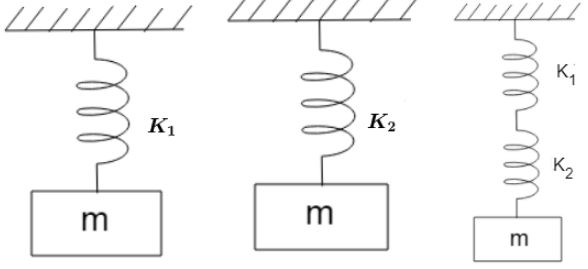
For series combination of springs, we have
$\dfrac{1}{{{k_s}}} = \dfrac{1}{{{k_1}}} + \dfrac{1}{{{k_2}}}$
$\Rightarrow {k_s} = \dfrac{{{k_1}{k_2}}}{{{k_1} + {k_2}}} - - - - - - - - - - - (4)$
Now, squaring eq$(1)$ and eq$(2)$ and adding, we get
$T_1^2 + T_2^2 = {\left( {2\pi } \right)^2}\left( {\dfrac{m}{{{k_1}}} + \dfrac{m}{{{k_2}}}} \right)$
$\Rightarrow T_1^2 + T_2^2 = {\left( {2\pi } \right)^2}\left( {\dfrac{{m({k_1} + {k_2})}}{{{k_1}{k_2}}}} \right)$
$\Rightarrow T_1^2 + T_2^2 = {\left( {2\pi } \right)^2}\left( {\dfrac{m}{{{k_s}}}} \right) - - - - - - - - - - $ From eq$(4)$
$\Rightarrow T_1^2 + T_2^2 = {T^2} - - - - - - - - - - $ From eq $(3)$
$\therefore T = \sqrt {T_1^2 + T_2^2} $
The combined time period of oscillation of the body attached to two springs is $T = \sqrt {T_1^2 + T_2^2} $.
Hence, option D is correct.
Additional information: If two springs of spring constants \[{k_1}\] and \[{k_2}\] are joined in parallel, the resultant spring constant of the combination is given by
\[{k_p} = {k_1} + {k_2}\]
Note:In this question, the same mass is suspended to the combination of springs, and hence, there is no change in mass of the body. The change will occur only in the spring constant of combined springs. There are two types of springs : Light spring and heavy spring.So, always look at what has been given in the question.In general, light springs are used. But, if the spring has mass $M$ and a mass $m$ is suspended from it, then the time period is given by
\[T = 2\pi \sqrt {\dfrac{{{M_{eff}}}}{k}} \], where ${M_{eff}} = m + \dfrac{M}{3}$.
$\dfrac{1}{{{k_s}}} = \dfrac{1}{{{k_1}}} + \dfrac{1}{{{k_2}}}$
Formula used:
Time period of oscillation of a body attached to spring is given by
$T = 2\pi \sqrt {\dfrac{m}{k}} $
Where, $m$ - mass of the body / inertia factor and $k$ - spring constant of the spring.
Complete step by step answer:
Let us denote some terms to the given data for better understanding.
${T_1}$ - time period of oscillation of a body attached to the spring of constant ${k_1}$
${T_2}$ - time period of oscillation of a body attached to the spring of constant ${k_2}$
Writing the time period of oscillation for both springs,
${T_1} = 2\pi \sqrt {\dfrac{m}{{{k_1}}}} - - - - - - - - - - - - - (1)$
$\Rightarrow {T_2} = 2\pi \sqrt {\dfrac{m}{{{k_2}}}} - - - - - - - - - - - - - (2)$
$\Rightarrow T = 2\pi \sqrt {\dfrac{m}{{{k_s}}}} - - - - - - - - - - - - - (3)$
We have to calculate the combined period of oscillation when the body is attached to series combination of two springs as shown.
For series combination of springs, we have
$\dfrac{1}{{{k_s}}} = \dfrac{1}{{{k_1}}} + \dfrac{1}{{{k_2}}}$
$\Rightarrow {k_s} = \dfrac{{{k_1}{k_2}}}{{{k_1} + {k_2}}} - - - - - - - - - - - (4)$
Now, squaring eq$(1)$ and eq$(2)$ and adding, we get
$T_1^2 + T_2^2 = {\left( {2\pi } \right)^2}\left( {\dfrac{m}{{{k_1}}} + \dfrac{m}{{{k_2}}}} \right)$
$\Rightarrow T_1^2 + T_2^2 = {\left( {2\pi } \right)^2}\left( {\dfrac{{m({k_1} + {k_2})}}{{{k_1}{k_2}}}} \right)$
$\Rightarrow T_1^2 + T_2^2 = {\left( {2\pi } \right)^2}\left( {\dfrac{m}{{{k_s}}}} \right) - - - - - - - - - - $ From eq$(4)$
$\Rightarrow T_1^2 + T_2^2 = {T^2} - - - - - - - - - - $ From eq $(3)$
$\therefore T = \sqrt {T_1^2 + T_2^2} $
The combined time period of oscillation of the body attached to two springs is $T = \sqrt {T_1^2 + T_2^2} $.
Hence, option D is correct.
Additional information: If two springs of spring constants \[{k_1}\] and \[{k_2}\] are joined in parallel, the resultant spring constant of the combination is given by
\[{k_p} = {k_1} + {k_2}\]
Note:In this question, the same mass is suspended to the combination of springs, and hence, there is no change in mass of the body. The change will occur only in the spring constant of combined springs. There are two types of springs : Light spring and heavy spring.So, always look at what has been given in the question.In general, light springs are used. But, if the spring has mass $M$ and a mass $m$ is suspended from it, then the time period is given by
\[T = 2\pi \sqrt {\dfrac{{{M_{eff}}}}{k}} \], where ${M_{eff}} = m + \dfrac{M}{3}$.
Recently Updated Pages
Master Class 11 Computer Science: Engaging Questions & Answers for Success

Master Class 11 Business Studies: Engaging Questions & Answers for Success
Master Class 11 Economics: Engaging Questions & Answers for Success
Master Class 11 English: Engaging Questions & Answers for Success
Master Class 11 Maths: Engaging Questions & Answers for Success
Master Class 11 Biology: Engaging Questions & Answers for Success
Trending doubts
One Metric ton is equal to kg A 10000 B 1000 C 100 class 11 physics CBSE
There are 720 permutations of the digits 1 2 3 4 5 class 11 maths CBSE
Discuss the various forms of bacteria class 11 biology CBSE
Draw a diagram of a plant cell and label at least eight class 11 biology CBSE
State the laws of reflection of light
10 examples of friction in our daily life