




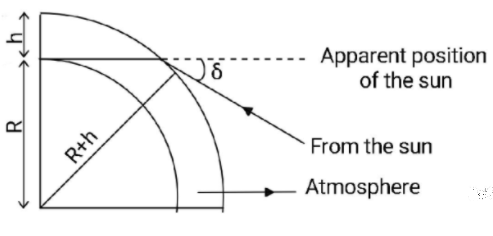
When the sun is either rising or setting and appears to be just on the horizon, it is in fact below the horizon. The explanation for this seeming paradox is that light from the sun bends slightly when entering the earth’s atmosphere as shown in figure. Assume that the atmosphere has uniform density and hence uniform index of refraction $n$ and extends to a height $h$ above the earth’s surface, at which point it abruptly stops. The angle $\delta $ above the Sun’s true position is given by
(A) \[{\sin ^{ - 1}}\left( {\dfrac{{nR}}{{R + h}}} \right)\]
(B) ${\sin ^{ - 1}}\left( {\dfrac{R}{{R + h}}} \right)$
(C) \[{\sin ^{ - 1}}\left( {\dfrac{{nR}}{{R + h}}} \right) + {\sin ^{ - 1}}\left( {\dfrac{R}{{R + h}}}
\right)\]
(D) \[{\sin ^{ - 1}}\left( {\dfrac{{nR}}{{R + h}}} \right) - {\sin ^{ - 1}}\left( {\dfrac{R}{{R + h}}}
\right)\]
Answer
 Verified
573k+ views
Hint:The actual position of the sun is below the horizon. The reason that it appears to be seen above the horizon is given that the light from the sun bends as it enters the atmosphere. The deflection at the interface of two mediums of a light is known as refraction. Think of what rules or laws related to refraction can be applied in order to get equations expressing the angle $\delta $.
After deriving the expression, apply the knowledge of geometry on the given figure to express the angle $\delta $ explicitly.
Complete step by step solution:
Consider the ray hitting the space atmosphere interface. As the light from the sun hits the interface, it will refract and get diverged from its original path. Here, we can use the Snell’s Law. Snell’s Law gives you the relation between the angle of incidence, angle of refraction and the refractive index of the two mediums, in this case, the space and the atmosphere. Consider a normal passing through the centre of earth and the point of incidence of the light ray.
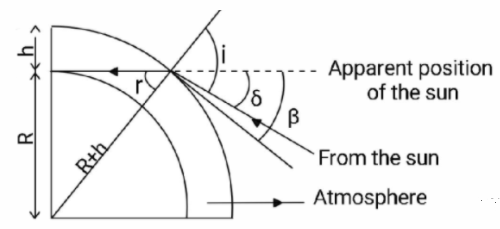
As the Snell’s Law is given as ${n_1}\sin i = {n_2}\sin r$, where ${n_1}\& {n_2}$ are the refractive index of the mediums, $i$ is the angle of incidence and $r$ is the angle of refraction.
If we compare this with our situation, ${n_1} = 1$ as it will be vacuum and ${n_2} = n$ which is given.
Here, the line representing the apparent position of the sun is the line of horizon and the line which is extending an angle of $\beta $ with the line of horizon is perpendicular to the normal. So, from Snell’s law, we have $\left( 1 \right)\sin i = \left( n \right)\sin r$. From figure, you can see that \[\sin r = \dfrac{R}{{R + h}}\]
$\therefore \sin i = n\left( {\dfrac{R}{{R + h}}} \right) = \dfrac{{nR}}{{R + h}} \Rightarrow i = {\sin
^{ - 1}}\left( {\dfrac{{nR}}{{R + h}}} \right)$
Now, let us apply geometry. If you observe the diagram carefully, you can see that the normal line and the line of horizon make a pair of opposite angles. One of them is $r$ and the other has to be $i
- \delta $. As we know that opposite angles must be equal, $\therefore r = i - \delta $$ \to \delta =
i - r$$...\left( 1 \right)$
Since \[\sin r = \dfrac{R}{{R + h}}\], therefore we have $r = {\sin ^{ - 1}}\left( {\dfrac{R}{{R + h}}}
\right)$.
Substituting the values of $i\& r$ in equation $\left( 1 \right)$, we will get,
$\delta = {\sin ^{ - 1}}\left( {\dfrac{{nR}}{{R + h}}} \right) - {\sin ^{ - 1}}\left( {\dfrac{R}{{R + h}}}
\right)$
Therefore, the angle $\delta $ above the Sun’s true position is given by ${\sin ^{ - 1}}\left(
{\dfrac{{nR}}{{R + h}}} \right) - {\sin ^{ - 1}}\left( {\dfrac{R}{{R + h}}} \right)$.
Hence,Option (D) is correct.
Note:Whenever questions related to refraction are seen, you should first think of Snell’s Law $ \to {n_1}\sin i = {n_2}\sin r$. Also, remember how we applied geometry to find the angles, this will help you to solve many questions related to refraction or say Snell’s Law.
Note that the actual ray of light is not tangent to the earth’s surface or say not perpendicular to the normal, that is why we drew a line which is perpendicular to the surface.
After deriving the expression, apply the knowledge of geometry on the given figure to express the angle $\delta $ explicitly.
Complete step by step solution:
Consider the ray hitting the space atmosphere interface. As the light from the sun hits the interface, it will refract and get diverged from its original path. Here, we can use the Snell’s Law. Snell’s Law gives you the relation between the angle of incidence, angle of refraction and the refractive index of the two mediums, in this case, the space and the atmosphere. Consider a normal passing through the centre of earth and the point of incidence of the light ray.
As the Snell’s Law is given as ${n_1}\sin i = {n_2}\sin r$, where ${n_1}\& {n_2}$ are the refractive index of the mediums, $i$ is the angle of incidence and $r$ is the angle of refraction.
If we compare this with our situation, ${n_1} = 1$ as it will be vacuum and ${n_2} = n$ which is given.
Here, the line representing the apparent position of the sun is the line of horizon and the line which is extending an angle of $\beta $ with the line of horizon is perpendicular to the normal. So, from Snell’s law, we have $\left( 1 \right)\sin i = \left( n \right)\sin r$. From figure, you can see that \[\sin r = \dfrac{R}{{R + h}}\]
$\therefore \sin i = n\left( {\dfrac{R}{{R + h}}} \right) = \dfrac{{nR}}{{R + h}} \Rightarrow i = {\sin
^{ - 1}}\left( {\dfrac{{nR}}{{R + h}}} \right)$
Now, let us apply geometry. If you observe the diagram carefully, you can see that the normal line and the line of horizon make a pair of opposite angles. One of them is $r$ and the other has to be $i
- \delta $. As we know that opposite angles must be equal, $\therefore r = i - \delta $$ \to \delta =
i - r$$...\left( 1 \right)$
Since \[\sin r = \dfrac{R}{{R + h}}\], therefore we have $r = {\sin ^{ - 1}}\left( {\dfrac{R}{{R + h}}}
\right)$.
Substituting the values of $i\& r$ in equation $\left( 1 \right)$, we will get,
$\delta = {\sin ^{ - 1}}\left( {\dfrac{{nR}}{{R + h}}} \right) - {\sin ^{ - 1}}\left( {\dfrac{R}{{R + h}}}
\right)$
Therefore, the angle $\delta $ above the Sun’s true position is given by ${\sin ^{ - 1}}\left(
{\dfrac{{nR}}{{R + h}}} \right) - {\sin ^{ - 1}}\left( {\dfrac{R}{{R + h}}} \right)$.
Hence,Option (D) is correct.
Note:Whenever questions related to refraction are seen, you should first think of Snell’s Law $ \to {n_1}\sin i = {n_2}\sin r$. Also, remember how we applied geometry to find the angles, this will help you to solve many questions related to refraction or say Snell’s Law.
Note that the actual ray of light is not tangent to the earth’s surface or say not perpendicular to the normal, that is why we drew a line which is perpendicular to the surface.
Recently Updated Pages
Basicity of sulphurous acid and sulphuric acid are

Master Class 12 English: Engaging Questions & Answers for Success
Master Class 12 Social Science: Engaging Questions & Answers for Success
Master Class 12 Maths: Engaging Questions & Answers for Success
Master Class 12 Economics: Engaging Questions & Answers for Success
Master Class 12 Physics: Engaging Questions & Answers for Success
Trending doubts
Which are the Top 10 Largest Countries of the World?
Draw a labelled sketch of the human eye class 12 physics CBSE
Give 10 examples of unisexual and bisexual flowers
Coming together federation is practiced in A India class 12 social science CBSE
Write the formula to find the shortest distance between class 12 maths CBSE
Find the foot of the perpendicular from point232to class 12 maths CBSE