




Sulphaguanidine is used for the treatment of:
(A) Bacillary Dysentery
(B) Pneumonia
(C) Urinary infection
(D) Brain disorder
Answer
 Verified
645.9k+ views
Hint: It is a type of sulphonamide which is used for the treatment of enteric infections. It cures a disease which is a type of infection in the intestine that causes bloody diarrhea and can be caused by some parasite or some bacteria.
Complete step by step answer:
-First of all we will see what Sulphaguanidine is.
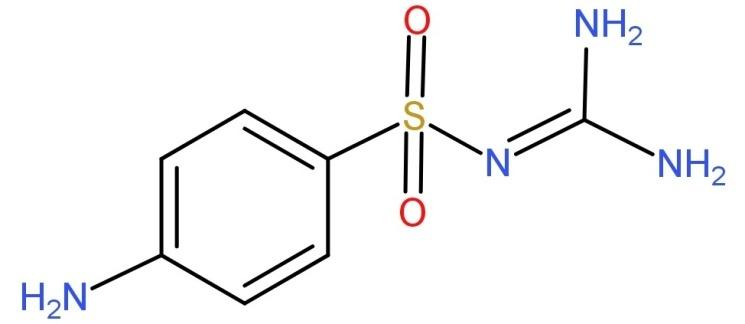
It is basically an organic compound with a molecular formula of ${C_7}{H_{10}}{N_4}{O_2}S$. It is a type of sulphonamide. Its IUPAC name is: 4-Amino-N-(diaminomethylidene) benzenesulfonamide. It is a guanidine derivative of sulphanilamide and is an anti-infective agent which is mostly used for treatment of enteric infections although it is poorly absorbed by the gut.
Its molecular structure is:
-Being an anti-infective agent it is used for the treatment of Bacillary dysentery. It is a type of dysentery caused by a species of bacteria from the family Enterobacteriaceae. It can also be termed as a form of shigellosis infection. It is also one of the most common types of dysentery. Its symptoms include bloody diarrhea, fever, nausea, vomiting, belly cramps, etc.
-For the treatment of Bacillary dysentery sulphaguanidine is prescribed at an amount of about 6-12 g/day in 2 divided doses. This drug is stored at normal room temperature.
So, the correct answer is “Option A”.
Note: Along with its ability to treat bacillary dysentery, sulphaguanidine has some severe side effects also like: kidney damage, liver impairment, heart disease, gastrointestinal effects, hypersensitivity reactions, neurological reactions, jaundice, low blood sugar, intestinal inflammation, etc.
Complete step by step answer:
-First of all we will see what Sulphaguanidine is.
It is basically an organic compound with a molecular formula of ${C_7}{H_{10}}{N_4}{O_2}S$. It is a type of sulphonamide. Its IUPAC name is: 4-Amino-N-(diaminomethylidene) benzenesulfonamide. It is a guanidine derivative of sulphanilamide and is an anti-infective agent which is mostly used for treatment of enteric infections although it is poorly absorbed by the gut.
Its molecular structure is:
-Being an anti-infective agent it is used for the treatment of Bacillary dysentery. It is a type of dysentery caused by a species of bacteria from the family Enterobacteriaceae. It can also be termed as a form of shigellosis infection. It is also one of the most common types of dysentery. Its symptoms include bloody diarrhea, fever, nausea, vomiting, belly cramps, etc.
-For the treatment of Bacillary dysentery sulphaguanidine is prescribed at an amount of about 6-12 g/day in 2 divided doses. This drug is stored at normal room temperature.
So, the correct answer is “Option A”.
Note: Along with its ability to treat bacillary dysentery, sulphaguanidine has some severe side effects also like: kidney damage, liver impairment, heart disease, gastrointestinal effects, hypersensitivity reactions, neurological reactions, jaundice, low blood sugar, intestinal inflammation, etc.
Recently Updated Pages
Master Class 12 Physics: Engaging Questions & Answers for Success

Master Class 12 Social Science: Engaging Questions & Answers for Success
Master Class 12 English: Engaging Questions & Answers for Success
Master Class 12 Maths: Engaging Questions & Answers for Success
Master Class 12 Business Studies: Engaging Questions & Answers for Success
Master Class 12 Chemistry: Engaging Questions & Answers for Success
Trending doubts
Draw a labelled sketch of the human eye class 12 physics CBSE
Which are the Top 10 Largest Countries of the World?
Draw ray diagrams each showing i myopic eye and ii class 12 physics CBSE
Which is the correct genotypic ratio of mendel dihybrid class 12 biology CBSE
Differentiate between homogeneous and heterogeneous class 12 chemistry CBSE
Give 10 examples of unisexual and bisexual flowers