




What would you suggest to a student if while performing an experiment he finds that the pointer/needle of the ammeter and voltmeter do not coincide with the zero marks on the scales when the circuit is open? No extra ammeter/voltmeter is available in the laboratory.
Answer
 Verified
612.3k+ views
Hint: As we know that no measurement is perfect as the errors are involved in the process, cannot be removed. And the type of error given in this question is an error related to the Least count which comes under the systematic errors. Systematics errors are the errors that tend to be in one direction only, either positive or negative. In fact, the causes of systematic errors are known.
Complete step by step solution:
While solving these types of errors first we have to tell the students that they have to measure the least count of both ammeter and voltmeter.
The smallest value that can be measured by a measuring instrument is called the least count of the instrument.
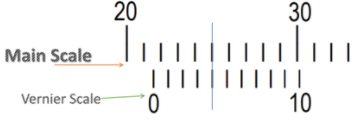
For example, the meter scale we are using in day-to-day life has a total of 150 divisions on the main scale and the main scale reading is 15cm. So, least count can be measured by dividing the main scale reading with the total number of divisions on the main scale i.e.,
Least Count \[ = \dfrac{{15}}{{150}}\]
Least Count \[ = \dfrac{1}{{10}} = 0.1\]cm or \[1\]mm.
Similarly, the least count of the given ammeter and voltmeter can be measured in a similar manner.
Step 2: After measuring the least counts of the given meters, we should add the least counts as much as are needed to reach up to the point where the needle of the open circuit ammeter or voltmeter coincides.
Step 3: After calculating the value in an open circuit that will be considered as initial reading or value for that measurement, that meter can be connected in the circuit.
After connecting in the circuit, the taken measurement will be the final reading or value.
To get the more prominent answer initial reading should be subtracted from the final reading and that will be our actual answer.
Actual reading \[ = \] Final reading \[ - \]Initial reading
Note:
- While calculating the least count first we have to see what kind of instrument we are using because if an instrument is having a secondary scale also then there will be two least counts.
- Least count of main scale \[ = \] Smallest reading on the main scale/total number of divisions on the main scale
- Instrument Least count \[ = \] Least count of main scale/total number of divisions on secondary scale.
- The least count error is the error associated with the resolution of the instrument.
Complete step by step solution:
While solving these types of errors first we have to tell the students that they have to measure the least count of both ammeter and voltmeter.
The smallest value that can be measured by a measuring instrument is called the least count of the instrument.
For example, the meter scale we are using in day-to-day life has a total of 150 divisions on the main scale and the main scale reading is 15cm. So, least count can be measured by dividing the main scale reading with the total number of divisions on the main scale i.e.,
Least Count \[ = \dfrac{{15}}{{150}}\]
Least Count \[ = \dfrac{1}{{10}} = 0.1\]cm or \[1\]mm.
Similarly, the least count of the given ammeter and voltmeter can be measured in a similar manner.
Step 2: After measuring the least counts of the given meters, we should add the least counts as much as are needed to reach up to the point where the needle of the open circuit ammeter or voltmeter coincides.
Step 3: After calculating the value in an open circuit that will be considered as initial reading or value for that measurement, that meter can be connected in the circuit.
After connecting in the circuit, the taken measurement will be the final reading or value.
To get the more prominent answer initial reading should be subtracted from the final reading and that will be our actual answer.
Actual reading \[ = \] Final reading \[ - \]Initial reading
Note:
- While calculating the least count first we have to see what kind of instrument we are using because if an instrument is having a secondary scale also then there will be two least counts.
- Least count of main scale \[ = \] Smallest reading on the main scale/total number of divisions on the main scale
- Instrument Least count \[ = \] Least count of main scale/total number of divisions on secondary scale.
- The least count error is the error associated with the resolution of the instrument.

Recently Updated Pages
Master Class 12 Business Studies: Engaging Questions & Answers for Success

Master Class 12 Biology: Engaging Questions & Answers for Success
Master Class 12 Chemistry: Engaging Questions & Answers for Success
Class 12 Question and Answer - Your Ultimate Solutions Guide
Master Class 11 Social Science: Engaging Questions & Answers for Success
Master Class 11 English: Engaging Questions & Answers for Success
Trending doubts
Full Form of IASDMIPSIFSIRSPOLICE class 7 social science CBSE
Convert 200 Million dollars in rupees class 7 maths CBSE
List of coprime numbers from 1 to 100 class 7 maths CBSE
How many thousands make a crore class 7 maths CBSE
Differentiate between map and globe class 7 social science CBSE
The least number which is a perfect square and is divisible class 7 maths CBSE