




Suggest a suitable physical situation for each of the following graphs:
A.
B.
C.
Answer
 Verified
568.8k+ views
Hint:Here we have to apply the concepts of velocity time graph and also apply the concepts of motion. Objects moving in straight lines are described by one dimensional motion. If the velocity of an object changes with time, it is said that the object is accelerating.
Complete answer:
When limited to one dimension, the velocity and acceleration vectors can point in only two possible directions. An object's velocity is its speed in a given direction. The speed and distance an object moves over a given span of time is displayed by a velocity-time graph. Velocity-time graphs are sometimes called graphs of speed-time. The vertical axis in a time-velocity graph is the object's velocity.
In mechanics, acceleration is the rate at which an object's velocity varies in response to time. Accelerations are (in that they include magnitude and direction) vector quantities. The direction of the acceleration of an object is provided by the orientation of the net force which acts on that object.
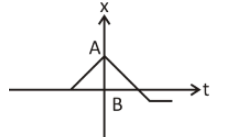
The graph A indicates that the body was at rest originally. And, for some time, it gains steady speed. The velocity then decreases to a value in the negative direction and then becomes constant for some time. It is close to throwing a football and then rebounding from the wall and going in a negative direction.
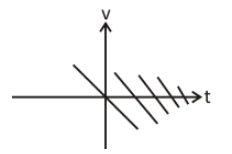
The graph B shows that the velocity decreases from a positive to a negative value, and its value unexpectedly decreases at a moment. The mechanism that applies to the graph is the motion of a ball dropping from a height on a floor and rebounding again.
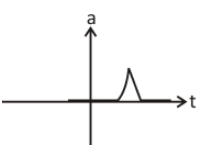
The graph C shows that a body first runs at a uniform velocity and then the acceleration unexpectedly increases and reduces for a very tiny moment and then it becomes zero again. The same mechanism that describes the graph is the pounding of a hammer on a nail.
Note:A direction does not matter in one dimension since; the motion travels in one direction only. So, the direction is not that much necessary, only the magnitude is necessary. Objects moving in straight lines are represented by one dimensional motion. If the velocity of an object varies over time, it is said that the object is accelerating. When constrained to one dimension, the velocity and acceleration vectors will point in just two possible directions.
Complete answer:
When limited to one dimension, the velocity and acceleration vectors can point in only two possible directions. An object's velocity is its speed in a given direction. The speed and distance an object moves over a given span of time is displayed by a velocity-time graph. Velocity-time graphs are sometimes called graphs of speed-time. The vertical axis in a time-velocity graph is the object's velocity.
In mechanics, acceleration is the rate at which an object's velocity varies in response to time. Accelerations are (in that they include magnitude and direction) vector quantities. The direction of the acceleration of an object is provided by the orientation of the net force which acts on that object.
The graph A indicates that the body was at rest originally. And, for some time, it gains steady speed. The velocity then decreases to a value in the negative direction and then becomes constant for some time. It is close to throwing a football and then rebounding from the wall and going in a negative direction.
The graph B shows that the velocity decreases from a positive to a negative value, and its value unexpectedly decreases at a moment. The mechanism that applies to the graph is the motion of a ball dropping from a height on a floor and rebounding again.
The graph C shows that a body first runs at a uniform velocity and then the acceleration unexpectedly increases and reduces for a very tiny moment and then it becomes zero again. The same mechanism that describes the graph is the pounding of a hammer on a nail.
Note:A direction does not matter in one dimension since; the motion travels in one direction only. So, the direction is not that much necessary, only the magnitude is necessary. Objects moving in straight lines are represented by one dimensional motion. If the velocity of an object varies over time, it is said that the object is accelerating. When constrained to one dimension, the velocity and acceleration vectors will point in just two possible directions.
Recently Updated Pages
Master Class 11 Computer Science: Engaging Questions & Answers for Success

Master Class 11 Business Studies: Engaging Questions & Answers for Success
Master Class 11 Economics: Engaging Questions & Answers for Success
Master Class 11 English: Engaging Questions & Answers for Success
Master Class 11 Maths: Engaging Questions & Answers for Success
Master Class 11 Biology: Engaging Questions & Answers for Success
Trending doubts
One Metric ton is equal to kg A 10000 B 1000 C 100 class 11 physics CBSE
There are 720 permutations of the digits 1 2 3 4 5 class 11 maths CBSE
Discuss the various forms of bacteria class 11 biology CBSE
Draw a diagram of a plant cell and label at least eight class 11 biology CBSE
State the laws of reflection of light
Explain zero factorial class 11 maths CBSE