




Succession on the sand dune is
(a)Lithosere
(b)Psychrosere
(c)Psammosere
(d)Halosere
Answer
 Verified
649.5k+ views
Hint: Ecological succession is the phenomenon by which the construction of a biological community develops over time. Types of succession are of two major categories, which are primary succession and secondary succession depending upon the type of environmental conditions.
Complete answer:
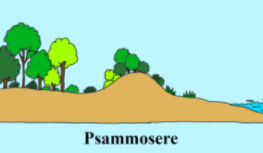
Succession on the sand dune is Psammosere. Ecological succession is the series of sere, which starts from barren land and ends in a climax. The progressing stages of a community are called seral stages In ecological terms. The final stage of sere is known as the climax.
Additional Information: -A lithosere is a plant succession that starts life on a new rock surface, such as an abandoned one due to glacial withdrawal, tectonic upthrust which forms a raised seashore, or volcanic eruptions. If the succession occurs in a salty environment, it is known as the Halosere.
-In a psammosere, the organisms nearest to the ocean will be pioneer species, which will be salt-tolerant species. For example, littoral algae and glasswort.
-Many distinctive features alter and aid in determining the natural succession of the dunes. For example, the drainage decelerates as the land becomes more compacted and has improved soils and the pH decreases as the percentage of seashell fragments reduces,and the number of humus increases.
So, the correct answer is ‘Psammosere’.
Note: -The primordial trees or the pioneer trees that show up first are usually fast-growing trees like birch, willow, or rowan.
-These fast-growing trees will be substituted by slow-growing, bigger trees such as ash or oak. This is known as the climax community, which can be explained as the point where a botanical succession cannot grow anymore because it has touched equilibrium with the environment, in a certain climate.
Complete answer:
Succession on the sand dune is Psammosere. Ecological succession is the series of sere, which starts from barren land and ends in a climax. The progressing stages of a community are called seral stages In ecological terms. The final stage of sere is known as the climax.
Additional Information: -A lithosere is a plant succession that starts life on a new rock surface, such as an abandoned one due to glacial withdrawal, tectonic upthrust which forms a raised seashore, or volcanic eruptions. If the succession occurs in a salty environment, it is known as the Halosere.
-In a psammosere, the organisms nearest to the ocean will be pioneer species, which will be salt-tolerant species. For example, littoral algae and glasswort.
-Many distinctive features alter and aid in determining the natural succession of the dunes. For example, the drainage decelerates as the land becomes more compacted and has improved soils and the pH decreases as the percentage of seashell fragments reduces,and the number of humus increases.
So, the correct answer is ‘Psammosere’.
Note: -The primordial trees or the pioneer trees that show up first are usually fast-growing trees like birch, willow, or rowan.
-These fast-growing trees will be substituted by slow-growing, bigger trees such as ash or oak. This is known as the climax community, which can be explained as the point where a botanical succession cannot grow anymore because it has touched equilibrium with the environment, in a certain climate.
Recently Updated Pages
What is BLO What is the full form of BLO class 8 social science CBSE

Explain the Treaty of Vienna of 1815 class 10 social science CBSE
10 examples of friction in our daily life
Draw a diagram of nephron and explain its structur class 11 biology CBSE
Write structures of the following compounds i 2 Chloro3methylpentane class 11 chemistry CBSE
A Paragraph on Pollution in about 100-150 Words
Trending doubts
Draw a labelled sketch of the human eye class 12 physics CBSE
Which are the Top 10 Largest Countries of the World?
Differentiate between homogeneous and heterogeneous class 12 chemistry CBSE
Draw ray diagrams each showing i myopic eye and ii class 12 physics CBSE
Which is the correct genotypic ratio of mendel dihybrid class 12 biology CBSE
What is the Full Form of PVC, PET, HDPE, LDPE, PP and PS ?