




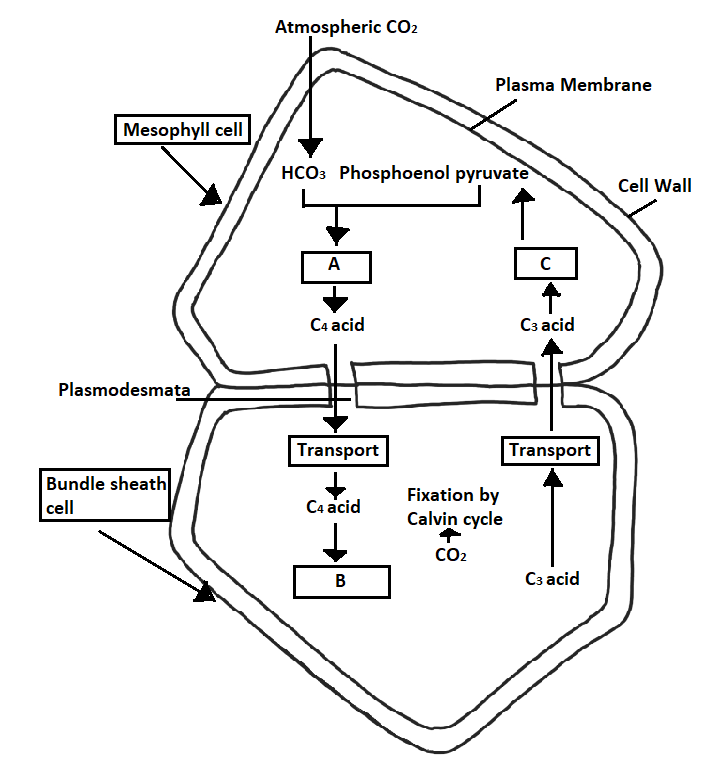
Study the pathway given above.
In which of the following options correct words for all the three blanks A, B, and C are indicated?
A B C 1. Carboxylation Decarboxylation Reduction 2. Decarboxylation Reduction Regeneration 3. Fixation Transamination Regeneration 4. Fixation Decarboxylation Regeneration
A. 1
B. 2
C. 3
D. 4
| A | B | C | |
| 1. | Carboxylation | Decarboxylation | Reduction |
| 2. | Decarboxylation | Reduction | Regeneration |
| 3. | Fixation | Transamination | Regeneration |
| 4. | Fixation | Decarboxylation | Regeneration |
Answer
 Verified
576k+ views
Hint: The \[{C_4}\] cycle is considered a very efficient cycle. During the \[{C_4}\] cycle, the atmospheric carbon dioxide is fixed by the plants into the carbon compounds. These compounds then undergo a series of reactions and processes and are decarboxylated. Later on, regeneration of the initial products occurs.
Complete answer: The given figure is of the \[{C_4}\] cycle in plants. The \[{C_4}\] cycle was proposed by the American scientists Hatch and Slack. The plants in which the \[{C_4}\] cycle occurs are known as the \[{C_4}\] plants. \[{C_4}\] plants have special leaf anatomy known as the Kranz Anatomy. \[{C_4}\] plants are more efficient than the \[{C_3}\] plants.
-In the \[{C_4}\] plants, the atmospheric carbon dioxide is fixed in the mesophyll cells with the help of the PEP carboxylase enzyme. This carbon dioxide is fixed as a four-carbon acid. Therefore, A will be a fixation. It is then carried or transported to the Bundle Sheath Cells.
-Here the decarboxylation of the four-carbon acid occurs. It is converted to carbon dioxide and a three-carbon acid. Therefore, B will be Decarboxylation.
-The carbon dioxide is fixed by the Calvin cycle or the \[{C_3}\] cycle. The three-carbon acid is transported back to the mesophyll cell. Here the regeneration of the initial products from the three-carbon acid occurs. Therefore, C will be Regeneration. In this way, the \[{C_4}\] cycle is completed.
Thus, based on the above information we can conclude that A – Fixation, B – Decarboxylation, and C – Regeneration are the correct words.
Hence, the correct answer is option (D).
Note: Kranz anatomy makes the \[{C_4}\] plants more efficient. In Kranz anatomy, there are two kinds of cells present where the \[{C_4}\] cycle occurs. One is the Bundle sheath cells that are large in size and compactly arranged. The second type of cell is the Mesophyll cells which are small in size and loosely arranged. These plants also have dimorphic chloroplasts.
Complete answer: The given figure is of the \[{C_4}\] cycle in plants. The \[{C_4}\] cycle was proposed by the American scientists Hatch and Slack. The plants in which the \[{C_4}\] cycle occurs are known as the \[{C_4}\] plants. \[{C_4}\] plants have special leaf anatomy known as the Kranz Anatomy. \[{C_4}\] plants are more efficient than the \[{C_3}\] plants.
-In the \[{C_4}\] plants, the atmospheric carbon dioxide is fixed in the mesophyll cells with the help of the PEP carboxylase enzyme. This carbon dioxide is fixed as a four-carbon acid. Therefore, A will be a fixation. It is then carried or transported to the Bundle Sheath Cells.
-Here the decarboxylation of the four-carbon acid occurs. It is converted to carbon dioxide and a three-carbon acid. Therefore, B will be Decarboxylation.
-The carbon dioxide is fixed by the Calvin cycle or the \[{C_3}\] cycle. The three-carbon acid is transported back to the mesophyll cell. Here the regeneration of the initial products from the three-carbon acid occurs. Therefore, C will be Regeneration. In this way, the \[{C_4}\] cycle is completed.
Thus, based on the above information we can conclude that A – Fixation, B – Decarboxylation, and C – Regeneration are the correct words.
Hence, the correct answer is option (D).
Note: Kranz anatomy makes the \[{C_4}\] plants more efficient. In Kranz anatomy, there are two kinds of cells present where the \[{C_4}\] cycle occurs. One is the Bundle sheath cells that are large in size and compactly arranged. The second type of cell is the Mesophyll cells which are small in size and loosely arranged. These plants also have dimorphic chloroplasts.
Recently Updated Pages
Master Class 11 Computer Science: Engaging Questions & Answers for Success

Master Class 11 Business Studies: Engaging Questions & Answers for Success
Master Class 11 Economics: Engaging Questions & Answers for Success
Master Class 11 English: Engaging Questions & Answers for Success
Master Class 11 Maths: Engaging Questions & Answers for Success
Master Class 11 Biology: Engaging Questions & Answers for Success
Trending doubts
One Metric ton is equal to kg A 10000 B 1000 C 100 class 11 physics CBSE
There are 720 permutations of the digits 1 2 3 4 5 class 11 maths CBSE
Discuss the various forms of bacteria class 11 biology CBSE
Draw a diagram of a plant cell and label at least eight class 11 biology CBSE
State the laws of reflection of light
10 examples of friction in our daily life