




Study the following figures and select the correct statements regarding these.
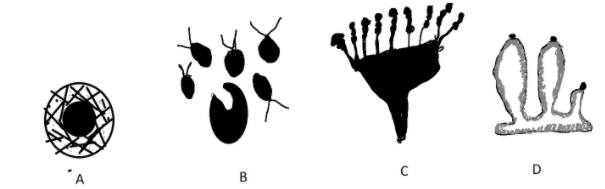
(i) A shows mode of asexual reproduction in sponges through internal buds.
(ii) B shows sexual reproduction through zoospores in Chlamydomonas.
(iii) C shows asexual reproduction through conidiospores in Penicillium.
(iv) D shows external budding in Sycon.
A) (i) and (ii)
B) (i) and (iii)
C) (ii), (iii) and (iv)
D) (i), (iii) and (iv)
Answer
 Verified
585.9k+ views
Hint: Sponges are hermaphrodites, Chlamydomonas are single celled algae which reproduce both sexually and asexually, penicillium shows asexual reproduction through asexual spores, sycon is a calcerous sponge which reproduce both sexually and asexually.
Complete answer:
To answer this question, let us discuss different types of reproduction in the organisms given in the question.
A) Sponges- Asexual reproduction in sponges is mainly through bud formation called the gemmules. These are packets of many cells inside a protective covering. (statement I is correct).
B) Chlamydomonas- The figure B shows asexual reproduction in Chlamydomonas through zoospores. The zoospores are motile and flagellated spores which are produced inside zoosporangia. The zoospores do not have a cell wall. The sexual reproduction takes place through isogamy or oogamy. (Statement ii is incorrect)
C) Penicillium- The figure C shows asexual reproduction in penicillium through the conidiospore formation. These spores are uninucleate, non-motile and are formed on conidiophore. (Statement iii is correct).
D) Sycon- Figure D shows asexual reproduction in Sycon through budding. These buds are produced in the external body which are similar in appearance to gemmules in sponges. (Statement iv in correct)
Thus, the correct answer is option ‘D’.
Note: Sexual reproduction involves fusion of male and female gametes whereas asexual reproduction mostly takes place through budding, binary fission, spore formation or regeneration. In case of budding, small projections arise from the organism under favourable conditions.
Complete answer:
To answer this question, let us discuss different types of reproduction in the organisms given in the question.
A) Sponges- Asexual reproduction in sponges is mainly through bud formation called the gemmules. These are packets of many cells inside a protective covering. (statement I is correct).
B) Chlamydomonas- The figure B shows asexual reproduction in Chlamydomonas through zoospores. The zoospores are motile and flagellated spores which are produced inside zoosporangia. The zoospores do not have a cell wall. The sexual reproduction takes place through isogamy or oogamy. (Statement ii is incorrect)
C) Penicillium- The figure C shows asexual reproduction in penicillium through the conidiospore formation. These spores are uninucleate, non-motile and are formed on conidiophore. (Statement iii is correct).
D) Sycon- Figure D shows asexual reproduction in Sycon through budding. These buds are produced in the external body which are similar in appearance to gemmules in sponges. (Statement iv in correct)
Thus, the correct answer is option ‘D’.
Note: Sexual reproduction involves fusion of male and female gametes whereas asexual reproduction mostly takes place through budding, binary fission, spore formation or regeneration. In case of budding, small projections arise from the organism under favourable conditions.
Recently Updated Pages
Master Class 11 English: Engaging Questions & Answers for Success

Master Class 11 Physics: Engaging Questions & Answers for Success
Master Class 11 Computer Science: Engaging Questions & Answers for Success
Master Class 11 Chemistry: Engaging Questions & Answers for Success
Master Class 11 Social Science: Engaging Questions & Answers for Success
Master Class 11 Accountancy: Engaging Questions & Answers for Success
Trending doubts
Difference Between Prokaryotic Cells and Eukaryotic Cells
Two of the body parts which do not appear in MRI are class 11 biology CBSE
One Metric ton is equal to kg A 10000 B 1000 C 100 class 11 physics CBSE
10 examples of friction in our daily life
Draw a diagram of nephron and explain its structur class 11 biology CBSE
Draw a diagram of a plant cell and label at least eight class 11 biology CBSE