




Structure which maintains the shape of the eyeball and the area of no vision.
Answer
 Verified
532.5k+ views
Hint: The visual system includes the eyes. They give animals eyesight, the ability to receive and interpret visual information, and the ability to perform many photo response functions that are not dependent on vision. Light is detected by the eyes and converted into electrochemical impulses in the neurons.
Complete answer:
The cornea is the transparent, dome-shaped front part of the eye that focuses light into the eye. The anterior chamber is a fluid-filled region behind the cornea.
The iris, the coloured component of the eye, and the pupil, the dark hole in the middle, are located behind the anterior chamber. To control the amount of light reaching the back of the eye, muscles in the iris dilate or constrict the pupil. The lens is located directly behind the pupil. The lens directs light toward the retina at the back of the eye.
Vitreous humour is a jellyfish fluid with the name vitreous humour. Between the lens and the back of the eye is the vitreous cavity. The cavity is filled with vitreous humour, a jellylike material. The cornea and lens focus light into the eye, which travels through the vitreous and onto the retina, the light-sensitive tissue lining the back of the eye.
Aqueous humour is the name for the fluid. Aqueous humour is constantly produced by the eye. Aqueous humour drains from the eye in a region known as the drainage angle to maintain a consistent ocular pressure. The shape of the eyeball is maintained by aqueous humour. The back part (posterior segment) stretches from the lens's front surface to the retina, acting as no-vision zones.
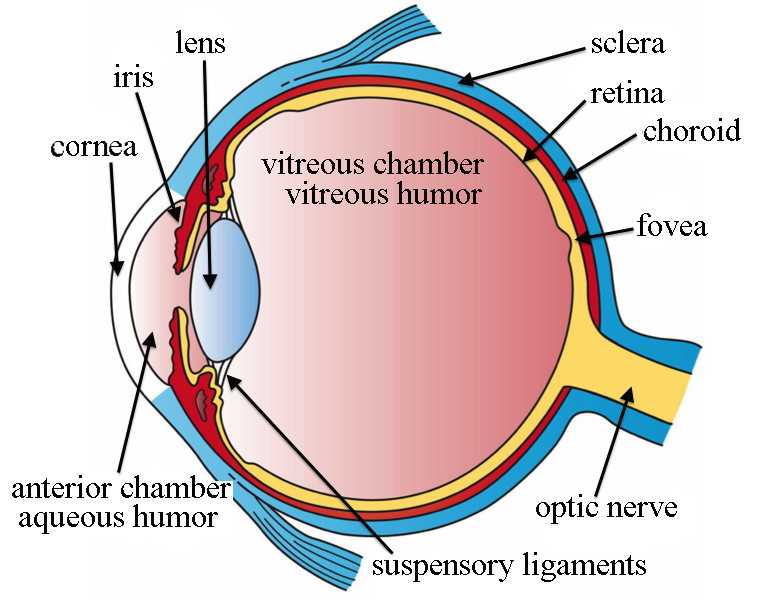
Note: The aqueous humour bathes and nourishes the lens while also maintaining ocular pressure. Because the lens and cornea lack a blood supply, the aqueous humour serves as a substitute for blood in transporting nutrients to those structures.
Complete answer:
The cornea is the transparent, dome-shaped front part of the eye that focuses light into the eye. The anterior chamber is a fluid-filled region behind the cornea.
The iris, the coloured component of the eye, and the pupil, the dark hole in the middle, are located behind the anterior chamber. To control the amount of light reaching the back of the eye, muscles in the iris dilate or constrict the pupil. The lens is located directly behind the pupil. The lens directs light toward the retina at the back of the eye.
Vitreous humour is a jellyfish fluid with the name vitreous humour. Between the lens and the back of the eye is the vitreous cavity. The cavity is filled with vitreous humour, a jellylike material. The cornea and lens focus light into the eye, which travels through the vitreous and onto the retina, the light-sensitive tissue lining the back of the eye.
Aqueous humour is the name for the fluid. Aqueous humour is constantly produced by the eye. Aqueous humour drains from the eye in a region known as the drainage angle to maintain a consistent ocular pressure. The shape of the eyeball is maintained by aqueous humour. The back part (posterior segment) stretches from the lens's front surface to the retina, acting as no-vision zones.
Note: The aqueous humour bathes and nourishes the lens while also maintaining ocular pressure. Because the lens and cornea lack a blood supply, the aqueous humour serves as a substitute for blood in transporting nutrients to those structures.
Recently Updated Pages
Master Class 11 Social Science: Engaging Questions & Answers for Success

Master Class 11 English: Engaging Questions & Answers for Success
Master Class 11 Maths: Engaging Questions & Answers for Success
Master Class 11 Chemistry: Engaging Questions & Answers for Success
Master Class 11 Biology: Engaging Questions & Answers for Success
Master Class 11 Physics: Engaging Questions & Answers for Success
Trending doubts
Differentiate between an exothermic and an endothermic class 11 chemistry CBSE
One Metric ton is equal to kg A 10000 B 1000 C 100 class 11 physics CBSE
Difference Between Prokaryotic Cells and Eukaryotic Cells
There are 720 permutations of the digits 1 2 3 4 5 class 11 maths CBSE
Two of the body parts which do not appear in MRI are class 11 biology CBSE
Which gas is abundant in air class 11 chemistry CBSE