




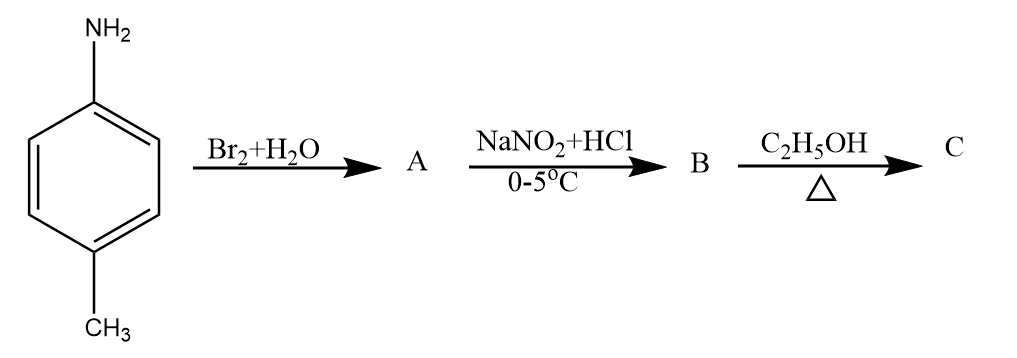
Structure of C in the given reaction sequence is:
A.
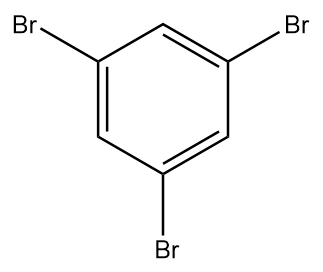
B.
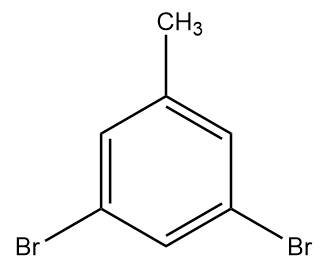
C.
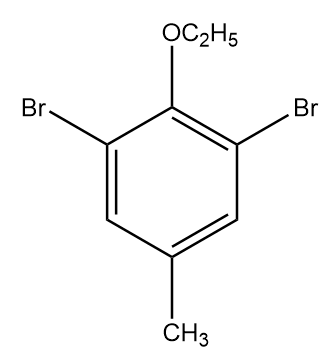
D.
Answer
 Verified
511.5k+ views
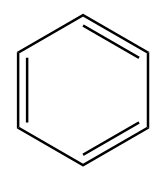
Hint :Just like an alkene, the benzene ring which is an aromatic compound consists of a cloud of pi electrons and is composed of a single bond framework. Although the benzene ring forms a stable aromatic system due to resonance , the atoms are still available for reactions with strong electrophiles to undergo electrophilic substitution reaction.
Complete Step By Step Answer:
The mechanism for given reaction sequence is as follows:
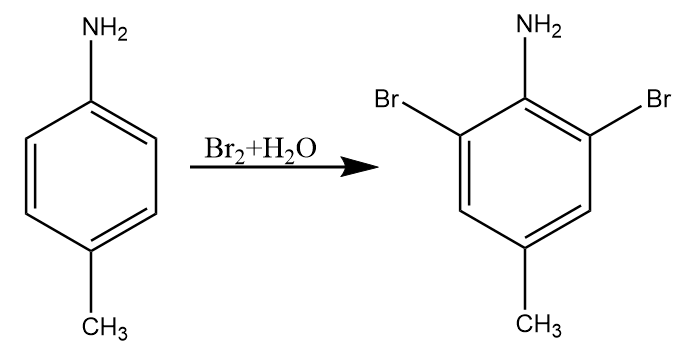
Step-1: The given reactant i.e., para-toluidine reacts with bromine water to undergo bromination. As aniline group is ortho para directing but para position is blocked by methyl group. So, bromine atoms will attack at both ortho positions of the ring and formation of product A i.e., 2,6-dibromo-4-methylaniline takes place. The reaction proceeds as follows:
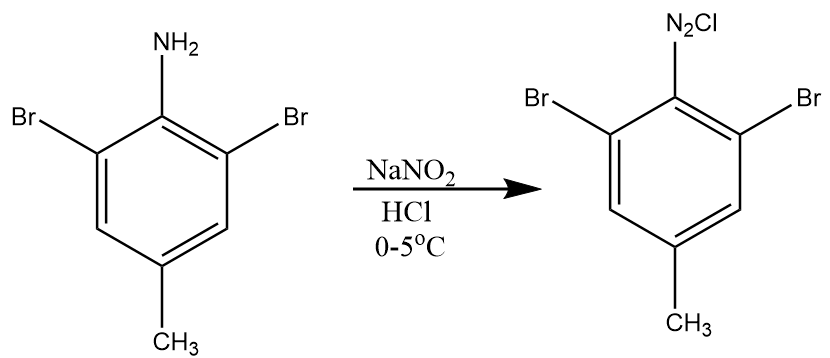
Step-2: In the presence of $NaN{O_2}$ and $HCl$, the product A undergoes diazotization reaction and $N{H_2}$ group will be converted into ${N_2}Cl$ under given conditions. So, the product B formed is 1-chloro-2-(2,6-dibromo-4methylphenyl) diazene. The reaction proceeds as follows:
Step-3: On reaction of ethanol with product B, reduction of compound takes place and 1,3-dibromo-methyl benzene is formed as the final product along with the removal of acetaldehyde, nitrogen and hydrogen chloride. The reaction proceeds as follows:
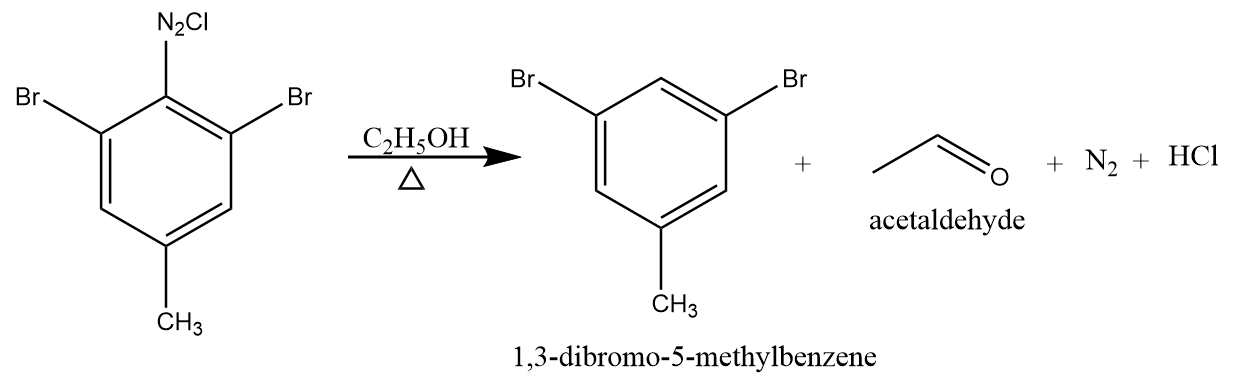
Hence, the final product formed i.e., product C is 1,3-dibromo-5methylbenzene and it is structurally represented as:
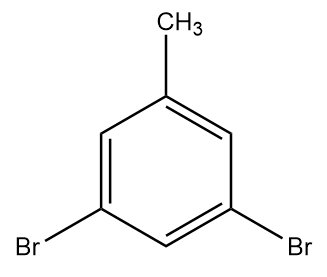
Therefore, option (B) is the correct answer.
Note :
It is important to note that in the reaction sequence, bromination and diazotization are type aromatic electrophilic substitution reaction i.e., an external electrophile replaced an electrophile from the benzene ring and formation of substituted aromatic product takes place whereas in last step, deamination of azo compound occurs to form final product.
Complete Step By Step Answer:
The mechanism for given reaction sequence is as follows:
Step-1: The given reactant i.e., para-toluidine reacts with bromine water to undergo bromination. As aniline group is ortho para directing but para position is blocked by methyl group. So, bromine atoms will attack at both ortho positions of the ring and formation of product A i.e., 2,6-dibromo-4-methylaniline takes place. The reaction proceeds as follows:
Step-2: In the presence of $NaN{O_2}$ and $HCl$, the product A undergoes diazotization reaction and $N{H_2}$ group will be converted into ${N_2}Cl$ under given conditions. So, the product B formed is 1-chloro-2-(2,6-dibromo-4methylphenyl) diazene. The reaction proceeds as follows:
Step-3: On reaction of ethanol with product B, reduction of compound takes place and 1,3-dibromo-methyl benzene is formed as the final product along with the removal of acetaldehyde, nitrogen and hydrogen chloride. The reaction proceeds as follows:
Hence, the final product formed i.e., product C is 1,3-dibromo-5methylbenzene and it is structurally represented as:
Therefore, option (B) is the correct answer.
Note :
It is important to note that in the reaction sequence, bromination and diazotization are type aromatic electrophilic substitution reaction i.e., an external electrophile replaced an electrophile from the benzene ring and formation of substituted aromatic product takes place whereas in last step, deamination of azo compound occurs to form final product.
Recently Updated Pages
Master Class 11 Computer Science: Engaging Questions & Answers for Success

Master Class 11 Business Studies: Engaging Questions & Answers for Success
Master Class 11 Economics: Engaging Questions & Answers for Success
Master Class 11 English: Engaging Questions & Answers for Success
Master Class 11 Maths: Engaging Questions & Answers for Success
Master Class 11 Biology: Engaging Questions & Answers for Success
Trending doubts
One Metric ton is equal to kg A 10000 B 1000 C 100 class 11 physics CBSE
There are 720 permutations of the digits 1 2 3 4 5 class 11 maths CBSE
Discuss the various forms of bacteria class 11 biology CBSE
Draw a diagram of a plant cell and label at least eight class 11 biology CBSE
State the laws of reflection of light
Explain zero factorial class 11 maths CBSE