




Structural and functional unit of the nervous system is
A) Nephron
B) Cyton
C) Neuron
D) Axon
Answer
 Verified
648.9k+ views
Hint: There are certain cells in our body that are specialised to execute special functions which help various systems of the body to coordinate easily with each other.
Complete answer:
Neuron also known as a nerve cell is the functional and structural unit of the nervous system which has the capability to get excited by electrical or chemical impulse. These cells help in communication inside the body. These cells are found in animals except sponges whereas plants and fungi lack these cells.
These cells are classified into three types:
a) Sensory Neurons: These respond to stimuli for example touch.
b) Motor Neurons: Controls the process like muscle contraction and coordinates with the brain and spinal cord.
c) Interneurons: These are the connection of neurons in the same region of the brain or spinal cord.
Structure of Neuron:
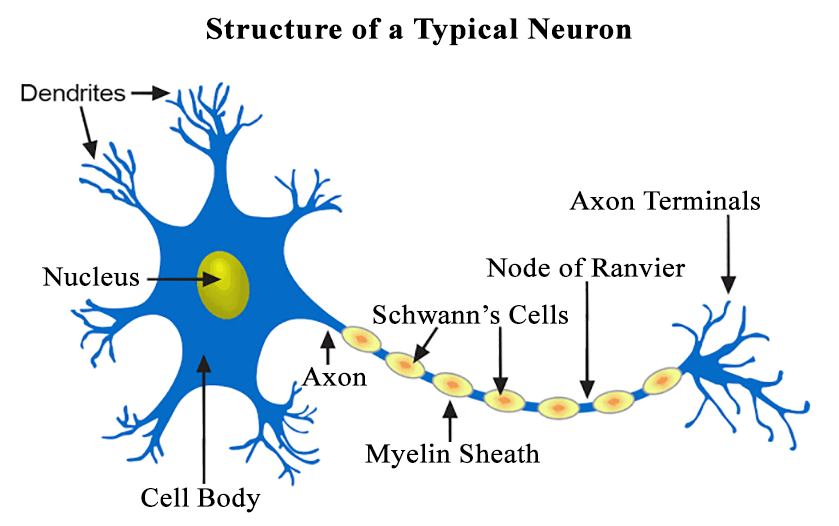
1) A typical neuron has three main parts:- cell body also known as soma, dendrites and axon.
2) Soma or cell body is a compact structure from which dendrites and axon eject. It also contains the nucleus and Nissl’s granules.
3) Dendrites help in receiving and the processing of the information. These signals can be either exciting or inhibitory depending on the need.
4) A single neuron has more than one dendrites which help it to receive thousands of signals.
5) Axon: These are long fibres which emerge from the cell body and consist of a branched distal end. Its space is filled with neurotransmitters which help in transmission and it terminates at the synaptic knob.
6) Some axons are covered by a sheath known as the myelin sheath. It is formed with a plasma membrane and helps to increase the transmission speed.
7) These myelinated sheath axons have a gap in between known as nodes of Ranvier.
8) The neurotransmitter molecules are present at the end of the axon.
9) Nissl’ s granules are rough endoplasmic reticulum which helps in the protein synthesis.
10) Schwann cells which are also known as neurilemma cells are responsible for the production of the myelin sheath.
11) Nerve ending or Axon terminal is the distal part of the neuron that comes in contact with other cells.
12) The function of Neurons: The main and the basic function of a neuron is to send and receive signals by using action potential and can be achieved by either chemical or electrical means. The site at which neurons come in contact with other cells is synapses.
13) Nerve cells are the connection in our body which helps to communicate the entire body with each other. These cells do not execute cell division and are very specialised.
So, the correct answer is ‘Neuron’.
Note: Myelin is a lipid-rich substance that covers the axons. Most of the synapses use chemical messengers to communicate. Neurotransmitters are the chemicals that help in neurotransmission like acetylcholine.
Complete answer:
Neuron also known as a nerve cell is the functional and structural unit of the nervous system which has the capability to get excited by electrical or chemical impulse. These cells help in communication inside the body. These cells are found in animals except sponges whereas plants and fungi lack these cells.
These cells are classified into three types:
a) Sensory Neurons: These respond to stimuli for example touch.
b) Motor Neurons: Controls the process like muscle contraction and coordinates with the brain and spinal cord.
c) Interneurons: These are the connection of neurons in the same region of the brain or spinal cord.
Structure of Neuron:
1) A typical neuron has three main parts:- cell body also known as soma, dendrites and axon.
2) Soma or cell body is a compact structure from which dendrites and axon eject. It also contains the nucleus and Nissl’s granules.
3) Dendrites help in receiving and the processing of the information. These signals can be either exciting or inhibitory depending on the need.
4) A single neuron has more than one dendrites which help it to receive thousands of signals.
5) Axon: These are long fibres which emerge from the cell body and consist of a branched distal end. Its space is filled with neurotransmitters which help in transmission and it terminates at the synaptic knob.
6) Some axons are covered by a sheath known as the myelin sheath. It is formed with a plasma membrane and helps to increase the transmission speed.
7) These myelinated sheath axons have a gap in between known as nodes of Ranvier.
8) The neurotransmitter molecules are present at the end of the axon.
9) Nissl’ s granules are rough endoplasmic reticulum which helps in the protein synthesis.
10) Schwann cells which are also known as neurilemma cells are responsible for the production of the myelin sheath.
11) Nerve ending or Axon terminal is the distal part of the neuron that comes in contact with other cells.
12) The function of Neurons: The main and the basic function of a neuron is to send and receive signals by using action potential and can be achieved by either chemical or electrical means. The site at which neurons come in contact with other cells is synapses.
13) Nerve cells are the connection in our body which helps to communicate the entire body with each other. These cells do not execute cell division and are very specialised.
So, the correct answer is ‘Neuron’.
Note: Myelin is a lipid-rich substance that covers the axons. Most of the synapses use chemical messengers to communicate. Neurotransmitters are the chemicals that help in neurotransmission like acetylcholine.
Recently Updated Pages
Basicity of sulphurous acid and sulphuric acid are

Master Class 10 Computer Science: Engaging Questions & Answers for Success
Master Class 10 Social Science: Engaging Questions & Answers for Success
Master Class 10 Science: Engaging Questions & Answers for Success
Class 10 Question and Answer - Your Ultimate Solutions Guide
Master Class 10 Maths: Engaging Questions & Answers for Success
Trending doubts
What is the Total Duration of Football Match?
Explain the Treaty of Vienna of 1815 class 10 social science CBSE
In football, which nation is called "La Roja"?
Why is there a time difference of about 5 hours between class 10 social science CBSE
10 examples of evaporation in daily life with explanations
What is the full form of POSCO class 10 social science CBSE