




(Street Plan): A city has two main roads which cross each other at the center of the city. These two roads are along the North-South direction and the East-West direction. All the other streets of the city-run parallel to these roads and are $200m$ apart. There are $5$ streets in each direction. Using $1cm=200m,$ draw a model of the city on your notebook. Represent the roads/streets by single lines. There are many cross-streets in your model. A particular cross-street is made by two streets, one running in the North-South direction and another in the East-West direction. Each cross street is referred to in the following manner: If the ${{2}^{nd}}$ street running in the North-South direction and ${{5}^{th}}$ in the East-West direction meet at some crossing, then we will call this cross-street $\left( 2,5 \right).$ Using this conversion, find:
\[\left( i \right)\] How many cross-streets can be referred to as $\left( 4,3 \right)$
$\left( ii \right)$ How many cross-streets can be referred to as $\left( 3,4 \right).$
Answer
 Verified
557.4k+ views
Hint: We know that if there are cross-streets referred to as $\left( m,n \right),$ then that means the ${{m}^{th}}$ street running in the North-South direction and the ${{n}^{th}}$ street running in the East-West direction meet at some crossing.
Complete step by step answer:
Let us draw a model of the city as follows,
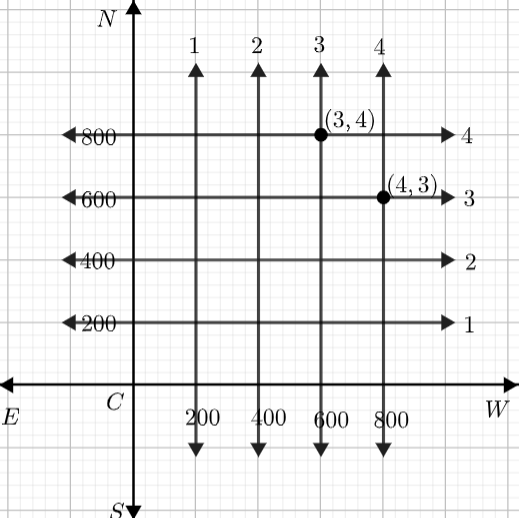
We can see many cross-streets in the model. We are asked to find
\[\left( i \right)\] the number of cross-streets that can be referred to as $\left( 4,3 \right)$
$\left( ii \right)$ the number of cross-streets that can be referred to as $\left( 3,4 \right)$
So, as we can see, the ${{4}^{th}}$ street running in the North-South direction and the ${{3}^{rd}}$ street running in the East-West direction meet at $\left( 4,3 \right).$ So, there is only one cross-street we can refer to as $\left( 4,3 \right).$
Similarly, we can see that the ${{3}^{rd}}$ street running in the North-South direction and the ${{4}^{th}}$ street running in the East-West direction meet at $\left( 3,4 \right).$ So, there is only one cross-street we can refer to as $\left( 3,4 \right).$
Hence the cross-streets that can be referred to as $\left( 4,3 \right)$ and $\left( 3,4 \right)$ are uniquely found.
Note: As we know, the street plan is a map of a town or city, showing the position and names of all the streets. Here, we use a model of the city that contains streets in the North-South direction and East-West direction. The horizontal lines and the vertical lines we draw are the streets and if the lines meet at some points, then the streets are called cross-streets and referred to as the point at which they meet.
Complete step by step answer:
Let us draw a model of the city as follows,
We can see many cross-streets in the model. We are asked to find
\[\left( i \right)\] the number of cross-streets that can be referred to as $\left( 4,3 \right)$
$\left( ii \right)$ the number of cross-streets that can be referred to as $\left( 3,4 \right)$
So, as we can see, the ${{4}^{th}}$ street running in the North-South direction and the ${{3}^{rd}}$ street running in the East-West direction meet at $\left( 4,3 \right).$ So, there is only one cross-street we can refer to as $\left( 4,3 \right).$
Similarly, we can see that the ${{3}^{rd}}$ street running in the North-South direction and the ${{4}^{th}}$ street running in the East-West direction meet at $\left( 3,4 \right).$ So, there is only one cross-street we can refer to as $\left( 3,4 \right).$
Hence the cross-streets that can be referred to as $\left( 4,3 \right)$ and $\left( 3,4 \right)$ are uniquely found.
Note: As we know, the street plan is a map of a town or city, showing the position and names of all the streets. Here, we use a model of the city that contains streets in the North-South direction and East-West direction. The horizontal lines and the vertical lines we draw are the streets and if the lines meet at some points, then the streets are called cross-streets and referred to as the point at which they meet.
Recently Updated Pages
Master Class 11 Social Science: Engaging Questions & Answers for Success

Master Class 11 English: Engaging Questions & Answers for Success
Master Class 11 Maths: Engaging Questions & Answers for Success
Master Class 11 Chemistry: Engaging Questions & Answers for Success
Master Class 11 Biology: Engaging Questions & Answers for Success
Master Class 11 Physics: Engaging Questions & Answers for Success
Trending doubts
One Metric ton is equal to kg A 10000 B 1000 C 100 class 11 physics CBSE
Difference Between Prokaryotic Cells and Eukaryotic Cells
How many of the following diseases can be studied with class 11 biology CBSE
Draw a diagram of a plant cell and label at least eight class 11 biology CBSE
Two of the body parts which do not appear in MRI are class 11 biology CBSE
Which gas is abundant in air class 11 chemistry CBSE