




When stomata are opening; we observe which of the following changes in the guard cells?
A. OP increase and TP decreases
B. OP and TP increases
C. OP decreases, TP increases
D. OP and TP decreases
Answer
 Verified
621k+ views
Hint: Stomata are minute openings present on the epidermis of the leaves, generally on the lower side of the leaves. They are an essential part of the plant and play a crucial role in the gaseous exchange and during photosynthesis.
Complete answer:
If we look at the structure of stomata, stoma (i.e. plural stomata) possesses two kidney bean-shaped guard cells containing chloroplasts with a respiratory chamber found under each stoma. These guard cells are further surrounded by subsidiary cells and also control the transpiration rate in the stomata. Open and closed stoma as shown in the figure below;
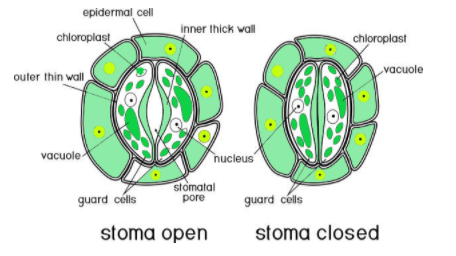
The mechanism of the opening of stomata occurs due to the changes in the turgidity of the guard cells. Stoma opens during the day time and closes in the night time. A sequence of events involved in stomata opening includes; Potassium ions uptake by the guard cells, along with this water enters into guard cells and it leads to an increase in the turgor pressure, because of this high turgor pressure cells swell, bends away from each other and leads to the opening of stomata for gaseous exchange. TP (Turgor pressure) is controlled by the movements of these ion solutes. During stomatal opening osmotic pressure decreases as guard cells regulate the rate of transpiration by the opening and closing of stomata the osmotic pressure changes accordingly to cool the plants. The stomatal opening allows water to transpire and carbon dioxide enters via the leaf stomatal pore.
As discussed above, turgor pressure is a pressure that is exerted by the solute present in the cell that forces the cell membrane against the cell wall whereas osmotic pressure is pressure applied by the dissolved substances on the semi permeable membrane (through which it cannot invade).
Hence, the correct answer is option (C).
Note: Guard cells as the name suggests protect the plant from water loss by controlling the rate of transpiration which helps the plants from wilting (loss of rigidity by the plants). The opening and closing of stomata are guarded by the guard cells by increasing or decreasing the quantity of water present in them.
Complete answer:
If we look at the structure of stomata, stoma (i.e. plural stomata) possesses two kidney bean-shaped guard cells containing chloroplasts with a respiratory chamber found under each stoma. These guard cells are further surrounded by subsidiary cells and also control the transpiration rate in the stomata. Open and closed stoma as shown in the figure below;
The mechanism of the opening of stomata occurs due to the changes in the turgidity of the guard cells. Stoma opens during the day time and closes in the night time. A sequence of events involved in stomata opening includes; Potassium ions uptake by the guard cells, along with this water enters into guard cells and it leads to an increase in the turgor pressure, because of this high turgor pressure cells swell, bends away from each other and leads to the opening of stomata for gaseous exchange. TP (Turgor pressure) is controlled by the movements of these ion solutes. During stomatal opening osmotic pressure decreases as guard cells regulate the rate of transpiration by the opening and closing of stomata the osmotic pressure changes accordingly to cool the plants. The stomatal opening allows water to transpire and carbon dioxide enters via the leaf stomatal pore.
As discussed above, turgor pressure is a pressure that is exerted by the solute present in the cell that forces the cell membrane against the cell wall whereas osmotic pressure is pressure applied by the dissolved substances on the semi permeable membrane (through which it cannot invade).
Hence, the correct answer is option (C).
Note: Guard cells as the name suggests protect the plant from water loss by controlling the rate of transpiration which helps the plants from wilting (loss of rigidity by the plants). The opening and closing of stomata are guarded by the guard cells by increasing or decreasing the quantity of water present in them.
Recently Updated Pages
Master Class 10 Computer Science: Engaging Questions & Answers for Success

Master Class 10 Social Science: Engaging Questions & Answers for Success
Master Class 10 Science: Engaging Questions & Answers for Success
Class 10 Question and Answer - Your Ultimate Solutions Guide
Master Class 10 Maths: Engaging Questions & Answers for Success
Master Class 10 English: Engaging Questions & Answers for Success
Trending doubts
Difference Between Prokaryotic Cells and Eukaryotic Cells
Two of the body parts which do not appear in MRI are class 11 biology CBSE
10 examples of friction in our daily life
Draw a diagram of nephron and explain its structur class 11 biology CBSE
One Metric ton is equal to kg A 10000 B 1000 C 100 class 11 physics CBSE
Draw a diagram of a plant cell and label at least eight class 11 biology CBSE