




Stereoisomers have different:
$ (i) $ molecular mass
$ (ii) $ molecular formula
$ (iii) $ structural formula
$ (iv) $ configuration
Answer
 Verified
579k+ views
Hint: Isomers are those compounds which have the same molecular formula but they have different structural formulas. Stereoisomers are one of the types of isomers which have the same molecular formula but they have different spatial arrangement of atoms . They do not differ by functional groups but they differ by their arrangement of atoms or molecules.
Complete answer:
Isomers refer to that class of organic molecules which have the same molecular formula but they differ with each other in terms of the structural formula. Basically isomers are classify into two types:
$ (i) $ Constitutional or Structural Isomers: These isomers generally differ in functional group, carbon chain, position of the functional group and tautomer.
$ (ii) $ Stereoisomers: These isomers have the same molecular formula but they differ from each other in terms of arrangement of atoms. They can be further classified as,
$ (a.) $ Conformational Isomers
$ (b.) $ Configurational Isomers
$ (c.) $ Diastereomers
$ (d.) $ Enantiomers
All these categories of the stereoisomers are based on the different configuration of atoms present in the molecule. We can also differentiate them by looking at their images. Thus isomers are optically active.
Example of stereoisomer:
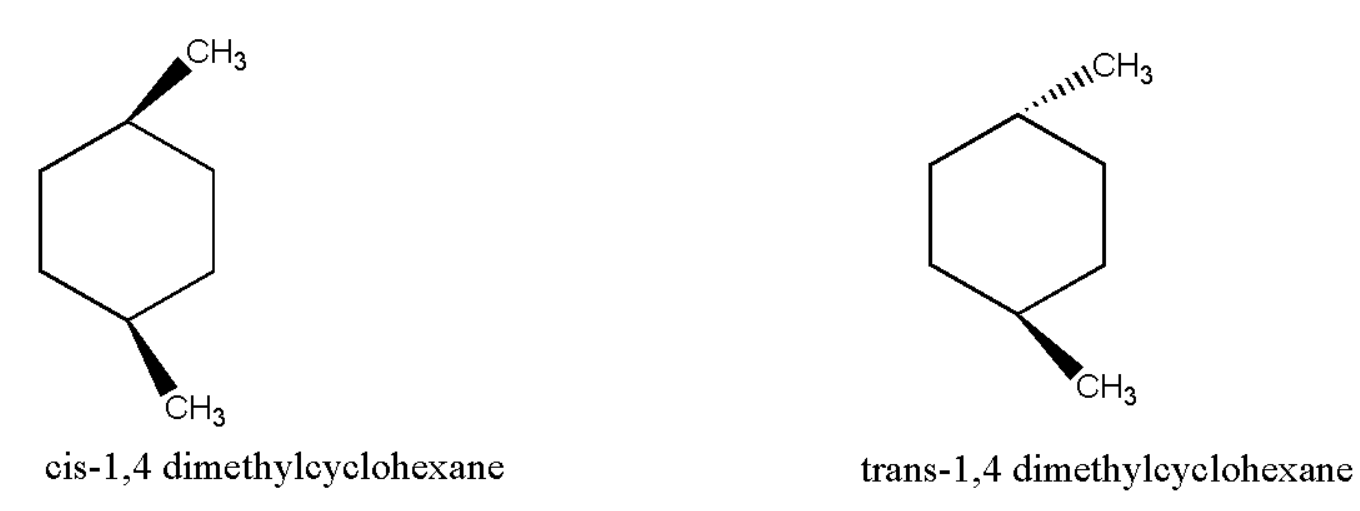
Therefore we can say that in one molecule both the methyl atoms are pointed into the plane while in the other one methyl is pointed into the plane while the other is pointed outward. Hence we can observe that the suitable option for stereoisomers is $ (iv) $ configuration.
Note:
There are other stereoisomers which are optically active while some are not. Basically the configuration in each stereoisomer is different from each other. We can find the structural isomers by looking at their two dimensional image but in the case of stereoisomers we look into the three dimensional image of the molecule.
Complete answer:
Isomers refer to that class of organic molecules which have the same molecular formula but they differ with each other in terms of the structural formula. Basically isomers are classify into two types:
$ (i) $ Constitutional or Structural Isomers: These isomers generally differ in functional group, carbon chain, position of the functional group and tautomer.
$ (ii) $ Stereoisomers: These isomers have the same molecular formula but they differ from each other in terms of arrangement of atoms. They can be further classified as,
$ (a.) $ Conformational Isomers
$ (b.) $ Configurational Isomers
$ (c.) $ Diastereomers
$ (d.) $ Enantiomers
All these categories of the stereoisomers are based on the different configuration of atoms present in the molecule. We can also differentiate them by looking at their images. Thus isomers are optically active.
Example of stereoisomer:
Therefore we can say that in one molecule both the methyl atoms are pointed into the plane while in the other one methyl is pointed into the plane while the other is pointed outward. Hence we can observe that the suitable option for stereoisomers is $ (iv) $ configuration.
Note:
There are other stereoisomers which are optically active while some are not. Basically the configuration in each stereoisomer is different from each other. We can find the structural isomers by looking at their two dimensional image but in the case of stereoisomers we look into the three dimensional image of the molecule.
Recently Updated Pages
Which will be the least stable resonating structure class 11 chemistry CBSE

How many 5 digit telephone numbers can be construc-class-11-maths-CBSE
How do you find the angle of the resultant vector class 11 physics CBSE
Draw labelled diagram of the following i Gram seed class 11 biology CBSE
1 Quintal is equal to a 110 kg b 10 kg c 100kg d 1000 class 11 physics CBSE
What is the need and importance of classification class 11 biology CBSE
Trending doubts
Find the value of the expression given below sin 30circ class 11 maths CBSE
One Metric ton is equal to kg A 10000 B 1000 C 100 class 11 physics CBSE
10 examples of friction in our daily life
Draw a diagram of a plant cell and label at least eight class 11 biology CBSE
Difference between physical and chemical change class 11 chemistry CBSE
Proton was discovered by A Thomson B Rutherford C Chadwick class 11 chemistry CBSE