




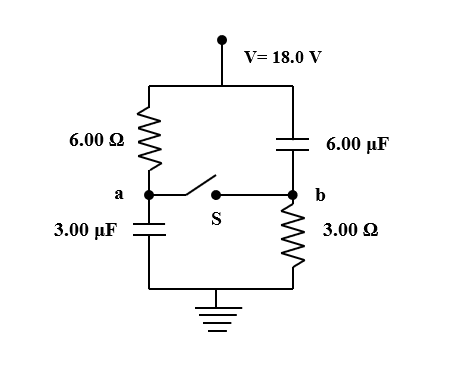
What is the steady state potential (in V) of point a with respect to point b in figure when switch S is open?
Answer
 Verified
596.7k+ views
Hint: In a steady state, the capacitor becomes open. So, no current will flow through them. We also know, no current flows through an open switch. Thus, no current will flow through capacitors as well as open switches. Using this information, find the potential at point a and then the potential at point b. Subtract these potentials to get the steady state potential of point a with respect to point b in figure when switch S is open.
Complete answer:
As it is a steady state, the capacitors are fully charged and they behave as an open circuit. Current does not pass through an open circuit. Thus, no current will pass through the capacitors. It is given that the switch S is open, so the current will only pass through $6\Omega$ resistor up to point a and will not flow through the remaining circuit.
Thus, the voltage at point a is given by,
${V}_{a}= 18 V$
Voltage at point b will be,
${V}_{b}=0$
Potential of point a with respect to point b is given by,
${V}_{ab}= {V}_{a}-{V}_{b}$
Substituting the values in above equation we get,
${V}_{ab}=18-0$
$\Rightarrow {V}_{ab}= 18 V$
Thus, the steady state potential (in V) of point a with respect to point b in figure when switch S is open is 18 V.
Note:
Students should not get confused between an open and a close circuit. Current passes through a closed circuit but it does not flow through an open circuit. The term steady state is a state of circuit in which the charge or current flowing into any point in the circuit is equal to the charge or current flowing out of it. A system can attain steady state when the current at each point in the circuit is constant i.e. the current does not change with time.
Complete answer:
As it is a steady state, the capacitors are fully charged and they behave as an open circuit. Current does not pass through an open circuit. Thus, no current will pass through the capacitors. It is given that the switch S is open, so the current will only pass through $6\Omega$ resistor up to point a and will not flow through the remaining circuit.
Thus, the voltage at point a is given by,
${V}_{a}= 18 V$
Voltage at point b will be,
${V}_{b}=0$
Potential of point a with respect to point b is given by,
${V}_{ab}= {V}_{a}-{V}_{b}$
Substituting the values in above equation we get,
${V}_{ab}=18-0$
$\Rightarrow {V}_{ab}= 18 V$
Thus, the steady state potential (in V) of point a with respect to point b in figure when switch S is open is 18 V.
Note:
Students should not get confused between an open and a close circuit. Current passes through a closed circuit but it does not flow through an open circuit. The term steady state is a state of circuit in which the charge or current flowing into any point in the circuit is equal to the charge or current flowing out of it. A system can attain steady state when the current at each point in the circuit is constant i.e. the current does not change with time.
Recently Updated Pages
Master Class 12 Business Studies: Engaging Questions & Answers for Success

Master Class 12 Biology: Engaging Questions & Answers for Success
Master Class 12 Chemistry: Engaging Questions & Answers for Success
Class 12 Question and Answer - Your Ultimate Solutions Guide
Master Class 11 Social Science: Engaging Questions & Answers for Success
Master Class 11 English: Engaging Questions & Answers for Success
Trending doubts
Which is more stable and why class 12 chemistry CBSE
Which are the Top 10 Largest Countries of the World?
Draw a labelled sketch of the human eye class 12 physics CBSE
Differentiate between homogeneous and heterogeneous class 12 chemistry CBSE
What are the major means of transport Explain each class 12 social science CBSE
Sulphuric acid is known as the king of acids State class 12 chemistry CBSE