




Statement-1: Orthocentre of $\Delta $ where vertices are $\left( 8,2 \right),\left( 2,2 \right)\And \left( 8,6 \right)\text{ is }\left( 2,-2 \right).$
Statement-2: If $\Delta $ is right-angled $\Delta $ , then the orthocentre of $\Delta $ is the vertex having angle $90{}^\circ $.
A) Statement $1$ is true, statement $2$ is true; statement $2$ is the correct explanation for statement $1$.
B) Statement $1$ is true, statement $2$ is true; statement $2$ is not the correct explanation for statement $1$ .
C) Statement $1$ is true, statement $2$ is false.
D) Statement $1$ is false, statement $2$ is true.
Answer
 Verified
623.4k+ views
Hint: Centroid is the point of intersection of medians of a triangle.
Orthocentre is the point of intersection of altitudes of a triangle.
Circumcentre is the point of intersection of the perpendicular bisectors of the sides of a triangle.
Complete step-by-step answer:
Statement$1$:
Let the vertices of the triangle be $P\left( 8,2 \right),Q\left( 2,2 \right)$ and $R\left( 8,6 \right)$.
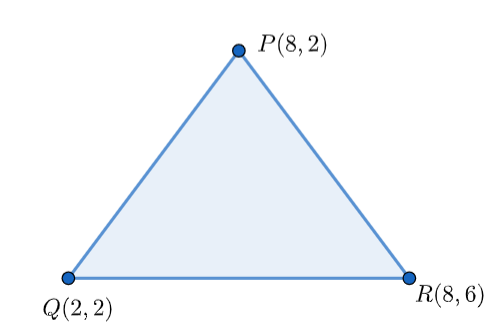
Now, we know the slope of the line joining $\left( {{x}_{1}},{{y}_{1}} \right)$ and $\left( {{x}_{2}},{{y}_{2}} \right)$ is given as $m=\dfrac{{{y}_{2}}-{{y}_{1}}}{{{x}_{2}}-{{x}_{1}}}$ .
So, the slope of $PQ={{m}_{PQ}}=\dfrac{2-2}{2-8}=0$ .
The slope of $PR={{m}_{PR}}=\dfrac{2-6}{8-8}=\infty $ .
Now, $PQ\And PR$ are perpendicular to each other. Hence, the triangle is right-angled . Now, we know in a right-angled triangle, the circumcentre is the midpoint of the hypotenuse .
Now, we will find the circumcentre, i.e. the midpoint of the hypotenuse.
We know, the midpoint of the line joining two points $\left( {{a}_{1}},{{b}_{1}} \right)$ and $\left( {{a}_{2}}{{b}_{2}} \right)$ is given as
$\left( \dfrac{{{a}_{1}}+{{a}_{2}}}{2},\dfrac{{{b}_{1}}+{{b}_{2}}}{2} \right)$
So, the midpoint of hypotenuse $QR$ is $\left( \dfrac{2+8}{2},\dfrac{2+6}{2} \right)$ .
$=C\left( 5,4 \right)$
Hence, the circumcentre of $\Delta PQR$ is $C\left( 5,4 \right)$ .
Now, we will find the centroid of $\Delta PQR$ .
We know the centroid of $\Delta $ with vertices \[\left( {{x}_{1}},{{y}_{1}} \right),\left( {{x}_{2}}{{y}_{2}} \right)\] and \[\left( {{x}_{3}}{{y}_{3}} \right)\] is given by:
$G\left( \dfrac{{{x}_{1}}+{{x}_{2}}+{{x}_{3}}}{3},\dfrac{{{y}_{1}}+{{y}_{2}}+{{y}_{3}}}{3} \right)$.
Hence, the centroid of $\Delta PQR$ is given by:
$G\left( \dfrac{8+2+8}{3},\dfrac{2+2+6}{3} \right)$
$=G\left( 6,\dfrac{10}{3} \right)$
Now, let the orthocentre of the triangle be $O\left( h,k \right)$ . We know, the centroid of a triangle divides the line joining orthocentre and circumcentre is the ratio $2:1$ .
Now, we know, if a point $\left( x,y \right)$ divides the line joining $\left( {{x}_{1}},{{y}_{1}} \right)$ and $\left( {{x}_{2}},{{y}_{2}} \right)$ in the ratio $m : n$, then
$\left( x,y \right)=\left( \dfrac{m{{x}_{2}}+n{{x}_{1}}}{m+n},\dfrac{m{{y}_{2}}+n{{y}_{1}}}{m+n} \right)$.
So, $\left( 6,\dfrac{10}{3} \right)=\left( \dfrac{\left( 1\times h \right)+\left( 2\times 5 \right)}{3},\dfrac{1\times k+\left( 2\times 4 \right)}{3} \right)$ .
Now, $6=\dfrac{h+10}{3}\Rightarrow h=8$
And $\dfrac{10}{3}=\dfrac{k+8}{3}\Rightarrow k=2$
So, the coordinates of orthocentre are $\left( 8,2 \right)$ .
Statement $2$ :
In a right-angled triangle, two sides are perpendicular to each other. Hence, they will be the altitudes and the meet at the vertex with $90{}^\circ $ angle.
Hence, the vertex with $90{}^\circ $ angle will be the orthocentre.
Hence, the correct option is option (d).
Note: The midpoint of the line joining the points$\left( {{x}_{1}},{{y}_{1}} \right)\text{ and }\left( {{x}_{2}},{{y}_{2}} \right)$ is given as:
$\left( \dfrac{\left( {{x}_{1}}+{{x}_{2}} \right)}{2},\dfrac{\left( {{y}_{1}}+{{y}_{2}} \right)}{2} \right)$ and not $\left( \dfrac{\left( {{x}_{1}}-{{x}_{2}} \right)}{2},\dfrac{\left( {{y}_{1}}-{{y}_{2}} \right)}{2} \right)$ . Students often get confused between the two. Due to this confusion, they generally end up getting a wrong answer. So, such mistakes should be avoided.
Orthocentre is the point of intersection of altitudes of a triangle.
Circumcentre is the point of intersection of the perpendicular bisectors of the sides of a triangle.
Complete step-by-step answer:
Statement$1$:
Let the vertices of the triangle be $P\left( 8,2 \right),Q\left( 2,2 \right)$ and $R\left( 8,6 \right)$.
Now, we know the slope of the line joining $\left( {{x}_{1}},{{y}_{1}} \right)$ and $\left( {{x}_{2}},{{y}_{2}} \right)$ is given as $m=\dfrac{{{y}_{2}}-{{y}_{1}}}{{{x}_{2}}-{{x}_{1}}}$ .
So, the slope of $PQ={{m}_{PQ}}=\dfrac{2-2}{2-8}=0$ .
The slope of $PR={{m}_{PR}}=\dfrac{2-6}{8-8}=\infty $ .
Now, $PQ\And PR$ are perpendicular to each other. Hence, the triangle is right-angled . Now, we know in a right-angled triangle, the circumcentre is the midpoint of the hypotenuse .
Now, we will find the circumcentre, i.e. the midpoint of the hypotenuse.
We know, the midpoint of the line joining two points $\left( {{a}_{1}},{{b}_{1}} \right)$ and $\left( {{a}_{2}}{{b}_{2}} \right)$ is given as
$\left( \dfrac{{{a}_{1}}+{{a}_{2}}}{2},\dfrac{{{b}_{1}}+{{b}_{2}}}{2} \right)$
So, the midpoint of hypotenuse $QR$ is $\left( \dfrac{2+8}{2},\dfrac{2+6}{2} \right)$ .
$=C\left( 5,4 \right)$
Hence, the circumcentre of $\Delta PQR$ is $C\left( 5,4 \right)$ .
Now, we will find the centroid of $\Delta PQR$ .
We know the centroid of $\Delta $ with vertices \[\left( {{x}_{1}},{{y}_{1}} \right),\left( {{x}_{2}}{{y}_{2}} \right)\] and \[\left( {{x}_{3}}{{y}_{3}} \right)\] is given by:
$G\left( \dfrac{{{x}_{1}}+{{x}_{2}}+{{x}_{3}}}{3},\dfrac{{{y}_{1}}+{{y}_{2}}+{{y}_{3}}}{3} \right)$.
Hence, the centroid of $\Delta PQR$ is given by:
$G\left( \dfrac{8+2+8}{3},\dfrac{2+2+6}{3} \right)$
$=G\left( 6,\dfrac{10}{3} \right)$
Now, let the orthocentre of the triangle be $O\left( h,k \right)$ . We know, the centroid of a triangle divides the line joining orthocentre and circumcentre is the ratio $2:1$ .
Now, we know, if a point $\left( x,y \right)$ divides the line joining $\left( {{x}_{1}},{{y}_{1}} \right)$ and $\left( {{x}_{2}},{{y}_{2}} \right)$ in the ratio $m : n$, then
$\left( x,y \right)=\left( \dfrac{m{{x}_{2}}+n{{x}_{1}}}{m+n},\dfrac{m{{y}_{2}}+n{{y}_{1}}}{m+n} \right)$.
So, $\left( 6,\dfrac{10}{3} \right)=\left( \dfrac{\left( 1\times h \right)+\left( 2\times 5 \right)}{3},\dfrac{1\times k+\left( 2\times 4 \right)}{3} \right)$ .
Now, $6=\dfrac{h+10}{3}\Rightarrow h=8$
And $\dfrac{10}{3}=\dfrac{k+8}{3}\Rightarrow k=2$
So, the coordinates of orthocentre are $\left( 8,2 \right)$ .
Statement $2$ :
In a right-angled triangle, two sides are perpendicular to each other. Hence, they will be the altitudes and the meet at the vertex with $90{}^\circ $ angle.
Hence, the vertex with $90{}^\circ $ angle will be the orthocentre.
Hence, the correct option is option (d).
Note: The midpoint of the line joining the points$\left( {{x}_{1}},{{y}_{1}} \right)\text{ and }\left( {{x}_{2}},{{y}_{2}} \right)$ is given as:
$\left( \dfrac{\left( {{x}_{1}}+{{x}_{2}} \right)}{2},\dfrac{\left( {{y}_{1}}+{{y}_{2}} \right)}{2} \right)$ and not $\left( \dfrac{\left( {{x}_{1}}-{{x}_{2}} \right)}{2},\dfrac{\left( {{y}_{1}}-{{y}_{2}} \right)}{2} \right)$ . Students often get confused between the two. Due to this confusion, they generally end up getting a wrong answer. So, such mistakes should be avoided.
Recently Updated Pages
Basicity of sulphurous acid and sulphuric acid are

Master Class 11 Business Studies: Engaging Questions & Answers for Success
Master Class 11 Computer Science: Engaging Questions & Answers for Success
Master Class 11 Economics: Engaging Questions & Answers for Success
Master Class 11 Social Science: Engaging Questions & Answers for Success
Master Class 11 English: Engaging Questions & Answers for Success
Trending doubts
One Metric ton is equal to kg A 10000 B 1000 C 100 class 11 physics CBSE
Explain zero factorial class 11 maths CBSE
State and prove Bernoullis theorem class 11 physics CBSE
What steps did the French revolutionaries take to create class 11 social science CBSE
The transition element that has lowest enthalpy of class 11 chemistry CBSE
Can anyone list 10 advantages and disadvantages of friction