




Statement I: The equation ${\left( {{{\sin }^{ - 1}}x} \right)^3} + {\left( {{{\cos }^{ - 1}}x} \right)^3} - a{\pi ^3} = 0$ has a solution for all $a \geqslant \dfrac{1}{{32}}$.
Statement II: For any $x \in \mathbb{R},{\text{ }}{\sin ^{ - 1}}x + {\cos ^{ - 1}}x = \dfrac{\pi }{2}$ and $0 \leqslant {\left( {{{\sin }^{ - 1}}x - \dfrac{\pi }{2}} \right)^2} \leqslant \dfrac{{9{\pi ^2}}}{{16}}.$
A) Both statements I and II are true.
B) Both statements I and II are true but I is not a correct explanation of II
C) Statement I is true and statement II is false
D) Statement I is false and statement II is true
Answer
 Verified
651.6k+ views
Hint: Reduce the given equation using the inverse trigonometric identity.
Roots (or solution) of an equation of variable $x$, is the value of $x$ which satisfies the equation.
The nature of the roots of a quadratic equation is determined by the value of the discriminant, denoted by D.
The discriminant of the quadratic equation $a{x^2} + bx + c$ would be ${b^2} - 4ac$ here, a,b and c are coefficients of the equation.
$D = {b^2} - 4ac$ (a, b and c are coefficients of the quadratic equation)
If $D < 0$, Equation would have complex roots (real part+ imaginary part)
If $D > 0$, Equation would have two distinct real roots
If $D = 0$, Equation would have two real and equal roots.
We consider the existence of a solution when the solution is real.
The domain of the function $f\left( x \right)$ , is a set of all values of x for which the function is valid. The range is the set of all output values of the function.
Complete step-by-step answer:
Step 1: Analysing statement I
Given equation: ${\left( {{{\sin }^{ - 1}}x} \right)^3} + {\left( {{{\cos }^{ - 1}}x} \right)^3} - a{\pi ^3} = 0$
Take ${\sin ^{ - 1}}x = t$
Using inverse trigonometric identity:
${\sin ^{ - 1}}x + {\cos ^{ - 1}}x = \dfrac{\pi }{2}$
$\because {\cos ^{ - 1}}x = \dfrac{\pi }{2} - {\sin ^{ - 1}}x$
Therefore, in terms of ‘t’, ${\cos ^{ - 1}}x = \dfrac{\pi }{2} - t$
Substituting in the given equation.
\[{\left( t \right)^3} + {\left( {\dfrac{\pi }{2} - t} \right)^3} - a{\pi ^3} = 0\] …… (1)
Expand \[{\left( {\dfrac{\pi }{2} - t} \right)^3}\] using identity ${\left( {a - b} \right)^3}$
i.e. ${\left( {a - b} \right)^3} = {a^3} - {b^3} - 3{a^2}b + 3a{b^2}$
on comparing, $a = \dfrac{\pi }{2},b = t$
$
{\left( {\dfrac{\pi }{2} - t} \right)^3} = {\left( {\dfrac{\pi }{2}} \right)^3} - {t^3} - 3{\left( {\dfrac{\pi }{2}} \right)^2}t + 3 \times \dfrac{\pi }{2}{t^2} \\
\Rightarrow {\dfrac{\pi }{8}^3} - {t^3} - {\dfrac{{3\pi }}{4}^2}t + \dfrac{{3\pi }}{2}{t^2} \\
$
On substituting in equation (1)
$
{t^3} + {\dfrac{\pi }{8}^3} - {t^3} - {\dfrac{{3\pi }}{4}^2}t + \dfrac{{3\pi }}{2}{t^2} - a{\pi ^3} = 0 \\
\Rightarrow \dfrac{{3\pi }}{2}{t^2} - {\dfrac{{3\pi }}{4}^2}t + {\dfrac{\pi }{8}^3} - a{\pi ^3} = 0 \\
$
Taking $\pi $as common and multiplying both sides by 2.
$ \Rightarrow 3{t^2} - \dfrac{{3\pi }}{2}t + {\dfrac{\pi }{4}^2} - 2a{\pi ^2} = 0$ …… (2)
Equation (2) is a quadratic equation in variable ‘t’
On comparing with the standard quadratic equation: $a{x^2} + bx + c = 0$
$a = 3,{\text{ }}b = - \dfrac{{3\pi }}{2},{\text{ }}c = {\dfrac{\pi }{4}^2} - 2a{\pi ^2}$
We know, the solution of a quadratic equation exists for $D \geqslant 0$
$D = {b^2} - 4ac$
Here, D is discriminant
Therefore, ${\left( { - \dfrac{{3\pi }}{2}} \right)^2} - 4 \times 3\left( {{{\dfrac{\pi }{4}}^2} - 2a{\pi ^2}} \right) \geqslant 0$
$
\Rightarrow \dfrac{{9{\pi ^2}}}{4} - 3{\pi ^2} + 24a{\pi ^2} \geqslant 0 \\
\Rightarrow \dfrac{{9{\pi ^2} - 12{\pi ^2}}}{4} + 24a{\pi ^2} \geqslant 0 \\
\Rightarrow \dfrac{{ - 3{\pi ^2}}}{4} + 24a{\pi ^2} \geqslant 0 \\
\Rightarrow 24a{\pi ^2} \geqslant \dfrac{{3{\pi ^2}}}{4} \\
\Rightarrow 24a \geqslant \dfrac{3}{4} \\
\Rightarrow a \geqslant \dfrac{3}{{4 \times 24}} \\
\Rightarrow a \geqslant \dfrac{1}{{32}} \\
$
Thus, the solution of the given equation exists when $a \geqslant \dfrac{1}{{32}}$.
Step 2: Analysing statement II
The inverse trigonometric identity:
${\sin ^{ - 1}}x + {\cos ^{ - 1}}x = \dfrac{\pi }{2}$ is valid for $x \in \left[ { - 1,1} \right]$
Graph of $y = {\sin ^{ - 1}}x$
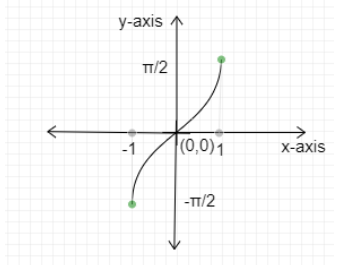
Domain: $\left[ { - 1,1} \right]$
Range: $\left[ { - \dfrac{\pi }{2},\dfrac{\pi }{2}} \right]$
$ \Rightarrow - \dfrac{\pi }{2} \leqslant {\sin ^{ - 1}}x \leqslant \dfrac{\pi }{2}$
Subtracting $\dfrac{\pi }{4}$ to both sides of the inequality.
$
\Rightarrow - \dfrac{\pi }{2} - \dfrac{\pi }{4} \leqslant \left( {{{\sin }^{ - 1}}x - \dfrac{\pi }{4}} \right) \leqslant \dfrac{\pi }{2} - \dfrac{\pi }{4} \\
\Rightarrow - \dfrac{{3\pi }}{4} \leqslant \left( {{{\sin }^{ - 1}}x - \dfrac{\pi }{4}} \right) \leqslant \dfrac{\pi }{4} \\
$
On squaring both sides of the inequality, we get
$0 \leqslant {\left( {{{\sin }^{ - 1}}x - \dfrac{\pi }{4}} \right)^2} \leqslant \dfrac{{9{\pi ^2}}}{{16}}$
In the given statement II, the interval for x is, $x \in \mathbb{R}$ ; but the above equations and expressions are true (or valid) for only $x \in \left[ { - 1,1} \right]$.
On analysis, the statement I comes out to be true but statement II is false. Thus, the correct option is (C).
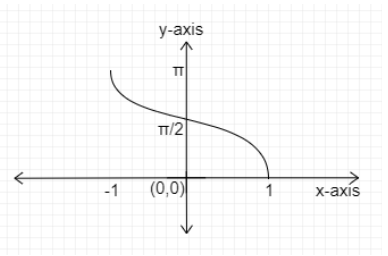
Note: Following graph will be useful in future reference.
The graph of \[y = {\cos ^{ - 1}}x\] :
Domain: $\left[ { - 1,1} \right]$
Range: $\left[ {0,\pi } \right]$
Students might go wrong while squaring the inequality $ - \dfrac{{3\pi }}{4} \leqslant \left( {{{\sin }^{ - 1}}x - \dfrac{\pi }{4}} \right) \leqslant \dfrac{\pi }{4}$.
They might write $\dfrac{{9{\pi ^2}}}{{16}} \leqslant {\left( {{{\sin }^{ - 1}}x - \dfrac{\pi }{4}} \right)^2} \leqslant \dfrac{{{\pi ^2}}}{{16}}$ , this is wrong for the following reasons.
The square of a real number is always greater and equal to zero. This implies $0 \leqslant {\left( {{{\sin }^{ - 1}}x - \dfrac{\pi }{4}} \right)^2}$.
The square of numbers from $\dfrac{{ - 3\pi }}{4}{\text{ to 0}}$ lies between $0{\text{ to }}\dfrac{{9{\pi ^2}}}{{16}}$; and the square of numbers from $0{\text{ to }}\dfrac{\pi }{4}$ lies between $0{\text{ to }}\dfrac{{{\pi ^2}}}{{16}}$; thus, the square of numbers from $\dfrac{{ - 3\pi }}{4}{\text{ to }}\dfrac{\pi }{4}$ lies between $0{\text{ to }}\dfrac{{9{\pi ^2}}}{{16}}$. Therefore the correct inequality is: $0 \leqslant {\left( {{{\sin }^{ - 1}}x - \dfrac{\pi }{4}} \right)^2} \leqslant \dfrac{{9{\pi ^2}}}{{16}}$ .
Roots (or solution) of an equation of variable $x$, is the value of $x$ which satisfies the equation.
The nature of the roots of a quadratic equation is determined by the value of the discriminant, denoted by D.
The discriminant of the quadratic equation $a{x^2} + bx + c$ would be ${b^2} - 4ac$ here, a,b and c are coefficients of the equation.
$D = {b^2} - 4ac$ (a, b and c are coefficients of the quadratic equation)
If $D < 0$, Equation would have complex roots (real part+ imaginary part)
If $D > 0$, Equation would have two distinct real roots
If $D = 0$, Equation would have two real and equal roots.
We consider the existence of a solution when the solution is real.
The domain of the function $f\left( x \right)$ , is a set of all values of x for which the function is valid. The range is the set of all output values of the function.
Complete step-by-step answer:
Step 1: Analysing statement I
Given equation: ${\left( {{{\sin }^{ - 1}}x} \right)^3} + {\left( {{{\cos }^{ - 1}}x} \right)^3} - a{\pi ^3} = 0$
Take ${\sin ^{ - 1}}x = t$
Using inverse trigonometric identity:
${\sin ^{ - 1}}x + {\cos ^{ - 1}}x = \dfrac{\pi }{2}$
$\because {\cos ^{ - 1}}x = \dfrac{\pi }{2} - {\sin ^{ - 1}}x$
Therefore, in terms of ‘t’, ${\cos ^{ - 1}}x = \dfrac{\pi }{2} - t$
Substituting in the given equation.
\[{\left( t \right)^3} + {\left( {\dfrac{\pi }{2} - t} \right)^3} - a{\pi ^3} = 0\] …… (1)
Expand \[{\left( {\dfrac{\pi }{2} - t} \right)^3}\] using identity ${\left( {a - b} \right)^3}$
i.e. ${\left( {a - b} \right)^3} = {a^3} - {b^3} - 3{a^2}b + 3a{b^2}$
on comparing, $a = \dfrac{\pi }{2},b = t$
$
{\left( {\dfrac{\pi }{2} - t} \right)^3} = {\left( {\dfrac{\pi }{2}} \right)^3} - {t^3} - 3{\left( {\dfrac{\pi }{2}} \right)^2}t + 3 \times \dfrac{\pi }{2}{t^2} \\
\Rightarrow {\dfrac{\pi }{8}^3} - {t^3} - {\dfrac{{3\pi }}{4}^2}t + \dfrac{{3\pi }}{2}{t^2} \\
$
On substituting in equation (1)
$
{t^3} + {\dfrac{\pi }{8}^3} - {t^3} - {\dfrac{{3\pi }}{4}^2}t + \dfrac{{3\pi }}{2}{t^2} - a{\pi ^3} = 0 \\
\Rightarrow \dfrac{{3\pi }}{2}{t^2} - {\dfrac{{3\pi }}{4}^2}t + {\dfrac{\pi }{8}^3} - a{\pi ^3} = 0 \\
$
Taking $\pi $as common and multiplying both sides by 2.
$ \Rightarrow 3{t^2} - \dfrac{{3\pi }}{2}t + {\dfrac{\pi }{4}^2} - 2a{\pi ^2} = 0$ …… (2)
Equation (2) is a quadratic equation in variable ‘t’
On comparing with the standard quadratic equation: $a{x^2} + bx + c = 0$
$a = 3,{\text{ }}b = - \dfrac{{3\pi }}{2},{\text{ }}c = {\dfrac{\pi }{4}^2} - 2a{\pi ^2}$
We know, the solution of a quadratic equation exists for $D \geqslant 0$
$D = {b^2} - 4ac$
Here, D is discriminant
Therefore, ${\left( { - \dfrac{{3\pi }}{2}} \right)^2} - 4 \times 3\left( {{{\dfrac{\pi }{4}}^2} - 2a{\pi ^2}} \right) \geqslant 0$
$
\Rightarrow \dfrac{{9{\pi ^2}}}{4} - 3{\pi ^2} + 24a{\pi ^2} \geqslant 0 \\
\Rightarrow \dfrac{{9{\pi ^2} - 12{\pi ^2}}}{4} + 24a{\pi ^2} \geqslant 0 \\
\Rightarrow \dfrac{{ - 3{\pi ^2}}}{4} + 24a{\pi ^2} \geqslant 0 \\
\Rightarrow 24a{\pi ^2} \geqslant \dfrac{{3{\pi ^2}}}{4} \\
\Rightarrow 24a \geqslant \dfrac{3}{4} \\
\Rightarrow a \geqslant \dfrac{3}{{4 \times 24}} \\
\Rightarrow a \geqslant \dfrac{1}{{32}} \\
$
Thus, the solution of the given equation exists when $a \geqslant \dfrac{1}{{32}}$.
Step 2: Analysing statement II
The inverse trigonometric identity:
${\sin ^{ - 1}}x + {\cos ^{ - 1}}x = \dfrac{\pi }{2}$ is valid for $x \in \left[ { - 1,1} \right]$
Graph of $y = {\sin ^{ - 1}}x$
Domain: $\left[ { - 1,1} \right]$
Range: $\left[ { - \dfrac{\pi }{2},\dfrac{\pi }{2}} \right]$
$ \Rightarrow - \dfrac{\pi }{2} \leqslant {\sin ^{ - 1}}x \leqslant \dfrac{\pi }{2}$
Subtracting $\dfrac{\pi }{4}$ to both sides of the inequality.
$
\Rightarrow - \dfrac{\pi }{2} - \dfrac{\pi }{4} \leqslant \left( {{{\sin }^{ - 1}}x - \dfrac{\pi }{4}} \right) \leqslant \dfrac{\pi }{2} - \dfrac{\pi }{4} \\
\Rightarrow - \dfrac{{3\pi }}{4} \leqslant \left( {{{\sin }^{ - 1}}x - \dfrac{\pi }{4}} \right) \leqslant \dfrac{\pi }{4} \\
$
On squaring both sides of the inequality, we get
$0 \leqslant {\left( {{{\sin }^{ - 1}}x - \dfrac{\pi }{4}} \right)^2} \leqslant \dfrac{{9{\pi ^2}}}{{16}}$
In the given statement II, the interval for x is, $x \in \mathbb{R}$ ; but the above equations and expressions are true (or valid) for only $x \in \left[ { - 1,1} \right]$.
On analysis, the statement I comes out to be true but statement II is false. Thus, the correct option is (C).
Note: Following graph will be useful in future reference.
The graph of \[y = {\cos ^{ - 1}}x\] :
Domain: $\left[ { - 1,1} \right]$
Range: $\left[ {0,\pi } \right]$
Students might go wrong while squaring the inequality $ - \dfrac{{3\pi }}{4} \leqslant \left( {{{\sin }^{ - 1}}x - \dfrac{\pi }{4}} \right) \leqslant \dfrac{\pi }{4}$.
They might write $\dfrac{{9{\pi ^2}}}{{16}} \leqslant {\left( {{{\sin }^{ - 1}}x - \dfrac{\pi }{4}} \right)^2} \leqslant \dfrac{{{\pi ^2}}}{{16}}$ , this is wrong for the following reasons.
The square of a real number is always greater and equal to zero. This implies $0 \leqslant {\left( {{{\sin }^{ - 1}}x - \dfrac{\pi }{4}} \right)^2}$.
The square of numbers from $\dfrac{{ - 3\pi }}{4}{\text{ to 0}}$ lies between $0{\text{ to }}\dfrac{{9{\pi ^2}}}{{16}}$; and the square of numbers from $0{\text{ to }}\dfrac{\pi }{4}$ lies between $0{\text{ to }}\dfrac{{{\pi ^2}}}{{16}}$; thus, the square of numbers from $\dfrac{{ - 3\pi }}{4}{\text{ to }}\dfrac{\pi }{4}$ lies between $0{\text{ to }}\dfrac{{9{\pi ^2}}}{{16}}$. Therefore the correct inequality is: $0 \leqslant {\left( {{{\sin }^{ - 1}}x - \dfrac{\pi }{4}} \right)^2} \leqslant \dfrac{{9{\pi ^2}}}{{16}}$ .
Recently Updated Pages
Which of the following graphs shows the variation of class 12 physics CBSE

Draw a labelled diagram of the human male reproductive class 12 biology CBSE
Describe the experiment to compare the emf of two cells class 12 physics CBSE
What is standard hydrogen electrode
What is conventional current and electric current class 12 physics CBSE
2Bromopentane is treated with an alcoholic KOH solution class 12 chemistry CBSE
Trending doubts
Draw a labelled sketch of the human eye class 12 physics CBSE
Which are the Top 10 Largest Countries of the World?
Differentiate between homogeneous and heterogeneous class 12 chemistry CBSE
Draw ray diagrams each showing i myopic eye and ii class 12 physics CBSE
Which is the correct genotypic ratio of mendel dihybrid class 12 biology CBSE
What is the Full Form of PVC, PET, HDPE, LDPE, PP and PS ?