




Statement I: \[CC{l_4}\]is a nonpolar compound.
Statement II: The dipole moments are canceled out.
a.) Statement 1 and Statement 2 are correct and Statement 2 is the correct explanation of Statement 1.
b.) Both the Statement 1 and Statement 2 are correct and Statement 2 is not the correct explanation of Statement 1.
c.) Statement 1 is correct but Statement 2 is not correct.
d.) Statement 1 is not correct but Statement 2 is correct.
e.) Both the Statement 1 and Statement 2 are not correct.
Answer
 Verified
616.5k+ views
Hint: We must recall that a molecule is said to be polar when the atoms that form the molecule are arranged in a way that gives one end of the molecule a positive charge while the other end of the molecule becomes negatively charged.
Complete step by step answer:
A polar molecule is created when an atom that has a high electronegativity combines or bonds with an atom which has a weaker electronegativity level. Thus, the resulting molecule has one region with high electronegativity and another with lower electronegativity or electrical poles.
In the molecule here, the four chlorine atoms are positioned symmetrically at the four corners of a tetrahedron, and a single bond joins each of them to the carbon atom in the center of the molecule. As a result, \[CC{l_4}\] has no net positive or negative dipole moment. But if an atom other than chlorine had been positioned at any other place in a molecule, the molecule would instead have a dipole moment and \[CC{l_4}\]would be polar as a result.
The structure of Carbon tetrachloride is illustrated below for better understanding.
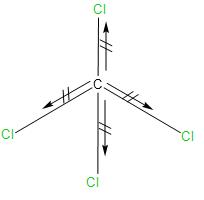
To sum it up, a molecule that has dipoles does not cancel each other out is polar, whereas nonpolar molecules are those where the charges of atoms cancel one another out and there is no charge at one end of the molecule or the other.
Hence, the correct answer is Option (A)
Note:
We should note that nonpolar molecules lack electrical poles, and the electrons within them are distributed in a more equal manner. Nonpolar molecules lack any charge at either end of the molecule. Most hydrocarbon liquids are nonpolar in nature.
Complete step by step answer:
A polar molecule is created when an atom that has a high electronegativity combines or bonds with an atom which has a weaker electronegativity level. Thus, the resulting molecule has one region with high electronegativity and another with lower electronegativity or electrical poles.
In the molecule here, the four chlorine atoms are positioned symmetrically at the four corners of a tetrahedron, and a single bond joins each of them to the carbon atom in the center of the molecule. As a result, \[CC{l_4}\] has no net positive or negative dipole moment. But if an atom other than chlorine had been positioned at any other place in a molecule, the molecule would instead have a dipole moment and \[CC{l_4}\]would be polar as a result.
The structure of Carbon tetrachloride is illustrated below for better understanding.
To sum it up, a molecule that has dipoles does not cancel each other out is polar, whereas nonpolar molecules are those where the charges of atoms cancel one another out and there is no charge at one end of the molecule or the other.
Hence, the correct answer is Option (A)
Note:
We should note that nonpolar molecules lack electrical poles, and the electrons within them are distributed in a more equal manner. Nonpolar molecules lack any charge at either end of the molecule. Most hydrocarbon liquids are nonpolar in nature.
Recently Updated Pages
Master Class 11 Social Science: Engaging Questions & Answers for Success

Master Class 11 Physics: Engaging Questions & Answers for Success
Master Class 11 Maths: Engaging Questions & Answers for Success
Master Class 11 Economics: Engaging Questions & Answers for Success
Master Class 11 Computer Science: Engaging Questions & Answers for Success
Master Class 11 Chemistry: Engaging Questions & Answers for Success
Trending doubts
One Metric ton is equal to kg A 10000 B 1000 C 100 class 11 physics CBSE
How many bones are in the spine class 11 biology CBSE
There are 720 permutations of the digits 1 2 3 4 5 class 11 maths CBSE
State and prove Bernoullis theorem class 11 physics CBSE
Difference Between Prokaryotic Cells and Eukaryotic Cells
1 Quintal is equal to a 110 kg b 10 kg c 100kg d 1000 class 11 physics CBSE