




Statement: Aluminium chloride $\text{ AlC}{{\text{l}}_{\text{3}}}\text{ }$ is a Lewis acid because it can donate the electron.
If a given statement is true enter 1 if false enter 0.
Answer
 Verified
605.7k+ views
Hint: Lewis suggested the acid-base concept. According to which the Lewis base is a chemical species that can donate the electron pair and Lewis base is a chemical species that can easily accept the electron pair. $\text{ AlC}{{\text{l}}_{\text{3}}}\text{ }$ has an empty orbital and accommodates the electron pair in an empty orbital.
Complete answer:
Lewis acid is an ion or a molecule that accepts the nonbonding valence electrons in its empty orbital. Lewis base is an ion or molecule which can donate an electron pair.
Aluminium trichloride $\text{ AlC}{{\text{l}}_{\text{3}}}\text{ }$ is an electron-deficient species.it has three electrons in the valence shell. The electronic configuration of aluminium is $\text{ Al = }\left[ \text{Ne} \right]\text{3}{{\text{s}}^{\text{2}}}\text{3}{{\text{p}}^{\text{1}}}\text{3}{{\text{d}}^{\text{0 }}}$
In $\text{ AlC}{{\text{l}}_{\text{3}}}\text{ }$ aluminium loses its three valence shell electrons. Two electrons from the 3s orbitals and one electron from the 3p orbital. When bonded with chlorine $\text{ A}{{\text{l}}^{\text{3+ }}}$ has empty 3s, 3p, and 3d orbitals. These empty orbitals are used to accommodate the nonbonding pair of the electron which are donated by the Lewis base.
Let’s consider a reaction of $\text{ A}{{\text{l}}^{\text{3+ }}}$ the water molecule. The $\text{ A}{{\text{l}}^{\text{3+ }}}$ ion is an electron-deficient species and bonds three chloride molecules. The bonding between the aluminium and chloride is as shown below,
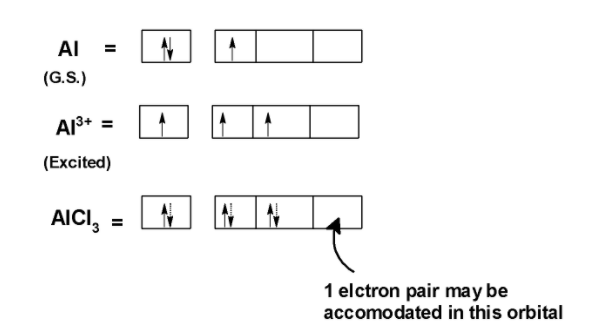
One orbital of the $\text{ AlC}{{\text{l}}_{\text{3}}}\text{ }$ is empty. This orbit can accommodate the nonbonding electron pair of electrons. Thus $\text{ AlC}{{\text{l}}_{\text{3}}}\text{ }$ acts as a Lewis acid because it can accept an electron.
Thus the given statement is false.
Hence, ‘0’ is the correct answer.
Note: Lewis acid is used as a catalyst in Friedel craft reaction. $\text{ AlC}{{\text{l}}_{\text{3}}}\text{ }$ accepts the lone pair from chloride ion and form the $\text{ AlCl}_{4}^{-}\text{ }$ ion. This forms a carbonium ion which further acts as a strong Lewis acid. Thus Friedel craft acylation and alkylation reactions are facilitated by $\text{ AlC}{{\text{l}}_{\text{3}}}\text{ }$ the catalyst.
Complete answer:
Lewis acid is an ion or a molecule that accepts the nonbonding valence electrons in its empty orbital. Lewis base is an ion or molecule which can donate an electron pair.
Aluminium trichloride $\text{ AlC}{{\text{l}}_{\text{3}}}\text{ }$ is an electron-deficient species.it has three electrons in the valence shell. The electronic configuration of aluminium is $\text{ Al = }\left[ \text{Ne} \right]\text{3}{{\text{s}}^{\text{2}}}\text{3}{{\text{p}}^{\text{1}}}\text{3}{{\text{d}}^{\text{0 }}}$
In $\text{ AlC}{{\text{l}}_{\text{3}}}\text{ }$ aluminium loses its three valence shell electrons. Two electrons from the 3s orbitals and one electron from the 3p orbital. When bonded with chlorine $\text{ A}{{\text{l}}^{\text{3+ }}}$ has empty 3s, 3p, and 3d orbitals. These empty orbitals are used to accommodate the nonbonding pair of the electron which are donated by the Lewis base.
Let’s consider a reaction of $\text{ A}{{\text{l}}^{\text{3+ }}}$ the water molecule. The $\text{ A}{{\text{l}}^{\text{3+ }}}$ ion is an electron-deficient species and bonds three chloride molecules. The bonding between the aluminium and chloride is as shown below,
One orbital of the $\text{ AlC}{{\text{l}}_{\text{3}}}\text{ }$ is empty. This orbit can accommodate the nonbonding electron pair of electrons. Thus $\text{ AlC}{{\text{l}}_{\text{3}}}\text{ }$ acts as a Lewis acid because it can accept an electron.
Thus the given statement is false.
Hence, ‘0’ is the correct answer.
Note: Lewis acid is used as a catalyst in Friedel craft reaction. $\text{ AlC}{{\text{l}}_{\text{3}}}\text{ }$ accepts the lone pair from chloride ion and form the $\text{ AlCl}_{4}^{-}\text{ }$ ion. This forms a carbonium ion which further acts as a strong Lewis acid. Thus Friedel craft acylation and alkylation reactions are facilitated by $\text{ AlC}{{\text{l}}_{\text{3}}}\text{ }$ the catalyst.
Recently Updated Pages
Master Class 12 Economics: Engaging Questions & Answers for Success

Master Class 12 English: Engaging Questions & Answers for Success
Master Class 12 Social Science: Engaging Questions & Answers for Success
Master Class 12 Maths: Engaging Questions & Answers for Success
Master Class 12 Physics: Engaging Questions & Answers for Success
Master Class 11 Social Science: Engaging Questions & Answers for Success
Trending doubts
One Metric ton is equal to kg A 10000 B 1000 C 100 class 11 physics CBSE
Difference Between Prokaryotic Cells and Eukaryotic Cells
Find the value of the expression given below sin 30circ class 11 maths CBSE
Two of the body parts which do not appear in MRI are class 11 biology CBSE
Draw a diagram of nephron and explain its structur class 11 biology CBSE
10 examples of friction in our daily life