




Statement 1: Reduction of but-2-yne by Na/liq. $N{{H}_{3}}$ gives trans but-2-ene.
Statement 2: It is an example of anti-addition.
A. Statement-1 is true, statement-2 is true and statement-2 is the correct explanation for the statement-1.
B. Statement-1 is true, statement-2 is true and statement-2 is NOT the correct explanation for the statement-1.
C. Statement-1 is true, statement-2 is false
D. Statement-1 is false, statement-2 is true
Answer
 Verified
610.2k+ views
Hint: The process of addition of electrons or addition of hydrogens is called reduction. The structure of but-2-yne is as follows.
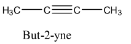
There is a triple bond at the center of the molecule.
Complete step by step answer:
- In the question it is asked to find the correct statements among the given two statements.
- Generally the compound which contains double or rippled bonds undergoes additional reactions and forms saturated compounds as the products.
- Generally reduction reactions are going to carry out the presence of hydrogen in the presence of Lindlar catalysts.
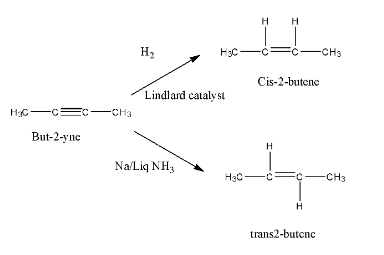
- In the presence of the Lindlar catalyst the product formed by the but-2-yne is cis -2-butene.
- But in the question it is given that but-2-yne is going to react with liquid ammonia in the presence of sodium.
- The chemical reaction of but-2-yne with hydrogen Lindlar catalyst and the sodium liquid ammonia is as follows.
- Therefore by observing the given statements
Statement 1: Reduction of but-2-yne by Na/liq. $N{{H}_{3}}$ gives trans but-2-ene.
Statement 2: It is an example of anti-addition.
Both the statements are correct and statement 2 is a right explanation form statement 1.
Therefore the correct option is option A.
Note: In the presence of sodium and liquid ammonia anti addition takes place and leads to the formation of trans-2-butene as the product. Linlard catalyst favors the formation of the cis but-2-ene as the product.
There is a triple bond at the center of the molecule.
Complete step by step answer:
- In the question it is asked to find the correct statements among the given two statements.
- Generally the compound which contains double or rippled bonds undergoes additional reactions and forms saturated compounds as the products.
- Generally reduction reactions are going to carry out the presence of hydrogen in the presence of Lindlar catalysts.
- In the presence of the Lindlar catalyst the product formed by the but-2-yne is cis -2-butene.
- But in the question it is given that but-2-yne is going to react with liquid ammonia in the presence of sodium.
- The chemical reaction of but-2-yne with hydrogen Lindlar catalyst and the sodium liquid ammonia is as follows.
- Therefore by observing the given statements
Statement 1: Reduction of but-2-yne by Na/liq. $N{{H}_{3}}$ gives trans but-2-ene.
Statement 2: It is an example of anti-addition.
Both the statements are correct and statement 2 is a right explanation form statement 1.
Therefore the correct option is option A.
Note: In the presence of sodium and liquid ammonia anti addition takes place and leads to the formation of trans-2-butene as the product. Linlard catalyst favors the formation of the cis but-2-ene as the product.
Recently Updated Pages
Which will be the least stable resonating structure class 11 chemistry CBSE

How many 5 digit telephone numbers can be construc-class-11-maths-CBSE
How do you find the angle of the resultant vector class 11 physics CBSE
Draw labelled diagram of the following i Gram seed class 11 biology CBSE
1 Quintal is equal to a 110 kg b 10 kg c 100kg d 1000 class 11 physics CBSE
What is the need and importance of classification class 11 biology CBSE
Trending doubts
Find the value of the expression given below sin 30circ class 11 maths CBSE
One Metric ton is equal to kg A 10000 B 1000 C 100 class 11 physics CBSE
10 examples of friction in our daily life
Draw a diagram of a plant cell and label at least eight class 11 biology CBSE
Difference between physical and chemical change class 11 chemistry CBSE
Proton was discovered by A Thomson B Rutherford C Chadwick class 11 chemistry CBSE