



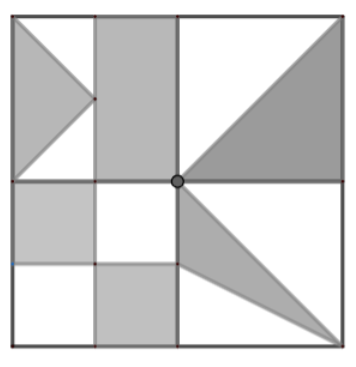
Statement 1: Fraction of shaded portion of is \[\dfrac{7}{16}\] .
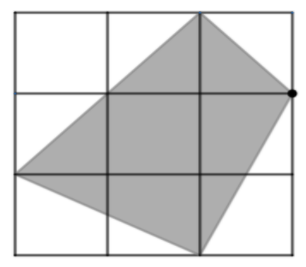
Statement 2: Fraction of shaded portion of is \[\dfrac{4}{9}\] .
Which of the following options holds?
(A) Both statement-1 and statement-2 are true.
(B) Statement-1 is true but statement-2 is false.
(C) Statement-1 is false but statement-2 is true.
(D) Both statement-1 and statement-2 are false.
Answer
 Verified
576.9k+ views
Hint: Label the small portions in the diagram given in both of statements. Now, calculate the fraction of the small shaded portions for both diagrams. Now, add all those fractions of the small shaded portions for both diagrams and calculate the fraction of the entire shaded portion. At last, verify the calculated fraction of the entire shaded portion with the fraction as mentioned in the statements and conclude whether they are true or false.
Complete step-by-step solution:
First of all, let us solve the statement-1 and find the fraction of the shaded portion.
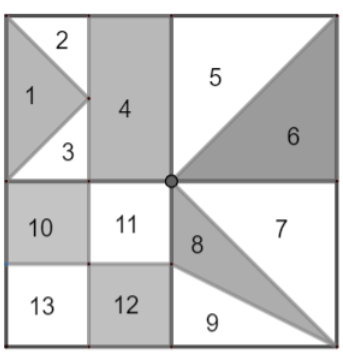
In the above diagram, we can observe that the section containing the portion labeled as 1, 2, 3, and 4 has a contribution equal to one-fourth of the total square.
Also, we can observe that the shaded portion labeled as 1 is one-fourth, and the portion labeled as 4 is one-half of the section containing the portion labeled as 1, 2, 3, and 4.
The fraction of the shaded portion labelled as 1 = \[\dfrac{1}{4}\times \dfrac{1}{4}=\dfrac{1}{16}\] ……………………………..(1)
The fraction of the shaded portion labelled as 4 = \[\dfrac{1}{4}\times \dfrac{1}{2}=\dfrac{1}{8}\] ……………………………..(2)
Similarly, we can observe that the section containing the portion labeled as 5 and 6 has a contribution equal to one-fourth of the total square.
Also, we can observe that the shaded portion labeled as 5 and 6 is one-half of the section containing the portion labeled as 5 and 6.
The fraction of the shaded portion labelled as 6 = \[\dfrac{1}{4}\times \dfrac{1}{2}=\dfrac{1}{8}\] ……………………………..(3)
Similarly, we can observe that the section containing the portion labeled as 10, 11, 12, and 13 has a contribution equal to one-fourth of the total square.
Also, we can observe that the shaded portion labeled as 10 and 12 is one-fourth of the section containing the portion labeled as 10, 11, 12, and 13.
The fraction of the shaded portion labelled as 10 = \[\dfrac{1}{4}\times \dfrac{1}{4}=\dfrac{1}{16}\] ……………………………..(4)
The fraction of the shaded portion labelled as 12 = \[\dfrac{1}{4}\times \dfrac{1}{4}=\dfrac{1}{16}\] ……………………………..(5)
Similarly, we can observe that the section containing the portion labeled as 5 and 6 has a contribution equal to one-fourth of the total square.
Also, we can observe that the portion labeled as 7 and combined potion 8 and 9 is one-half of the section containing the portion labeled as 7, 8, and 9.
The fraction of the shaded portion labelled as 8 = \[\dfrac{1}{4}\times \dfrac{1}{2}\times \dfrac{1}{2}=\dfrac{1}{16}\] …………………………………………..(6)
Now, on adding equation (1), equation (2), equation (3), equation (4), equation (5), and equation (6), we get
The fraction of the shaded portion = \[\dfrac{1}{16}+\dfrac{1}{8}+\dfrac{1}{8}+\dfrac{1}{16}+\dfrac{1}{16}+\dfrac{1}{16}=\dfrac{1}{2}\] …………………………………………(7)
But it is given that the fraction of the shaded portion is \[\dfrac{7}{16}\] …………………………………………….(8)
From equation (7) and equation (8), we can say that Statement-1 is false ………………………………….(9)
Now, let us solve the statement-2 and find the fraction of the shaded portion.
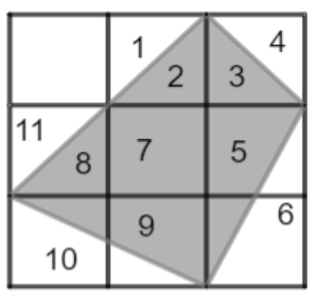
In the above diagram, we can observe that the section containing the combined portion labeled as 1 and 2, and the combined portion labeled as 3 and 4 have a contribution equal to one-ninth of the total square. Similarly, the combined portion labeled as 8 and 11 has a contribution equal to one-ninth of the total square.
Also, we can observe that the shaded portion labeled as 2 is one-half of the section containing the combined portion labeled as 1 and 2.
Similarly, the shaded portion labeled as 3 is one-half of the section containing the combined portion labeled as 3 and 4.
Similarly, the shaded portion labeled as 8 is one-half of the section containing the combined portion labeled as 11 and 8.
The fraction of the shaded portion labelled as 2 = \[\dfrac{1}{9}\times \dfrac{1}{2}=\dfrac{1}{18}\] ……………………………..(10)
The fraction of the shaded portion labelled as 3 = \[\dfrac{1}{9}\times \dfrac{1}{2}=\dfrac{1}{18}\] ……………………………..(11)
The fraction of the shaded portion labelled as 8 = \[\dfrac{1}{9}\times \dfrac{1}{2}=\dfrac{1}{18}\] ……………………………..(12)
We can observe that the portion labeled as 7 is one-ninth of the total.
The fraction of the shaded portion labeled as 7 = \[\dfrac{1}{9}\] ……………………………..(13)
We can also observe that the combined portion labeled as 9 and 10, and 5 and 6 is \[\dfrac{2}{9}\] of the total square.
Also, the portion labeled as 9 and 5 is one half of the combined portion labeled as 9 and 10, and 5 and 6 respectively.
The fraction of the shaded portion labelled as 9 = \[\dfrac{2}{9}\times \dfrac{1}{2}=\dfrac{1}{9}\] ………………………………………..(14)
The fraction of the shaded portion labelled as 5 = \[\dfrac{2}{9}\times \dfrac{1}{2}=\dfrac{1}{9}\] ………………………………………..(15)
Now, on adding equation (10), equation (11), equation (12), equation (13), equation (14), and equation (15), we get
The fraction of the shaded portion = \[\dfrac{1}{18}+\dfrac{1}{18}+\dfrac{1}{18}+\dfrac{1}{9}+\dfrac{1}{9}+\dfrac{1}{9}=\dfrac{1}{6}+\dfrac{1}{3}=\dfrac{3}{6}=\dfrac{1}{2}\] …………………………..(16)
But it is given that the fraction of the shaded portion is \[\dfrac{4}{9}\] ……………………………………….(17)
From equation (16) and equation (17), we can say that statement-2 is false ………………………………………………..(18)
Now, from equation (9) and equation (18), we have
Both statement-1 and statement-2 are false.
Hence, the correct option is (D).
Note: In this question, one might make a silly mistake in calculations while finding out the fraction of the shaded portion. Therefore, first of all, find the fraction of a small-small shaded portion and then add those all to obtain the fraction of the entire shaded portion.
Complete step-by-step solution:
First of all, let us solve the statement-1 and find the fraction of the shaded portion.
In the above diagram, we can observe that the section containing the portion labeled as 1, 2, 3, and 4 has a contribution equal to one-fourth of the total square.
Also, we can observe that the shaded portion labeled as 1 is one-fourth, and the portion labeled as 4 is one-half of the section containing the portion labeled as 1, 2, 3, and 4.
The fraction of the shaded portion labelled as 1 = \[\dfrac{1}{4}\times \dfrac{1}{4}=\dfrac{1}{16}\] ……………………………..(1)
The fraction of the shaded portion labelled as 4 = \[\dfrac{1}{4}\times \dfrac{1}{2}=\dfrac{1}{8}\] ……………………………..(2)
Similarly, we can observe that the section containing the portion labeled as 5 and 6 has a contribution equal to one-fourth of the total square.
Also, we can observe that the shaded portion labeled as 5 and 6 is one-half of the section containing the portion labeled as 5 and 6.
The fraction of the shaded portion labelled as 6 = \[\dfrac{1}{4}\times \dfrac{1}{2}=\dfrac{1}{8}\] ……………………………..(3)
Similarly, we can observe that the section containing the portion labeled as 10, 11, 12, and 13 has a contribution equal to one-fourth of the total square.
Also, we can observe that the shaded portion labeled as 10 and 12 is one-fourth of the section containing the portion labeled as 10, 11, 12, and 13.
The fraction of the shaded portion labelled as 10 = \[\dfrac{1}{4}\times \dfrac{1}{4}=\dfrac{1}{16}\] ……………………………..(4)
The fraction of the shaded portion labelled as 12 = \[\dfrac{1}{4}\times \dfrac{1}{4}=\dfrac{1}{16}\] ……………………………..(5)
Similarly, we can observe that the section containing the portion labeled as 5 and 6 has a contribution equal to one-fourth of the total square.
Also, we can observe that the portion labeled as 7 and combined potion 8 and 9 is one-half of the section containing the portion labeled as 7, 8, and 9.
The fraction of the shaded portion labelled as 8 = \[\dfrac{1}{4}\times \dfrac{1}{2}\times \dfrac{1}{2}=\dfrac{1}{16}\] …………………………………………..(6)
Now, on adding equation (1), equation (2), equation (3), equation (4), equation (5), and equation (6), we get
The fraction of the shaded portion = \[\dfrac{1}{16}+\dfrac{1}{8}+\dfrac{1}{8}+\dfrac{1}{16}+\dfrac{1}{16}+\dfrac{1}{16}=\dfrac{1}{2}\] …………………………………………(7)
But it is given that the fraction of the shaded portion is \[\dfrac{7}{16}\] …………………………………………….(8)
From equation (7) and equation (8), we can say that Statement-1 is false ………………………………….(9)
Now, let us solve the statement-2 and find the fraction of the shaded portion.
In the above diagram, we can observe that the section containing the combined portion labeled as 1 and 2, and the combined portion labeled as 3 and 4 have a contribution equal to one-ninth of the total square. Similarly, the combined portion labeled as 8 and 11 has a contribution equal to one-ninth of the total square.
Also, we can observe that the shaded portion labeled as 2 is one-half of the section containing the combined portion labeled as 1 and 2.
Similarly, the shaded portion labeled as 3 is one-half of the section containing the combined portion labeled as 3 and 4.
Similarly, the shaded portion labeled as 8 is one-half of the section containing the combined portion labeled as 11 and 8.
The fraction of the shaded portion labelled as 2 = \[\dfrac{1}{9}\times \dfrac{1}{2}=\dfrac{1}{18}\] ……………………………..(10)
The fraction of the shaded portion labelled as 3 = \[\dfrac{1}{9}\times \dfrac{1}{2}=\dfrac{1}{18}\] ……………………………..(11)
The fraction of the shaded portion labelled as 8 = \[\dfrac{1}{9}\times \dfrac{1}{2}=\dfrac{1}{18}\] ……………………………..(12)
We can observe that the portion labeled as 7 is one-ninth of the total.
The fraction of the shaded portion labeled as 7 = \[\dfrac{1}{9}\] ……………………………..(13)
We can also observe that the combined portion labeled as 9 and 10, and 5 and 6 is \[\dfrac{2}{9}\] of the total square.
Also, the portion labeled as 9 and 5 is one half of the combined portion labeled as 9 and 10, and 5 and 6 respectively.
The fraction of the shaded portion labelled as 9 = \[\dfrac{2}{9}\times \dfrac{1}{2}=\dfrac{1}{9}\] ………………………………………..(14)
The fraction of the shaded portion labelled as 5 = \[\dfrac{2}{9}\times \dfrac{1}{2}=\dfrac{1}{9}\] ………………………………………..(15)
Now, on adding equation (10), equation (11), equation (12), equation (13), equation (14), and equation (15), we get
The fraction of the shaded portion = \[\dfrac{1}{18}+\dfrac{1}{18}+\dfrac{1}{18}+\dfrac{1}{9}+\dfrac{1}{9}+\dfrac{1}{9}=\dfrac{1}{6}+\dfrac{1}{3}=\dfrac{3}{6}=\dfrac{1}{2}\] …………………………..(16)
But it is given that the fraction of the shaded portion is \[\dfrac{4}{9}\] ……………………………………….(17)
From equation (16) and equation (17), we can say that statement-2 is false ………………………………………………..(18)
Now, from equation (9) and equation (18), we have
Both statement-1 and statement-2 are false.
Hence, the correct option is (D).
Note: In this question, one might make a silly mistake in calculations while finding out the fraction of the shaded portion. Therefore, first of all, find the fraction of a small-small shaded portion and then add those all to obtain the fraction of the entire shaded portion.

Recently Updated Pages
Master Class 11 English: Engaging Questions & Answers for Success

Master Class 11 Maths: Engaging Questions & Answers for Success
Master Class 11 Biology: Engaging Questions & Answers for Success
Master Class 11 Social Science: Engaging Questions & Answers for Success
Master Class 11 Physics: Engaging Questions & Answers for Success
Master Class 11 Accountancy: Engaging Questions & Answers for Success
Trending doubts
What are the factors of 100 class 7 maths CBSE
The value of 6 more than 7 is A 1 B 1 C 13 D 13 class 7 maths CBSE
Convert 200 Million dollars in rupees class 7 maths CBSE
AIM To prepare stained temporary mount of onion peel class 7 biology CBSE
Write a letter to the editor of the national daily class 7 english CBSE
List of coprime numbers from 1 to 100 class 7 maths CBSE