




Statement 1: Eccentricity of an ellipse whose length of latus rectum is the same as the distance between its foci, is $2\sin {18^ \circ }$
Statement 2: For \[\dfrac{{{x^2}}}{{{a^2}}} + \dfrac{{{y^2}}}{{{b^2}}} = 1\], eccentricity \[e = \sqrt {1 - \dfrac{{{b^2}}}{{{a^2}}}} \]
A). Statement 1 is true, Statement 2 is true and Statement 2 is the correct explanation for statement 1.
B). Statement 1 is true, Statement 2 is true and Statement 2 is not the correct explanation for statement 1.
C). Statement 1 is true, Statement 2 is false.
D). Statement 1 is false, Statement 2 is true.
E). Both statements are false.
Answer
 Verified
584.4k+ views
Hint: Start by making an ellipse with all the important details marked. Find a relation between foci and latus rectum and use the formula of eccentricity to find out the desired value. Check the validity of each statement and mark the correct option.
Complete step-by-step answer:
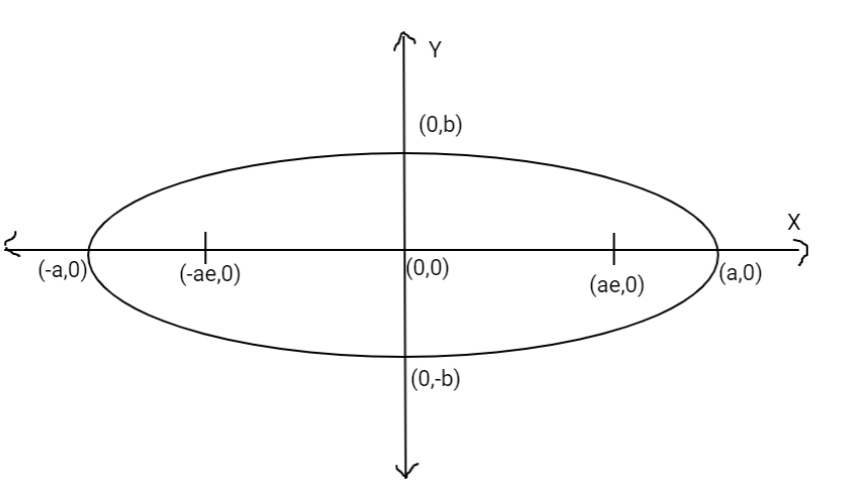
In order to answer or verify any statement, we need to understand about Ellipse first, Discuss its Focii, Eccentricity, major and minor axes.
Refer diagram for better understanding.
$[\dfrac{{{x^2}}}{{{a^2}}} + \dfrac{{{y^2}}}{{{b^2}}} = 1;{\text{ where }}a > b \to eqn(1)]$
a > b means the major axis lies on x-axis.
Focus (ae,0) and (-ae,0), which gives the distance between foci as 2ae.
Length of latus rectum = $[\dfrac{{2{b^2}}}{a}]$
Eccentricity = $[e = \sqrt {1 - \dfrac{{{b^2}}}{{{a^2}}}} \to eqn(2)]$
Now, We know that the distance between the foci is equal to the length of the latus rectum.
$[2ae = \dfrac{{2{b^2}}}{a} ]$
$[ \Rightarrow e = \dfrac{{{b^2}}}{{{a^2}}} \to eqn(3)]$
Now, from eqn(2) and eqn(3) , we get
$[\dfrac{{{b^2}}}{{{a^2}}} = \sqrt {1 - \dfrac{{{b^2}}}{{{a^2}}}} ]$
Squaring both the sides, we get
$ {\left[ {\dfrac{{{b^2}}}{{{a^2}}}} \right]^2} = 1 - \dfrac{{{b^2}}}{{{a^2}}} \\
\Rightarrow {e^2} = 1 - e \\
\Rightarrow {e^2} + e - 1 = 0 \\ $
Solving this quadratic equation by Discriminant rule[ for any quadratic equation $a{x^2} + bx + c = 0{\text{ , D = }}{b^2} - 4ac$and roots of the equation when D>0 is $ = \dfrac{{ - b \pm \sqrt D }}{{2a}}]$
We’ll obtain two values of e
$[e = \dfrac{{ - 1 \pm \sqrt 5 }}{2}]$
But the eccentricity can never be negative
$[\therefore e = \dfrac{{ - 1 + \sqrt 5 }}{2}]$
This can also be written as
$[e = 2 \times (\dfrac{{ - 1 + \sqrt 5 }}{4})]$
And we know that $[\sin {18^ \circ } = \dfrac{{ - 1 + \sqrt 5 }}{4}]$
Which shows $[e = 2\sin {18^ \circ }. ]$
This is in accordance with statement 1.
Therefore, Both the statements are true and statement 2 is the correct explanation of statement 1.
So, option A is the correct answer.
Note: All the properties and features of Parabola, Ellipse, Circle, Hyperbola must be known very well in order to solve such similar problems. Attention is to be given while forming the relations and must consider the possibilities of negative or positive quantities. For e.g. Eccentricity cannot be negative, Always take positive value.
Complete step-by-step answer:
In order to answer or verify any statement, we need to understand about Ellipse first, Discuss its Focii, Eccentricity, major and minor axes.
Refer diagram for better understanding.
$[\dfrac{{{x^2}}}{{{a^2}}} + \dfrac{{{y^2}}}{{{b^2}}} = 1;{\text{ where }}a > b \to eqn(1)]$
a > b means the major axis lies on x-axis.
Focus (ae,0) and (-ae,0), which gives the distance between foci as 2ae.
Length of latus rectum = $[\dfrac{{2{b^2}}}{a}]$
Eccentricity = $[e = \sqrt {1 - \dfrac{{{b^2}}}{{{a^2}}}} \to eqn(2)]$
Now, We know that the distance between the foci is equal to the length of the latus rectum.
$[2ae = \dfrac{{2{b^2}}}{a} ]$
$[ \Rightarrow e = \dfrac{{{b^2}}}{{{a^2}}} \to eqn(3)]$
Now, from eqn(2) and eqn(3) , we get
$[\dfrac{{{b^2}}}{{{a^2}}} = \sqrt {1 - \dfrac{{{b^2}}}{{{a^2}}}} ]$
Squaring both the sides, we get
$ {\left[ {\dfrac{{{b^2}}}{{{a^2}}}} \right]^2} = 1 - \dfrac{{{b^2}}}{{{a^2}}} \\
\Rightarrow {e^2} = 1 - e \\
\Rightarrow {e^2} + e - 1 = 0 \\ $
Solving this quadratic equation by Discriminant rule[ for any quadratic equation $a{x^2} + bx + c = 0{\text{ , D = }}{b^2} - 4ac$and roots of the equation when D>0 is $ = \dfrac{{ - b \pm \sqrt D }}{{2a}}]$
We’ll obtain two values of e
$[e = \dfrac{{ - 1 \pm \sqrt 5 }}{2}]$
But the eccentricity can never be negative
$[\therefore e = \dfrac{{ - 1 + \sqrt 5 }}{2}]$
This can also be written as
$[e = 2 \times (\dfrac{{ - 1 + \sqrt 5 }}{4})]$
And we know that $[\sin {18^ \circ } = \dfrac{{ - 1 + \sqrt 5 }}{4}]$
Which shows $[e = 2\sin {18^ \circ }. ]$
This is in accordance with statement 1.
Therefore, Both the statements are true and statement 2 is the correct explanation of statement 1.
So, option A is the correct answer.
Note: All the properties and features of Parabola, Ellipse, Circle, Hyperbola must be known very well in order to solve such similar problems. Attention is to be given while forming the relations and must consider the possibilities of negative or positive quantities. For e.g. Eccentricity cannot be negative, Always take positive value.
Recently Updated Pages
Master Class 11 Computer Science: Engaging Questions & Answers for Success

Master Class 11 Business Studies: Engaging Questions & Answers for Success
Master Class 11 Economics: Engaging Questions & Answers for Success
Master Class 11 English: Engaging Questions & Answers for Success
Master Class 11 Maths: Engaging Questions & Answers for Success
Master Class 11 Biology: Engaging Questions & Answers for Success
Trending doubts
One Metric ton is equal to kg A 10000 B 1000 C 100 class 11 physics CBSE
There are 720 permutations of the digits 1 2 3 4 5 class 11 maths CBSE
Discuss the various forms of bacteria class 11 biology CBSE
Draw a diagram of a plant cell and label at least eight class 11 biology CBSE
State the laws of reflection of light
Explain zero factorial class 11 maths CBSE