




State whether the two lines through (3,4) and (6,2) and through (4,2) and (6,5) are parallel, perpendicular or neither.
Answer
 Verified
559.8k+ views
Hint: Find the slope of the lines using the property that the slope of the line joining the points $A\left( {{x}_{1}},{{y}_{1}} \right)$ and $B\left( {{x}_{2}},{{y}_{2}} \right)$ is given by $m=\dfrac{{{y}_{2}}-{{y}_{1}}}{{{x}_{2}}-{{x}_{1}}}$. Use the fact that if the slopes of two lines are equal, then they are parallel to each other and if the product of the slopes of two lines is -1, then the lines are perpendicular. Hence determine whether the lines are parallel or perpendicular or neither.
Complete step-by-step solution:
Finding the slope of the line joining (3,4) and (6,2):
We know that the slope of the line joining the points $A\left( {{x}_{1}},{{y}_{1}} \right)$ and $B\left( {{x}_{2}},{{y}_{2}} \right)$ is given by $m=\dfrac{{{y}_{2}}-{{y}_{1}}}{{{x}_{2}}-{{x}_{1}}}$.
Here ${{x}_{1}}=3,{{x}_{2}}=6,{{y}_{1}}=4$ and ${{y}_{2}}=2$
Hence the slope of the line is $m=\dfrac{2-4}{6-3}=\dfrac{-2}{3}=\dfrac{-2}{3}$
Finding the slope of the line joining (4,2) and (6,5):
We know that the slope of the line joining the points $A\left( {{x}_{1}},{{y}_{1}} \right)$ and $B\left( {{x}_{2}},{{y}_{2}} \right)$ is given by $m=\dfrac{{{y}_{2}}-{{y}_{1}}}{{{x}_{2}}-{{x}_{1}}}$.
Here ${{x}_{1}}=4,{{x}_{2}}=6,{{y}_{1}}=2$ and ${{y}_{2}}=5$
Hence the slope of the line is $m=\dfrac{5-2}{6-\left( 4 \right)}=\dfrac{3}{2}=\dfrac{3}{2}$
Product of slope of the lines $=\dfrac{-2}{3}\times \dfrac{3}{2}=-1$
Now since the product of the slopes of the two lines is -1, the lines are perpendicular to each other.
Note: [i] Viewing graphically:
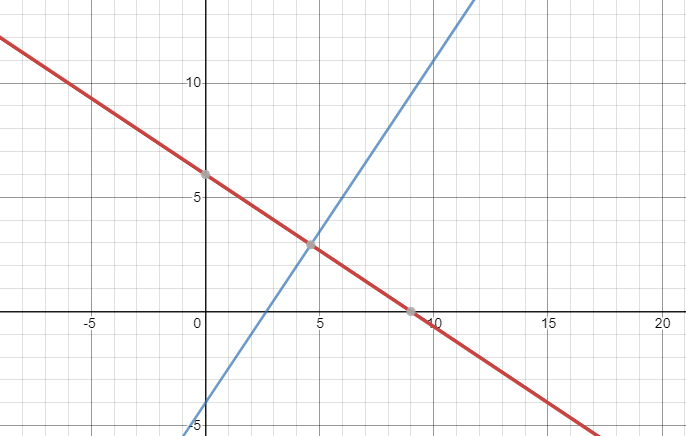
As is evident from the graph $AB\bot CD$
[ii] Alternative solution:
Let the equation of AB be y=mx+c
Since the line passes through (3,4), we have
$3m+c=4$
Also, since the line passes through (6,2), we have
$6m+c=2$
Hence, we have
$3m-6m=4-2\Rightarrow m=\dfrac{-2}{3}$
Hence the slope of AB is $\dfrac{-2}{3}$
Let the equation of CD be y = mx+c
Since the line passes through (4,2), we have
$4m+c=2$
Also, since the line passes through (6,5), we have
$6m+c=5$
Hence, we have
$6m-4m=5-2\Rightarrow m=\dfrac{3}{2}$
Hence the slope of CD is $\dfrac{3}{2}$
Hence the lines are perpendicular to each other.
Complete step-by-step solution:
Finding the slope of the line joining (3,4) and (6,2):
We know that the slope of the line joining the points $A\left( {{x}_{1}},{{y}_{1}} \right)$ and $B\left( {{x}_{2}},{{y}_{2}} \right)$ is given by $m=\dfrac{{{y}_{2}}-{{y}_{1}}}{{{x}_{2}}-{{x}_{1}}}$.
Here ${{x}_{1}}=3,{{x}_{2}}=6,{{y}_{1}}=4$ and ${{y}_{2}}=2$
Hence the slope of the line is $m=\dfrac{2-4}{6-3}=\dfrac{-2}{3}=\dfrac{-2}{3}$
Finding the slope of the line joining (4,2) and (6,5):
We know that the slope of the line joining the points $A\left( {{x}_{1}},{{y}_{1}} \right)$ and $B\left( {{x}_{2}},{{y}_{2}} \right)$ is given by $m=\dfrac{{{y}_{2}}-{{y}_{1}}}{{{x}_{2}}-{{x}_{1}}}$.
Here ${{x}_{1}}=4,{{x}_{2}}=6,{{y}_{1}}=2$ and ${{y}_{2}}=5$
Hence the slope of the line is $m=\dfrac{5-2}{6-\left( 4 \right)}=\dfrac{3}{2}=\dfrac{3}{2}$
Product of slope of the lines $=\dfrac{-2}{3}\times \dfrac{3}{2}=-1$
Now since the product of the slopes of the two lines is -1, the lines are perpendicular to each other.
Note: [i] Viewing graphically:
As is evident from the graph $AB\bot CD$
[ii] Alternative solution:
Let the equation of AB be y=mx+c
Since the line passes through (3,4), we have
$3m+c=4$
Also, since the line passes through (6,2), we have
$6m+c=2$
Hence, we have
$3m-6m=4-2\Rightarrow m=\dfrac{-2}{3}$
Hence the slope of AB is $\dfrac{-2}{3}$
Let the equation of CD be y = mx+c
Since the line passes through (4,2), we have
$4m+c=2$
Also, since the line passes through (6,5), we have
$6m+c=5$
Hence, we have
$6m-4m=5-2\Rightarrow m=\dfrac{3}{2}$
Hence the slope of CD is $\dfrac{3}{2}$
Hence the lines are perpendicular to each other.
Recently Updated Pages
Master Class 11 English: Engaging Questions & Answers for Success

Master Class 11 Maths: Engaging Questions & Answers for Success
Class 11 Question and Answer - Your Ultimate Solutions Guide
Master Class 11 Biology: Engaging Questions & Answers for Success
Master Class 11 Physics: Engaging Questions & Answers for Success
Master Class 11 Accountancy: Engaging Questions & Answers for Success
Trending doubts
Explain the Treaty of Vienna of 1815 class 10 social science CBSE
Who Won 36 Oscar Awards? Record Holder Revealed
What is the median of the first 10 natural numbers class 10 maths CBSE
Why is it 530 pm in india when it is 1200 afternoon class 10 social science CBSE
Why is there a time difference of about 5 hours between class 10 social science CBSE
What is the full form of POSCO class 10 social science CBSE