



State whether the following statement is true or false: A square has four right angles.
(a) True
(b) False
Answer
 Verified
582.3k+ views
Hint: Using the definition of a square, and the property of quadrilaterals, which tells us that the sum of all internal angles of a quadrilateral is 360 degrees, we can find the value of each internal angle of the square. We will see that each of its angles is a right angle.
Complete step by step answer:
We know that a square is quadrilateral in which all the four sides are equal, and all the four angles are equal. We can also define a square in terms of a rhombus. A rhombus is a parallelogram in which all four sides are equal to one another. A square is a rhombus in which the adjacent angles are equal, or we can say that all the angles are equal to one another.
Let us consider a square ABCD, as shown in the figure below.
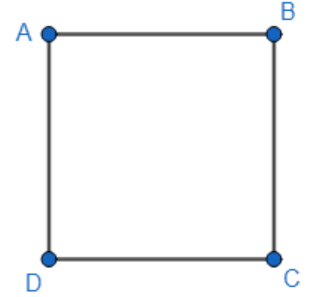
As per the definition of square, we have AB = BC = CD = DA and
Angle (ABC) = Angle (BCD) = Angle (CDA) = Angle (DAB).
But we know that ABCD is a quadrilateral and the sum of all internal angles of a quadrilateral is 360 degrees. Thus, we have
Angle (ABC) + Angle (BCD) + Angle (CDA) + Angle (DAB) = ${{360}^{\circ }}$
Hence, we can write
Angle (ABC) = Angle (BCD) = Angle (CDA) = Angle (DAB) = $\dfrac{{{360}^{\circ }}}{4}={{90}^{\circ }}$
Thus, we now know that all four angles of a square are equal to 90 degrees, or a right angle.
Hence, the statement that a square has four right angles is true.
So, the correct answer is “Option a”.
Note: There are many definitions for a square. We can define a square in terms of a quadrilateral, in terms of a parallelogram, in terms of a rhombus, or in terms of a rectangle. And we can get this end result through anyone of these definitions.
Complete step by step answer:
We know that a square is quadrilateral in which all the four sides are equal, and all the four angles are equal. We can also define a square in terms of a rhombus. A rhombus is a parallelogram in which all four sides are equal to one another. A square is a rhombus in which the adjacent angles are equal, or we can say that all the angles are equal to one another.
Let us consider a square ABCD, as shown in the figure below.
As per the definition of square, we have AB = BC = CD = DA and
Angle (ABC) = Angle (BCD) = Angle (CDA) = Angle (DAB).
But we know that ABCD is a quadrilateral and the sum of all internal angles of a quadrilateral is 360 degrees. Thus, we have
Angle (ABC) + Angle (BCD) + Angle (CDA) + Angle (DAB) = ${{360}^{\circ }}$
Hence, we can write
Angle (ABC) = Angle (BCD) = Angle (CDA) = Angle (DAB) = $\dfrac{{{360}^{\circ }}}{4}={{90}^{\circ }}$
Thus, we now know that all four angles of a square are equal to 90 degrees, or a right angle.
Hence, the statement that a square has four right angles is true.
So, the correct answer is “Option a”.
Note: There are many definitions for a square. We can define a square in terms of a quadrilateral, in terms of a parallelogram, in terms of a rhombus, or in terms of a rectangle. And we can get this end result through anyone of these definitions.
Recently Updated Pages
Basicity of sulphurous acid and sulphuric acid are

Master Class 12 Economics: Engaging Questions & Answers for Success
Master Class 12 Biology: Engaging Questions & Answers for Success
Master Class 11 English: Engaging Questions & Answers for Success
Master Class 11 Physics: Engaging Questions & Answers for Success
Master Class 11 Computer Science: Engaging Questions & Answers for Success
Trending doubts
Difference Between Plant Cell and Animal Cell
Fill the blanks with the suitable prepositions 1 The class 9 english CBSE
What is pollution? How many types of pollution? Define it
What is the full form of pH?
What is the Full Form of ICSE, CBSE and SSC
Name 10 Living and Non living things class 9 biology CBSE