




State whether the following is TRUE or FALSE: No charge will flow when two conductors having the same charge are connected to each other.
Answer
 Verified
579.9k+ views
Hint: The electric potential is the driving force for the charges to flow and a current flow to be established in a circuit. Conductors with equal charge may possess different potential at their respective ends. In a closed circuit the total charge flow remains a constant.
Complete answer:
We have learned in current electricity that current is the effect of the acting electric potential on a conductor. Here, the electric potential acts as an equivalent of force in electric current, whereas the current flowing is the effect caused by this potential difference.
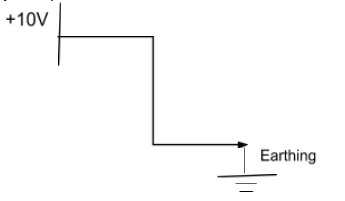
The potential difference is the difference in the electric potential between two points of a conductor. It is this difference in potential that drives the electron from one end to the other end in a metal conductor. The number of electrons or charge in the system always remains constant.
This is the same explanation for two conductors connected together. The flow of charges can take place only when there exists a potential difference between the two conductors. Otherwise, both the conductors are in equilibrium and don't constitute any flow of charges.
Therefore, the statement as per the question does not hold good without a potential difference between the conductors.
So, the statement is FALSE.
Additional Information:
A higher potential body when touching the ground can constitute a flow of charges which is known as earthing.
Note:
In electrostatics, the charges at rest develop an electric field which can attract or repel the charges around them. This can result in a sudden jump of charged particles from its position to attain equilibrium. In current electricity, the flow of charges is due to the potential difference only.
Complete answer:
We have learned in current electricity that current is the effect of the acting electric potential on a conductor. Here, the electric potential acts as an equivalent of force in electric current, whereas the current flowing is the effect caused by this potential difference.
The potential difference is the difference in the electric potential between two points of a conductor. It is this difference in potential that drives the electron from one end to the other end in a metal conductor. The number of electrons or charge in the system always remains constant.
This is the same explanation for two conductors connected together. The flow of charges can take place only when there exists a potential difference between the two conductors. Otherwise, both the conductors are in equilibrium and don't constitute any flow of charges.
Therefore, the statement as per the question does not hold good without a potential difference between the conductors.
So, the statement is FALSE.
Additional Information:
A higher potential body when touching the ground can constitute a flow of charges which is known as earthing.
Note:
In electrostatics, the charges at rest develop an electric field which can attract or repel the charges around them. This can result in a sudden jump of charged particles from its position to attain equilibrium. In current electricity, the flow of charges is due to the potential difference only.
Recently Updated Pages
Master Class 11 Computer Science: Engaging Questions & Answers for Success

Master Class 11 Business Studies: Engaging Questions & Answers for Success
Master Class 11 Economics: Engaging Questions & Answers for Success
Master Class 11 English: Engaging Questions & Answers for Success
Master Class 11 Maths: Engaging Questions & Answers for Success
Master Class 11 Biology: Engaging Questions & Answers for Success
Trending doubts
One Metric ton is equal to kg A 10000 B 1000 C 100 class 11 physics CBSE
There are 720 permutations of the digits 1 2 3 4 5 class 11 maths CBSE
Discuss the various forms of bacteria class 11 biology CBSE
Draw a diagram of a plant cell and label at least eight class 11 biology CBSE
State the laws of reflection of light
Explain zero factorial class 11 maths CBSE