




State two effects caused by refraction.
Answer
 Verified
625.8k+ views
Hint: In this question, we will know the two main effects caused by the phenomena ‘refraction’. This will help us to know what happens to the light rays falling from planets to our eyes and when a white light is passed to prism. Further, we will also study the basics of visible spectrum for our better understanding.
Complete answer:
(i).Here, as we know that planets shine more steadily because they are close to Earth compared to stars. So, planets appear not as pinpoints like stars, but they appear as tiny disks in the sky. Also, we can see the planets as disks when we look through our telescope, while stars remain pinpoints.
The light from these little disks is refracted by Earth’s atmosphere again and again, when it travels toward our eyes. As the light from one edge of the planet’s disk is forced to ‘zig’ one side and light from the opposite edge of the planet’s disk is forced to ‘zag’ on the opposite side. Therefore, these zigs and zags of light from the planetary disk cancel out each other. This is the reason why planets do not twinkle like stars.
(ii).Also, as we know that the dispersion is the phenomena of splitting of white light into its seven constituent colors i.e., violet, indigo, blue, green, yellow, orange, red also called VIBGYOR. The band of these seven colors i.e., VIBGYOR is known as spectrum.
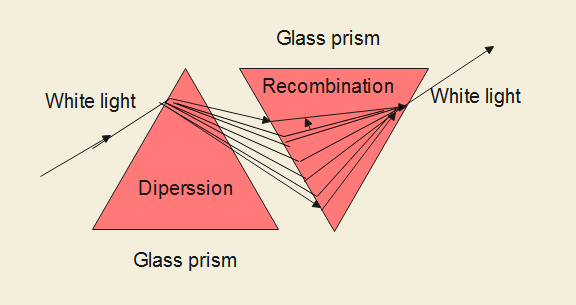
We can observe this process of splitting of white light into seven colors; by keeping the prism upside down the seven colors recombine to give white light.
Below is the ray diagram showing the recombination of the spectrum of white light by prism.
Additional information:
We should also know some of the important points about the spectrum of light. It consists of seven different colors, which are Violet, Indigo, Blue, Green, Yellow, Orange and Red (VIBGYOR). Further, these are arranged in increasing order of wavelength. Red light has the highest wavelength and lowest frequency (Wavelength is inversely proportional to frequency).VIBGYOR comes under visible region, which has wavelength ranging from 400nm to 700nm. There are different regions like infrared region, far infrared region, ultraviolet region, gamma region.
Note:
Here we note that refraction is the reason for not twinkling of planets and dispersion of light. Further we should also know the difference between reflection and refraction. Reflection is the change of the direction of wave or light to back to its original medium whereas, in refraction light slightly bends towards the normal when the medium is changed.
Complete answer:
(i).Here, as we know that planets shine more steadily because they are close to Earth compared to stars. So, planets appear not as pinpoints like stars, but they appear as tiny disks in the sky. Also, we can see the planets as disks when we look through our telescope, while stars remain pinpoints.
The light from these little disks is refracted by Earth’s atmosphere again and again, when it travels toward our eyes. As the light from one edge of the planet’s disk is forced to ‘zig’ one side and light from the opposite edge of the planet’s disk is forced to ‘zag’ on the opposite side. Therefore, these zigs and zags of light from the planetary disk cancel out each other. This is the reason why planets do not twinkle like stars.
(ii).Also, as we know that the dispersion is the phenomena of splitting of white light into its seven constituent colors i.e., violet, indigo, blue, green, yellow, orange, red also called VIBGYOR. The band of these seven colors i.e., VIBGYOR is known as spectrum.
We can observe this process of splitting of white light into seven colors; by keeping the prism upside down the seven colors recombine to give white light.
Below is the ray diagram showing the recombination of the spectrum of white light by prism.
Additional information:
We should also know some of the important points about the spectrum of light. It consists of seven different colors, which are Violet, Indigo, Blue, Green, Yellow, Orange and Red (VIBGYOR). Further, these are arranged in increasing order of wavelength. Red light has the highest wavelength and lowest frequency (Wavelength is inversely proportional to frequency).VIBGYOR comes under visible region, which has wavelength ranging from 400nm to 700nm. There are different regions like infrared region, far infrared region, ultraviolet region, gamma region.
Note:
Here we note that refraction is the reason for not twinkling of planets and dispersion of light. Further we should also know the difference between reflection and refraction. Reflection is the change of the direction of wave or light to back to its original medium whereas, in refraction light slightly bends towards the normal when the medium is changed.
Recently Updated Pages
Master Class 12 Economics: Engaging Questions & Answers for Success

Master Class 12 Social Science: Engaging Questions & Answers for Success
Master Class 12 English: Engaging Questions & Answers for Success
Master Class 12 Maths: Engaging Questions & Answers for Success
Master Class 12 Physics: Engaging Questions & Answers for Success
Master Class 12 Biology: Engaging Questions & Answers for Success
Trending doubts
Draw a labelled sketch of the human eye class 12 physics CBSE
Which are the Top 10 Largest Countries of the World?
Draw ray diagrams each showing i myopic eye and ii class 12 physics CBSE
Which is the correct genotypic ratio of mendel dihybrid class 12 biology CBSE
Differentiate between homogeneous and heterogeneous class 12 chemistry CBSE
Which animal never drinks water in its entire life class 12 biology CBSE