




State True or False.
The main function of ozone is to absorb the sun's UV radiations, hence protecting the Earth from its harmful effects.
A.True
B.false
Answer
 Verified
620.7k+ views
Hint: ozone layer is present just above the troposphere. UV radiations directed from the sun have to interact with ozone before hitting the earth.
Complete step by step answer:
The ozone layer is a thin layer present in the stratosphere, just above the troposphere. It is made of $O_3$ and it plays a very crucial role in protection of the earth surface. It acts like a sponge, and absorbs ultraviolet radiation, coming from the sun. Ultraviolet radiations can penetrate inside skins of living organisms, and it can cause skin cancer and other skin diseases if exposed for a longer period of time.
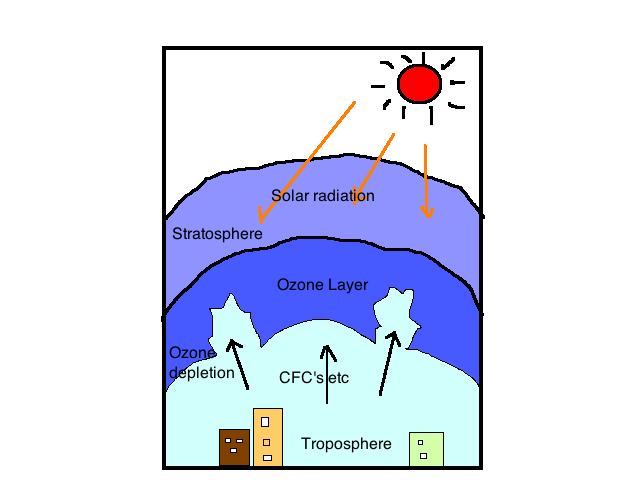
The thickness of the ozone layer is becoming lesser, because of some specific chemicals like chlorofluorocarbons, released by refrigerants, or the $CO_2$ released by chemical factories. The depletion of the ozone layer, in turn, results in more exposure of ultraviolet rays in that region. When the ozone layer becomes too thin in a specific area, it is known as an ozone hole.
The ozone layer is also responsible for something called greenhouse effect. In places with lower temperature, where farming is not possible naturally, some glass houses are made, as it traps the warmth from sunlight, which creates an ideal environment for the crops. The ozone layer shows a similar effect on a large scale as it traps the $CH_4$ and $CO_2$ etc. inside the troposphere layer, and the temperature of earth increases, causing global warming. Global warming is a serious issue, as it causes melting of glaciers which in turn results in flood and loss of resources. There are various ways in which all this could be avoided, as they say, “Plant more trees” and “use public transport” as these small steps could avoid formation of those harmful gases.
Hence the statement is true.
Note:
Most of the environmental issues regarding ozone layer and global warming is because people are unaware of the active contribution they make in this whole process. We could avoid or at least slow down the effects by simply creating awareness about it.
Complete step by step answer:
The ozone layer is a thin layer present in the stratosphere, just above the troposphere. It is made of $O_3$ and it plays a very crucial role in protection of the earth surface. It acts like a sponge, and absorbs ultraviolet radiation, coming from the sun. Ultraviolet radiations can penetrate inside skins of living organisms, and it can cause skin cancer and other skin diseases if exposed for a longer period of time.
The thickness of the ozone layer is becoming lesser, because of some specific chemicals like chlorofluorocarbons, released by refrigerants, or the $CO_2$ released by chemical factories. The depletion of the ozone layer, in turn, results in more exposure of ultraviolet rays in that region. When the ozone layer becomes too thin in a specific area, it is known as an ozone hole.
The ozone layer is also responsible for something called greenhouse effect. In places with lower temperature, where farming is not possible naturally, some glass houses are made, as it traps the warmth from sunlight, which creates an ideal environment for the crops. The ozone layer shows a similar effect on a large scale as it traps the $CH_4$ and $CO_2$ etc. inside the troposphere layer, and the temperature of earth increases, causing global warming. Global warming is a serious issue, as it causes melting of glaciers which in turn results in flood and loss of resources. There are various ways in which all this could be avoided, as they say, “Plant more trees” and “use public transport” as these small steps could avoid formation of those harmful gases.
Hence the statement is true.
Note:
Most of the environmental issues regarding ozone layer and global warming is because people are unaware of the active contribution they make in this whole process. We could avoid or at least slow down the effects by simply creating awareness about it.
Recently Updated Pages
Master Class 11 English: Engaging Questions & Answers for Success

Master Class 11 Social Science: Engaging Questions & Answers for Success
Master Class 11 Maths: Engaging Questions & Answers for Success
Master Class 11 Biology: Engaging Questions & Answers for Success
Master Class 11 Physics: Engaging Questions & Answers for Success
Master Class 11 Chemistry: Engaging Questions & Answers for Success
Trending doubts
One Metric ton is equal to kg A 10000 B 1000 C 100 class 11 physics CBSE
Difference Between Prokaryotic Cells and Eukaryotic Cells
Difference between physical and chemical change class 11 chemistry CBSE
Find the value of the expression given below sin 30circ class 11 maths CBSE
Two of the body parts which do not appear in MRI are class 11 biology CBSE
Draw a diagram of a plant cell and label at least eight class 11 biology CBSE