




State true or false:
If two lines intersect and if one pair of vertically opposite angles is formed by acute angles, then the other pair of vertically opposite angles will be formed by obtuse angles.
(a) True
(b) False
Answer
 Verified
630.6k+ views
Hint: First, we have to draw a figure as per mentioned in the question and then identify a linear pair which can be known as two angles that are said to be linear if they are adjacent angles formed by two intersecting lines. Then we have to find a measure of another angle which is not known to us while one angle is known to use i.e. acute angle whose measure is always less than 90.
Complete step-by-step answer:
Here, we will first draw a figure of two lines intersecting where one pair of vertically opposite angles is formed by acute angles. So, we get figure as
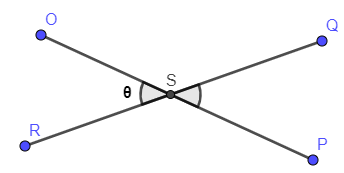
We can see that line OP and QR intersect at point S where angle OSR and angle QSP is considered as acute angles denoted by $\theta $ .
Now, we know the definition of linear pair angle i.e. two angles are said to be linear if they are adjacent angles formed by two intersecting lines. The measure of this linear pair angle is $180{}^\circ $ .
So, in our figure, we will find the value of linear pair angle given as below:
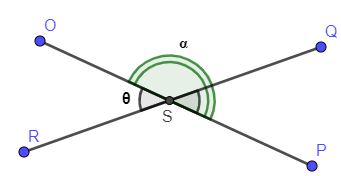
Here, $\angle OSQ+\angle QSP=180{}^\circ $ which is denoted by $\alpha $ . So, on solving this equation and finding angle $\angle OSQ$ , we get
$\angle OSQ=180-\angle QSP$ ……………………..(1)
But it is already given to us that $\angle QSP$ is acute angle which means angle less than 90. So, suppose if we take maximum value of acute angle i.e. 89, then we get value as
$\angle OSQ=180-89=91$ which is the value of obtuse angle.
So, another angle will be greater than 90 which is known as obtuse angle.
Hence, option (a) is correct.
Note: Remember to consider the value of acute angles which is always less than 90. Sometimes in a bit of a hurry students consider $90{}^\circ $ as an acute angle and on solving they do not get value of another angle greater than $90{}^\circ $. Also, do not consider that if one pair of vertically opposite angles is an acute angle then other pairs of vertically opposite angles will be acute angles only. This is a misconception students have. So, do not make this mistake.
Complete step-by-step answer:
Here, we will first draw a figure of two lines intersecting where one pair of vertically opposite angles is formed by acute angles. So, we get figure as
We can see that line OP and QR intersect at point S where angle OSR and angle QSP is considered as acute angles denoted by $\theta $ .
Now, we know the definition of linear pair angle i.e. two angles are said to be linear if they are adjacent angles formed by two intersecting lines. The measure of this linear pair angle is $180{}^\circ $ .
So, in our figure, we will find the value of linear pair angle given as below:
Here, $\angle OSQ+\angle QSP=180{}^\circ $ which is denoted by $\alpha $ . So, on solving this equation and finding angle $\angle OSQ$ , we get
$\angle OSQ=180-\angle QSP$ ……………………..(1)
But it is already given to us that $\angle QSP$ is acute angle which means angle less than 90. So, suppose if we take maximum value of acute angle i.e. 89, then we get value as
$\angle OSQ=180-89=91$ which is the value of obtuse angle.
So, another angle will be greater than 90 which is known as obtuse angle.
Hence, option (a) is correct.
Note: Remember to consider the value of acute angles which is always less than 90. Sometimes in a bit of a hurry students consider $90{}^\circ $ as an acute angle and on solving they do not get value of another angle greater than $90{}^\circ $. Also, do not consider that if one pair of vertically opposite angles is an acute angle then other pairs of vertically opposite angles will be acute angles only. This is a misconception students have. So, do not make this mistake.
Recently Updated Pages
Master Class 8 English: Engaging Questions & Answers for Success

Master Class 8 Science: Engaging Questions & Answers for Success
Master Class 8 Maths: Engaging Questions & Answers for Success
Class 8 Question and Answer - Your Ultimate Solutions Guide
Master Class 8 Social Science: Engaging Questions & Answers for Success
Master Class 12 Economics: Engaging Questions & Answers for Success
Trending doubts
What is BLO What is the full form of BLO class 8 social science CBSE
Citizens of India can vote at the age of A 18 years class 8 social science CBSE
Right to vote is a AFundamental Right BFundamental class 8 social science CBSE
Give me the opposite gender of Duck class 8 english CBSE
Full form of STD, ISD and PCO
Explain land use pattern in India and why has the land class 8 social science CBSE