




State the type of mirrors used for (i) headlights and (ii) rearview mirrors, in cars and motorcycles. Give the reason to justify your answer in each case:
Answer
 Verified
637.8k+ views
Hint: Headlight mirrors should enhance the light beam. A powerful light beam makes it easier for the driver to see what’s in front of him or her. However, rearview mirrors are used to see the traffic behind the car/motorcycle. We need a wider view.
Complete answer:
(i) Concave mirror in Headlights:
The primary objective of a headlight is to illuminate the road ahead. So, we need a focused and high-intensity light beam. This is achieved perfectly using a concave mirror. Let’s look at the following diagram:
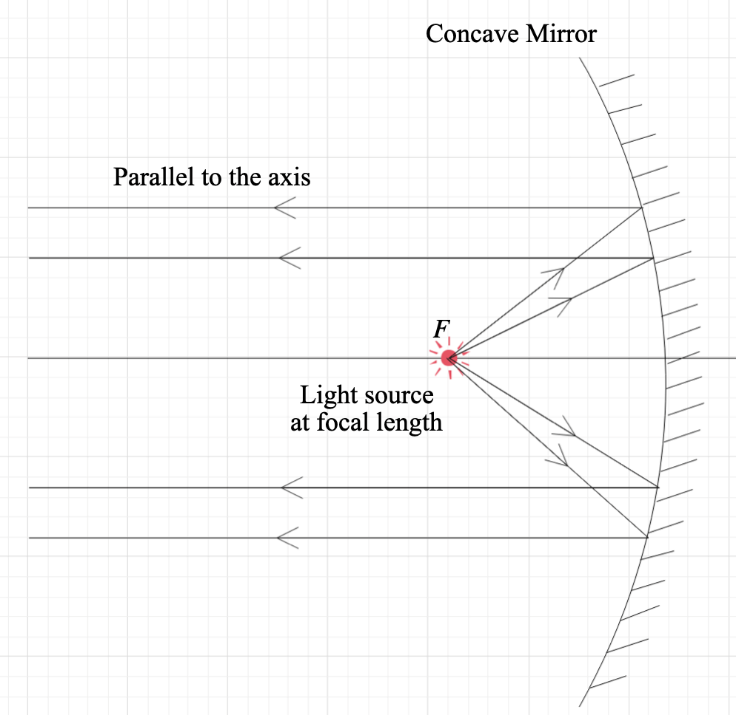
If we keep the light source at the focus of the concave mirror, we will get parallel light rays after the reflection. This property is used in the headlights. The diverging lights become concentrated and directed after getting reflected on the surface. That is why we use concave mirrors in headlights.
(ii) Convex mirror in the rearview mirror:
The convex mirror always produces an erect, diminished and virtual image. As a result, we can see a wider range of objects in the back. As the image does not depend on the distance from the mirror, there will not be any anomaly because of the distance. We can fit more objects in the small rearview mirror, which is the main reason why we use a convex mirror. Let us look at the type of image formed by the convex mirror.
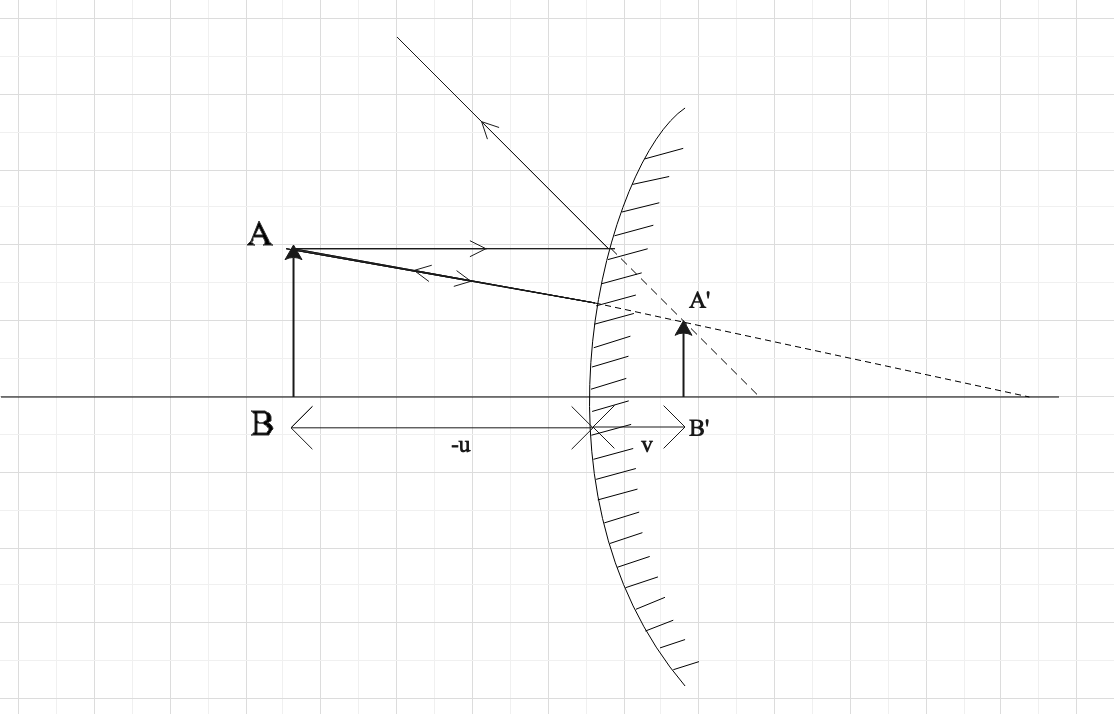
As we can see, A’B’ is the erect, diminished, and a virtual image of the object AB.
Note:
You can observe the phrase on the rearview mirror: “Objects in the mirror are closer than they appear”. It is a safety measure for the driver. We perceive the distance by the size of those objects. As the image produced by the convex mirror is diminished in size, it may appear that the vehicle is far away which isn’t the case actually.
Complete answer:
(i) Concave mirror in Headlights:
The primary objective of a headlight is to illuminate the road ahead. So, we need a focused and high-intensity light beam. This is achieved perfectly using a concave mirror. Let’s look at the following diagram:
If we keep the light source at the focus of the concave mirror, we will get parallel light rays after the reflection. This property is used in the headlights. The diverging lights become concentrated and directed after getting reflected on the surface. That is why we use concave mirrors in headlights.
(ii) Convex mirror in the rearview mirror:
The convex mirror always produces an erect, diminished and virtual image. As a result, we can see a wider range of objects in the back. As the image does not depend on the distance from the mirror, there will not be any anomaly because of the distance. We can fit more objects in the small rearview mirror, which is the main reason why we use a convex mirror. Let us look at the type of image formed by the convex mirror.
As we can see, A’B’ is the erect, diminished, and a virtual image of the object AB.
Note:
You can observe the phrase on the rearview mirror: “Objects in the mirror are closer than they appear”. It is a safety measure for the driver. We perceive the distance by the size of those objects. As the image produced by the convex mirror is diminished in size, it may appear that the vehicle is far away which isn’t the case actually.
Recently Updated Pages
Master Class 12 Business Studies: Engaging Questions & Answers for Success

Master Class 12 Chemistry: Engaging Questions & Answers for Success
Master Class 12 Biology: Engaging Questions & Answers for Success
Class 12 Question and Answer - Your Ultimate Solutions Guide
Master Class 11 English: Engaging Questions & Answers for Success
Master Class 11 Social Science: Engaging Questions & Answers for Success
Trending doubts
Which are the Top 10 Largest Countries of the World?
Draw a labelled sketch of the human eye class 12 physics CBSE
The end of compass needle which points towards north class 12 physics CBSE
Differentiate between homogeneous and heterogeneous class 12 chemistry CBSE
Why is the cell called the structural and functional class 12 biology CBSE
When was the first election held in India a 194748 class 12 sst CBSE