




State the numerical value of the frequency of oscillation of a second’s pendulum? Does it depend on the amplitude of the oscillation?
Answer
 Verified
654.3k+ views
Hint: We all know that the time period of the pendulum the amount of time a pendulum takes to come to the initial position when starting from the same initial mean position. While completing a 1-time period, the pendulum goes to two extreme positions also.
Formula Used:
The formula for calculating the frequency is of the pendulum is:
$f = \dfrac{1}{T}$
Complete step by step answer:
The formula for calculating the frequency is:
$f = \dfrac{1}{T}$
Put the value of time period (T) as 2 seconds in the above equation.
$\begin{array}{c}
f = \dfrac{1}{{2\,{\rm{s}}}}\\
= 0.5\,
\end{array}$
We can refer to the below figure for the diagram of the pendulum which is the length l of the pendulum and the mass of the bob is m.
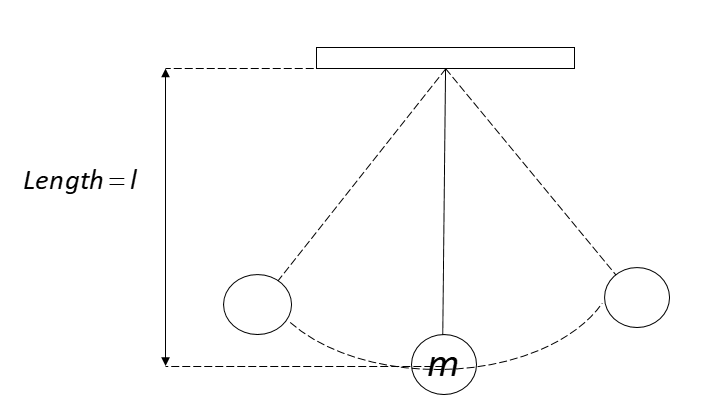
The frequency of the oscillation of a second’s pendulum depends on the time period of the oscillation. The time period further depends on the length of the pendulum and the acceleration due to gravity. Hence, the oscillation of a second’s pendulum is independent of the amplitude of the oscillation.
Additional Information:
The time period of the pendulum is also constant if there is no air drag or atmospheric friction. The time period of a pendulum in the moon will increase as the value of acceleration due to gravity g is less in the moon.
Note:
The effective length of the second’s pendulum, at a place where the value of acceleration due to gravity is g=9.8 m/$s^2$ (the average value), is nearly one meter. Here the string is considered as massless and only the mass of the bob is considered.
Formula Used:
The formula for calculating the frequency is of the pendulum is:
$f = \dfrac{1}{T}$
Complete step by step answer:
The formula for calculating the frequency is:
$f = \dfrac{1}{T}$
Put the value of time period (T) as 2 seconds in the above equation.
$\begin{array}{c}
f = \dfrac{1}{{2\,{\rm{s}}}}\\
= 0.5\,
\end{array}$
We can refer to the below figure for the diagram of the pendulum which is the length l of the pendulum and the mass of the bob is m.
The frequency of the oscillation of a second’s pendulum depends on the time period of the oscillation. The time period further depends on the length of the pendulum and the acceleration due to gravity. Hence, the oscillation of a second’s pendulum is independent of the amplitude of the oscillation.
Additional Information:
The time period of the pendulum is also constant if there is no air drag or atmospheric friction. The time period of a pendulum in the moon will increase as the value of acceleration due to gravity g is less in the moon.
Note:
The effective length of the second’s pendulum, at a place where the value of acceleration due to gravity is g=9.8 m/$s^2$ (the average value), is nearly one meter. Here the string is considered as massless and only the mass of the bob is considered.
Recently Updated Pages
If x a + bt + ct2 where x is in meters and t is in class 11 physics CBSE

A car covers the first half distance between two places class 11 physics CBSE
The resultant of two vectors overrightarrow P and overrightarrow class 11 physics CBSE
Find the value of cos 135 class 11 maths CBSE
A mass M is held in place by an applied force F and class 11 physics CBSE
A solution of glucose in water is labelled as 10 dfracwv class 11 chemistry CBSE
Trending doubts
One Metric ton is equal to kg A 10000 B 1000 C 100 class 11 physics CBSE
Find the value of the expression given below sin 30circ class 11 maths CBSE
What do you mean by retardation What is its SI uni class 11 physics CBSE
Draw a diagram of nephron and explain its structur class 11 biology CBSE
10 examples of friction in our daily life
Difference between physical and chemical change class 11 chemistry CBSE