




State laws of reflection. Draw the diagram to show the incident and final rays.
Answer
 Verified
654.6k+ views
Hint: Reflection is the phenomenon in which a change in direction of a wave front happening at the interface between two different media. It is because the wave front will be returned to the same media from which it originates. There are so many kinds of reflection happening mostly in sound and light. There are two laws for reflection in physics.
Complete step-by-step answer:
Reflection is a natural phenomenon which is mostly happening in our daily life. Reflection is happening when light bounces off an opaque object. If the surface of incidence is smooth and soft, like glass, water or polished metal like a mirror, the light will get reflected at the same angle as it falls on the surface. This is known as specular reflection. Basically there are two laws for reflection. First one states that ‘the angle of incidence is equal to the angle of reflection’. Second one is given as that the reflected rays, incident rays and normal should be in the same plane.
As per the first law, we can write that,
${{\theta }_{i}}={{\theta }_{r}}$
Where ${{\theta }_{i}}$ is the angle of incidence and ${{\theta }_{r}}$ is the angle of reflection.
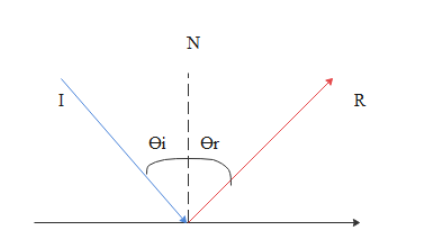
Here I is the incident ray and R is the reflected ray. N is denoted as the normal which is used as a reference here.
Note:Angle of incidence is the angle between incident ray falling on a surface and the line drawn perpendicular to the surface at the point of incidence, which is called as the normal and the angle between the reflected ray falling on the surface and the line of normal is called as the angle of reflection.
Complete step-by-step answer:
Reflection is a natural phenomenon which is mostly happening in our daily life. Reflection is happening when light bounces off an opaque object. If the surface of incidence is smooth and soft, like glass, water or polished metal like a mirror, the light will get reflected at the same angle as it falls on the surface. This is known as specular reflection. Basically there are two laws for reflection. First one states that ‘the angle of incidence is equal to the angle of reflection’. Second one is given as that the reflected rays, incident rays and normal should be in the same plane.
As per the first law, we can write that,
${{\theta }_{i}}={{\theta }_{r}}$
Where ${{\theta }_{i}}$ is the angle of incidence and ${{\theta }_{r}}$ is the angle of reflection.
Here I is the incident ray and R is the reflected ray. N is denoted as the normal which is used as a reference here.
Note:Angle of incidence is the angle between incident ray falling on a surface and the line drawn perpendicular to the surface at the point of incidence, which is called as the normal and the angle between the reflected ray falling on the surface and the line of normal is called as the angle of reflection.
Recently Updated Pages
Master Class 12 Economics: Engaging Questions & Answers for Success

Master Class 12 Social Science: Engaging Questions & Answers for Success
Master Class 12 English: Engaging Questions & Answers for Success
Master Class 12 Maths: Engaging Questions & Answers for Success
Master Class 12 Physics: Engaging Questions & Answers for Success
Master Class 12 Biology: Engaging Questions & Answers for Success
Trending doubts
Draw a labelled sketch of the human eye class 12 physics CBSE
Which are the Top 10 Largest Countries of the World?
Draw ray diagrams each showing i myopic eye and ii class 12 physics CBSE
Which is the correct genotypic ratio of mendel dihybrid class 12 biology CBSE
Differentiate between homogeneous and heterogeneous class 12 chemistry CBSE
Which animal never drinks water in its entire life class 12 biology CBSE