




State first law of motion and explain it.
Answer
 Verified
623.7k+ views
Hint: We know that Newton gives three laws of motion. Here we describe the first law of motion. We need these laws to determine the state of a body that is its speed and position under various instant of time. The motion can be horizontal or vertical under any acceleration and gravity.
Complete step by step answer:
compelled by the net external force to change that state.
This statement is divided into two parts:
(i) Everybody continues in its state of rest unless compelled by the net external force to change the state of rest.
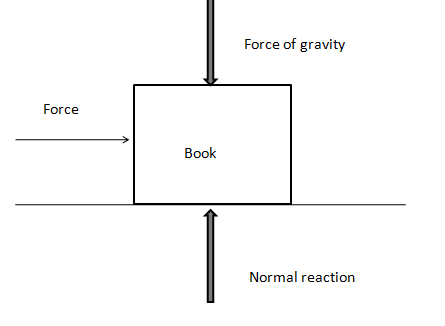
For instance, a book lying on a table remains there forever because the net force acting on the book is zero. In fact, two forces are acting on the book i.e.
(a) force due to the gravitational pull of the earth In the downward direction (weight of the book, W) and
(b) normal reaction R on the book due to the table in the upward direction. Since, the net external force acting on the book is zero, therefore, W-R = 0.
(ii) Everybody continues in its state of uniform motion in a straight line unless compelled by a net external force to change that state.
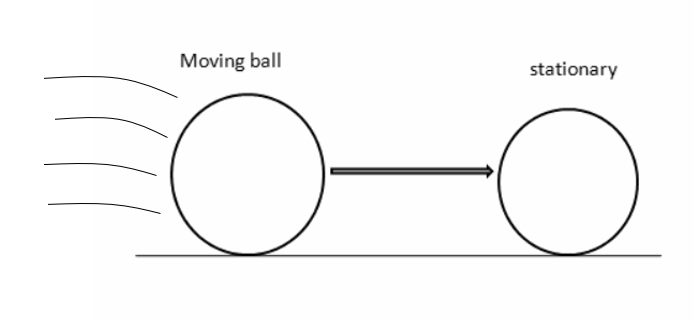
For example, when we push a ball on the floor, it comes to rest automatically after some time. But in fact, the ball does not come to rest by itself. It comes to rest due to the air resistance and the force of friction between the floor and the ball. If we eliminate these two forces, then the ball will continue to move forever in a straight line.
Note:
Basically, it is the definition of Inertia and the first law of motion can also be termed as the law of inertia. Force is something which changes or tends to change the state of rest or uniform motion of the body in a straight line. Thus, the definition of force comes from Newton’s first law of motion.
Complete step by step answer:
compelled by the net external force to change that state.
This statement is divided into two parts:
(i) Everybody continues in its state of rest unless compelled by the net external force to change the state of rest.
For instance, a book lying on a table remains there forever because the net force acting on the book is zero. In fact, two forces are acting on the book i.e.
(a) force due to the gravitational pull of the earth In the downward direction (weight of the book, W) and
(b) normal reaction R on the book due to the table in the upward direction. Since, the net external force acting on the book is zero, therefore, W-R = 0.
(ii) Everybody continues in its state of uniform motion in a straight line unless compelled by a net external force to change that state.
For example, when we push a ball on the floor, it comes to rest automatically after some time. But in fact, the ball does not come to rest by itself. It comes to rest due to the air resistance and the force of friction between the floor and the ball. If we eliminate these two forces, then the ball will continue to move forever in a straight line.
Note:
Basically, it is the definition of Inertia and the first law of motion can also be termed as the law of inertia. Force is something which changes or tends to change the state of rest or uniform motion of the body in a straight line. Thus, the definition of force comes from Newton’s first law of motion.
Recently Updated Pages
Master Class 11 English: Engaging Questions & Answers for Success

Master Class 11 Social Science: Engaging Questions & Answers for Success
Master Class 11 Maths: Engaging Questions & Answers for Success
Master Class 11 Biology: Engaging Questions & Answers for Success
Master Class 11 Physics: Engaging Questions & Answers for Success
Master Class 11 Chemistry: Engaging Questions & Answers for Success
Trending doubts
One Metric ton is equal to kg A 10000 B 1000 C 100 class 11 physics CBSE
Difference Between Prokaryotic Cells and Eukaryotic Cells
1 ton equals to A 100 kg B 1000 kg C 10 kg D 10000 class 11 physics CBSE
Find the value of the expression given below sin 30circ class 11 maths CBSE
Two of the body parts which do not appear in MRI are class 11 biology CBSE
What are hard magnetic materials class 11 physics CBSE